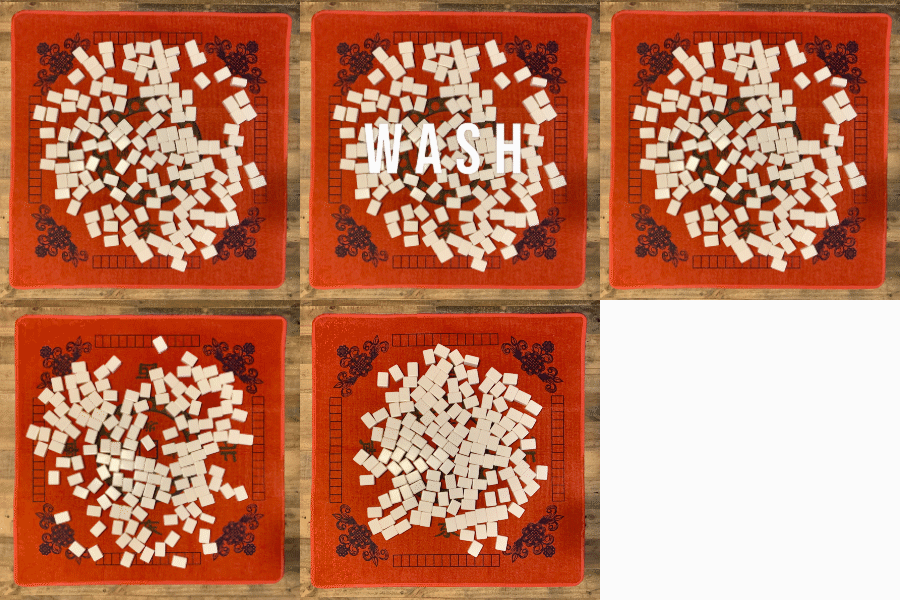
Every mahjong game starts with a good “wash” or shuffling of the tiles followed by building the wall. Some folks like to turn all the tiles back over before shuffling and/or building the wall. Theoretically, this is to prevent cheating, because if someone memorizes the position of a certain tile, they can use it to their advantage.
However, doing this creates multiple inefficiencies:
- It hinders efficient shuffling if you’re trying to keep tiles from turning over. A poorly shuffled wall creates even less anonymity of tile positions. You’ll know what I mean if you’ve ever seen consecutive tiles drawn, or only tiles of a certain suit.
- It slows down the building of the walls. Spending more time building means spending less time playing.
- If any tiles do turn over in the shuffling or building process, they’re easier for someone to memorize discreetly and gain an advantage. It’s easier to memorize one or two tiles than dozens of them.
Also, it’s worth noting that in Filipino mahjong, no single tile is worth more or is more rare than others. Filipino mahjong does not use dedicated joker tiles, and does not reward additional payouts based on seat position for flower tiles. Every tile has four copies, and is only valuable in combination with others. So memorizing one or two tile positions, won’t get you anywhere. There’s so much chance involved in whether the random tile you’ve memorized is useful, and whether you will even gain access to it.
The main benefit I can see from memorizing a tile’s position is that you may be able to track it into somebody’s hand and have a more educated guess at what they are waiting for. For example, say that you know they have a 4 sticks tile because you tracked it, and then you see them throw a 3 sticks and a 5 sticks. That means there’s a good chance they have at least two 4 sticks tiles, otherwise they wouldn’t have thrown the neighboring tiles. So you should refrain from throwing that tile, to prevent a pung or todas.
It’s nearly impossible to get a tile from simply knowing its position in the wall. The only advantage is simply knowing if it’s still in the wall. E.g., you have a 3 ball and 5 ball, and you’re trying to determine if it’s worth waiting for the 4 ball to win by paningit. You see that one 4 ball tile has been thrown, but you’re worried the other 4 ball tiles might be in someone else’s hand as an eye or pong. In that case, it may be useful to know that at least one 4 ball is still in the wall. But you still have just a roughly 1 in 4 chance of getting it and nothing you can do will increase those odds. Even if it’s a multiple of 4 number of tiles away from you, you have to also hope that nobody pongs or chows a discard, throwing off the distribution of the draw wall.
But both of these cases require so many other things to line up in order to actually effectuate any advantage. That’s some next level mahjongery and outside the scope of this article.
I know some folks might disagree with this, and if you’re playing with strangers for real money, I would understand taking extra precautions. But for casual play with family and friends, I’ve never seen a need to take the extra step to turn over the tiles.
 mahjongero