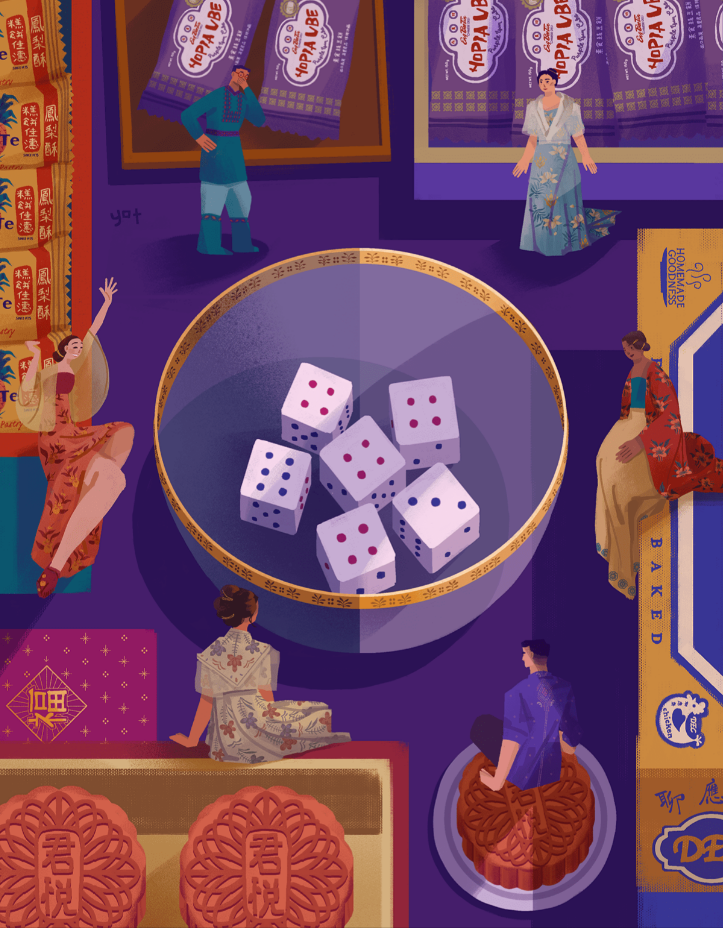

As summer winds down to a close, Chinese Filipinos are looking forward to the Mid-Autumn Festival, which will take place Saturday, September 10 this year. Filipinos of Chinese descent comprise over 20 million of the country’s population. That includes my family, through my lolo’s father, who was an immigrant to Negros Oriental from Amoy (now called Xiamen) in Fujian province. Though our branch grows more and more distant from our Chinese roots with each passing generation, we still have our Chinese last name — and mahjong.
Chinese Filipinos, colloquially known as Chinoys, largely trace their ancestry back to the Hokkien-speaking Fujian province, and Philippine Hokkien has developed as a lingua franca among the Chinese diaspora in the Philippines. Chinoys call the language Lán-nâng-uē, meaning our people’s speech. In practice though, many Chinoys would characterize their speech as Hokaglish, a form of code-switching between Hokkien, Tagalog, and English.
The Mid-Autumn Festival corresponds with the Chinese lunar calendar and is the second most important celebration for Chinoys after Lunar New Year. Also known as the Mooncake Festival, it celebrates the harvest and the autumn equinox when the moon is at its fullest and brightest. In the Philippines, mooncakes are called hopia, which means “good pastry” in Hokkien, and are often filled with an ube and mung bean paste. Some are savory though, with a sweet pork filling similar to siopao.
A fixture of the autumnal celebration is Pua Tiong Chiu (拔中秋), a dice game that requires some luck and very little strategy to win one of 63 prizes ranging from hopia to a hundred dollar bill. If you’re having trouble pronouncing it, try: WA-YONG-YU (one syllable each). Now add a P, T, and CH sound to the front of those syllables, respectively: PWA-TYONG-CHYU (one syllable each).
You may recognize the middle character of Pua Tiong Chiu: 中. Or perhaps this helps: 🀄. It is indeed the dagger or red dragon that you’re familiar with from mahjong. Here, it is the Hokkien tiong, which corresponds with the Mandarin zhong, meaning middle.
Download a cheat sheet for Pua Tiong Chiu here.

SETUP
The game requires:
- Six dice (preferably Chinese dice, which have red pips for the 1 and 4 faces)
- One porcelain or glass bowl
- 63 prizes of varying values
The prizes are distributed across six tiers, which are named in Hokkien after imperial examination titles. The first three titles correspond with the first, second, and third highest scorers of the imperial exam. The fourth title refers to one who passed the imperial examination. The fifth title is one who passed at the provincial level. And the sixth title is one who passed the entry level exam at the county level. So, everyone’s a winner here, but some are bigger winners than others.
- Tsiong Guan 狀 元 (1 prize)
- Pong Gan 榜 眼 (2 prizes)
- Tam Hue 碳 化 (4 prizes)
- Tsin Si 進士 (8 prizes)
- Ki Din 舉人 (16 prizes)
- Siu Tsai 秀才 (32 prizes)
Tsiong Guan, the first tier, is the top prize with only one winner. It might be something very cool and very expensive, like a TV. The number of prizes increases exponentially with each successive tier down to Siu Tsai, the bottom tier, which has 32 prizes. However, as a counterpoint, the value of each prize exponentially decreases as well. A typical Siu Tsai prize is a humble hopia; it is the Mooncake Festival after all.
🏆
🏆🏆
🏆🏆🏆🏆
🏆🏆🏆🏆🏆🏆🏆🏆
🏆🏆🏆🏆🏆🏆🏆🏆🏆🏆🏆🏆🏆🏆🏆🏆
🏆🏆🏆🏆🏆🏆🏆🏆🏆🏆🏆🏆🏆🏆🏆🏆🏆🏆🏆🏆🏆🏆🏆🏆🏆🏆🏆🏆🏆🏆🏆🏆
Decide on a budget for prizes and divide by 6 to determine a rough earmark for each tier of prizes. For example, a total budget of $600 would correspond to a top prize valued at $100 and bottom tier prizes valued at approximately $3 each.
An easy way to do this is with cash prizes:
- 1 $100 bill for Tsiong Guan
- 2 $50 bills for Pong Gan
- 4 $20 bills for Tam Hue
- 8 $10 bills for Tsin Si
- 16 $5 bills for Ki Din
- 32 $2 bills for Siu Tsai
But it’s traditional and always fun to incorporate hopia. And with the first day of school approaching, school supplies and other household items are fair game for the lower and mid tier prizes. This is a family game, so ideally you’ll have prizes pleasing to both kids and adults.
GAMEPLAY
The game organizer will often act as the emcee in charge of initiating and facilitating the game. They should begin by explaining the rules and previewing the prizes for the participants. The emcee can also be in charge of distributing the prizes, but they may want to put someone else in charge of that in order to focus on maintaining the interest of the audience.
The prizes should be in an enticing display on a long table (a small table would suffice for cash prizes). And the bowl should be in a visible location in front of this display. It can be on the table or on a tall stool in front of the table. The clink of the dice against the porcelain bowl serves as a bell to draw in the attention of the crowd.
RULES
- Each player gets one roll per round.
- All the dice must remain in the bowl and must be laying flat against the bottom of the bowl. The player must roll again otherwise.
- Tier 2 through Tier 6 prizes will be distributed immediately.
- Players who roll a combination eligible for Tier 1 (Tsiong Guan) will have their names and combinations recorded. The Tsiong Guan winner will be determined and announced at the end of the game.
The winning combinations for Tiers 2 through 6 are as follows:
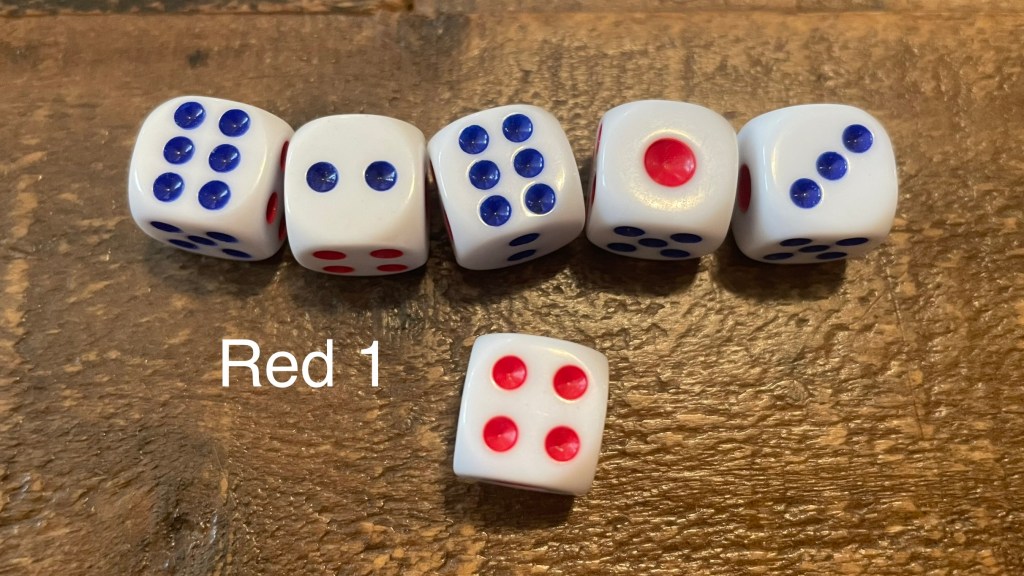
Tier 6 (Siu Tsai) requires a Red 1 — a single 4.
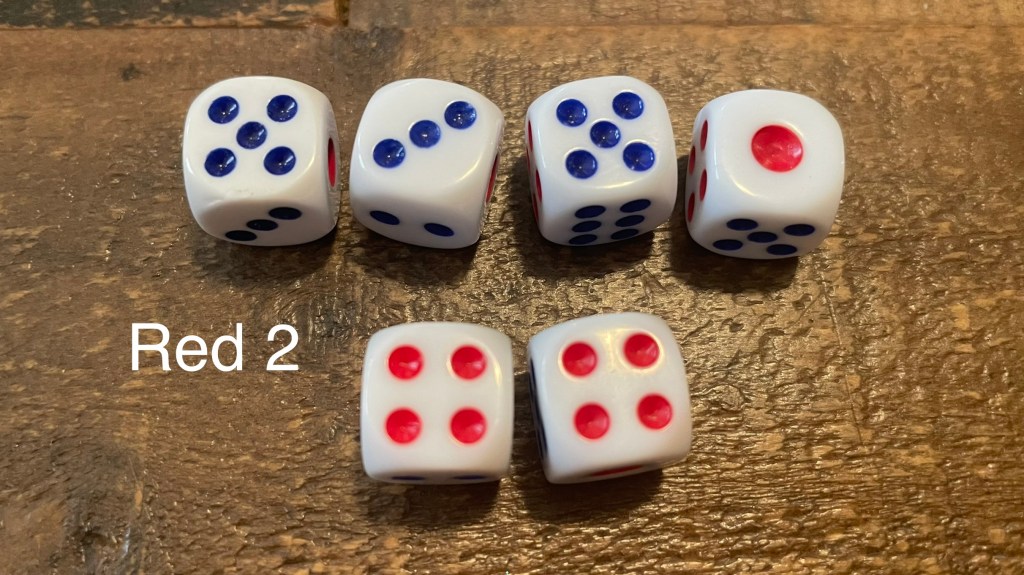
Tier 5 (Ki Din) requires a Red 2 — a pair of 4s.
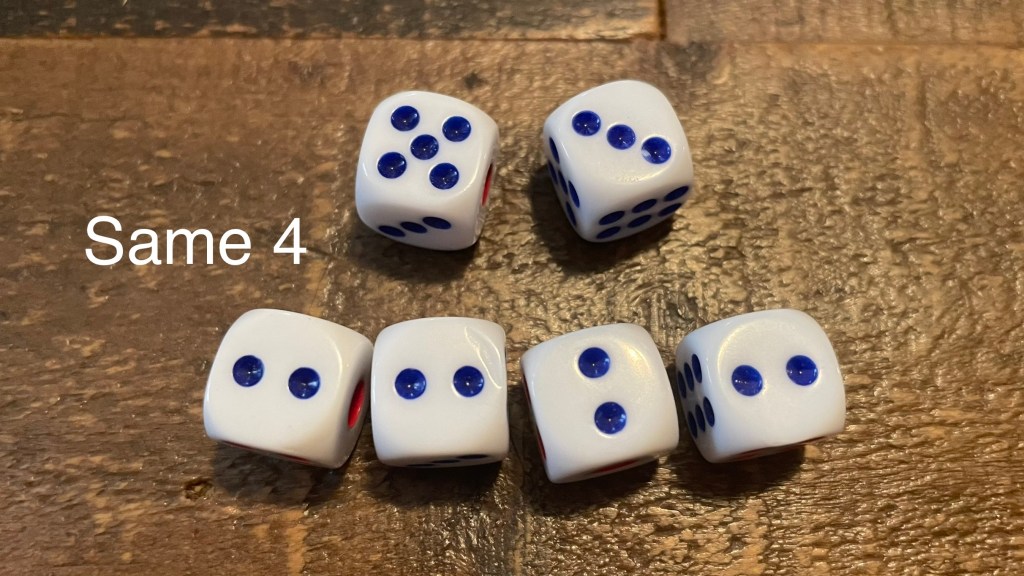
Tier 4 (Tsin Si) requires a Same 4 — a quartet of any face value but 4.
Tier 3 (Tam Hue) requires a Red 3 — a triplet of 4s.

Tier 2 (Pong Gan) requires an Escalera (Straight) of 1-2-3-4-5-6, or a Double Half — two sets of triplets.
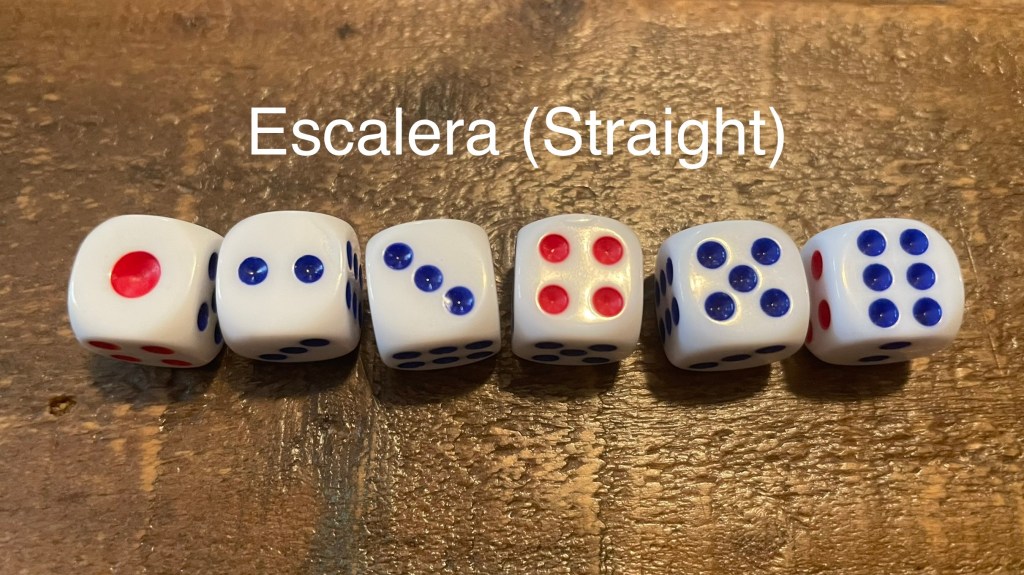
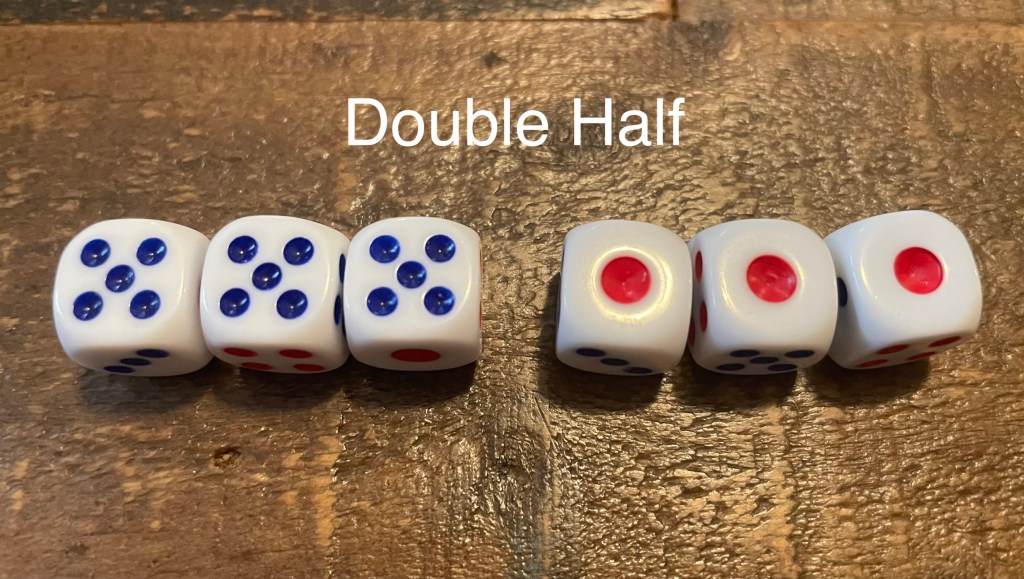
Tier 1 is TSIONG GUAN, and it is the top prize. There are multiple ways to be eligible for Tsiong Guan. Here is how each combination ranks from lowest to highest:
Red 4 is a quartet of 4s.
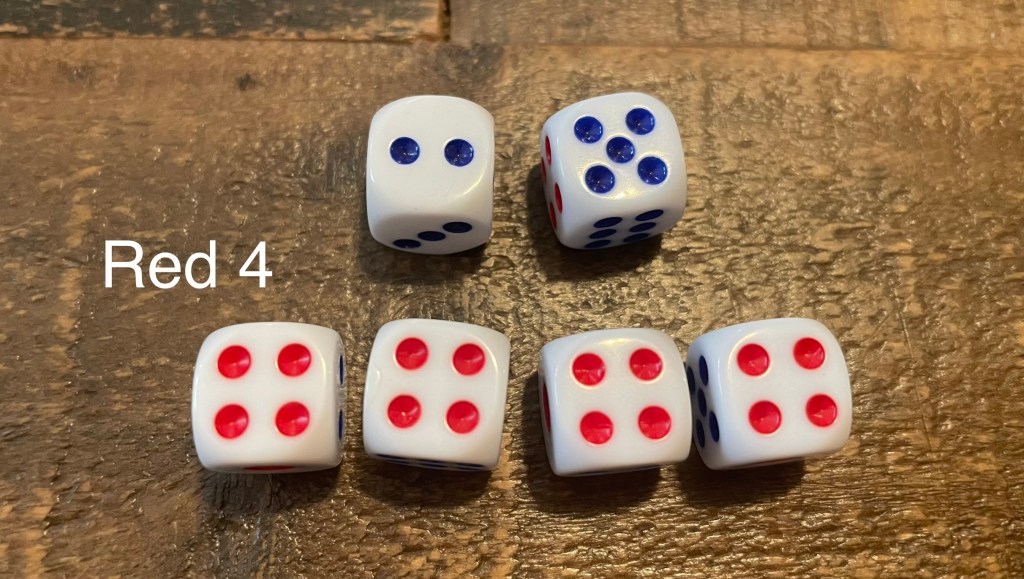
Same 5 is a quintet of any face value but 4.
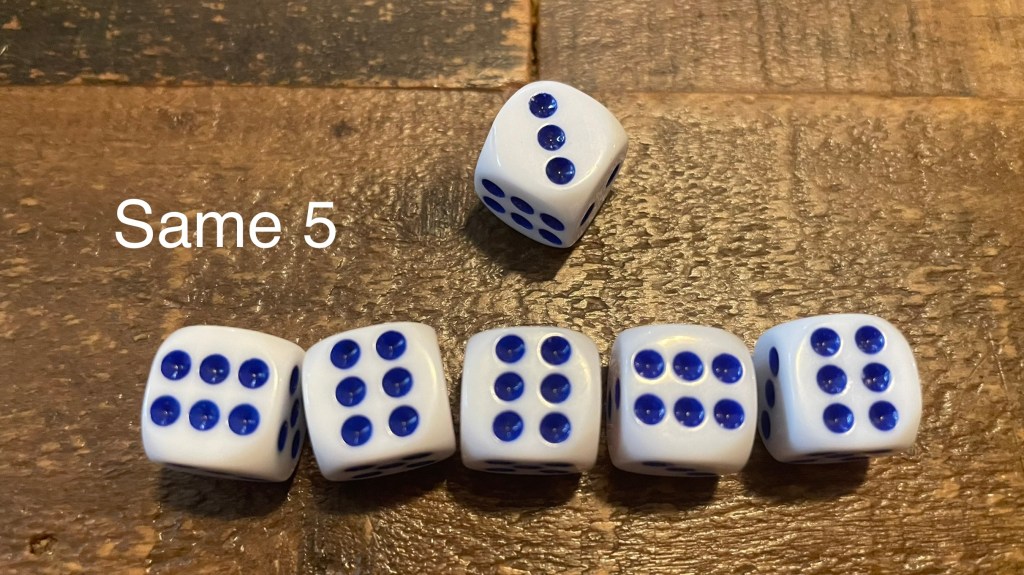
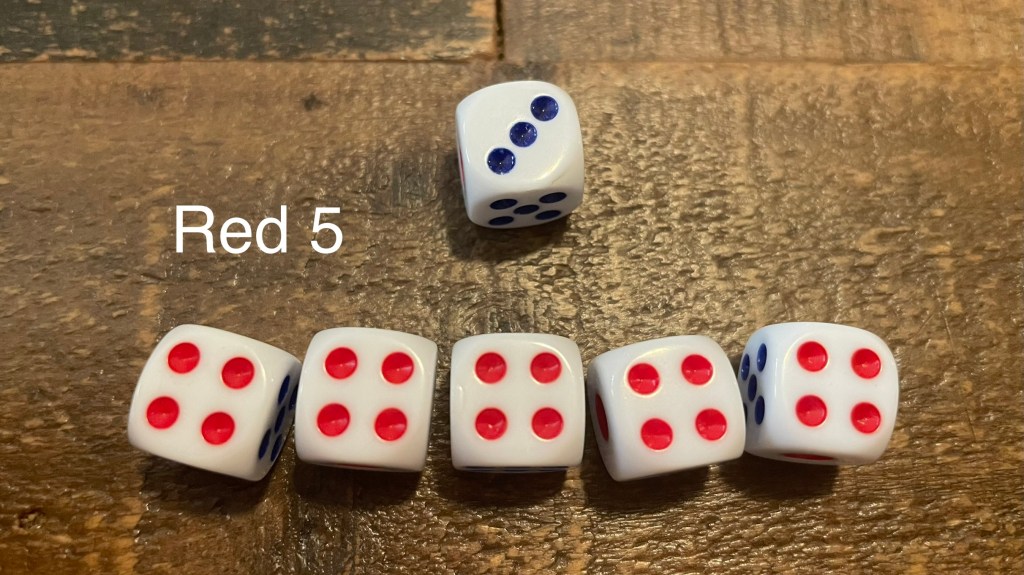
Red 5 a quintet of 4s.
Same 6 is a sextet of any face value but 4. It is very rare.
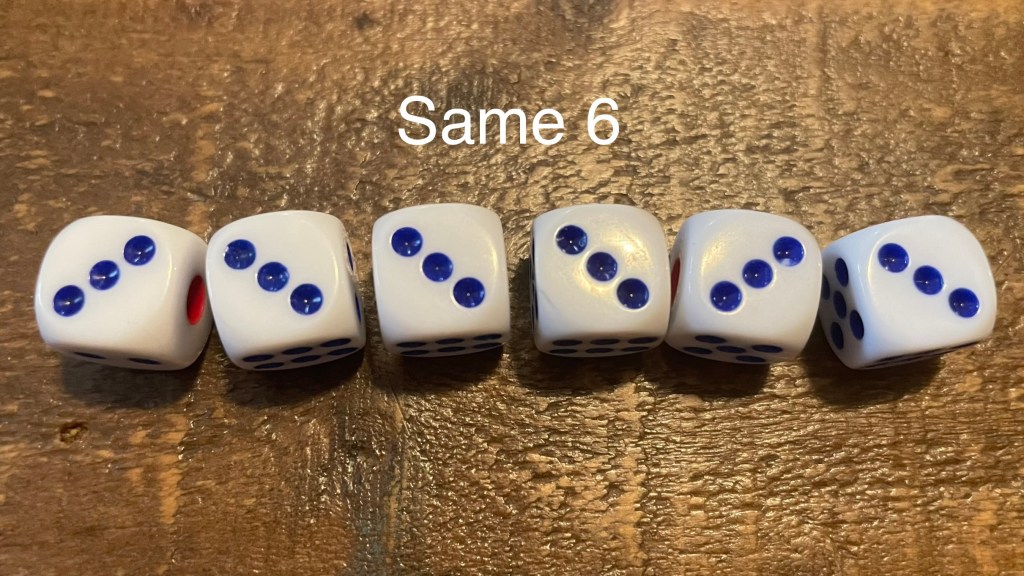
- For Same 5 or Same 6 combinations, a higher value will have a higher ranking. For example a Same 5 of 6s will outrank a Same 5 of 3s.
- For Red 4, Same 5, and Same 6 combinations of equal value, the sum of the unmatched one or two dice will determine the ranking. For example if two players have Red 4 combinations of 4-4-4-4-1-6 and 4-4-4-4-3-5 respectively, the 4-4-4-4-3-5 will be more highly ranked, because the sum of its unmatched dice (3+5=8) is higher than the other (6+1= 7).
- If somehow the two (or more) highest ranked combinations for Tsiong Guan are identical, then the competing players each get one more roll of the dice. The roll with the highest number of 4s wins. In the event that the top rolls are equal, the process repeats itself until there is a winner.
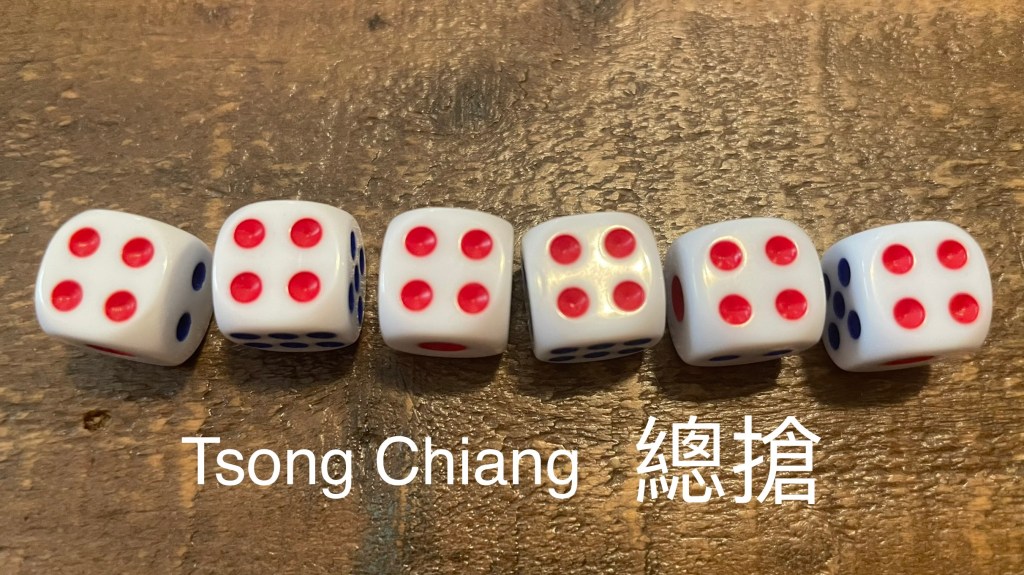
Tsong Chiang 總搶 means total grab or winner takes all in Hokkien. It is awarded for the most elusive roll of a Red 6. Tsong Chiang immediately ends gameplay and the winner is awarded all prizes, including the ones that have already been handed out.
I hope you enjoy the Mid-Autumn Festival this year and this fun game manages to make its way into your family traditions. Wishing you a good end of summer and a bountiful harvest!
Download a cheat sheet for Pua Tiong Chiu here.
 mahjongero