Along with pusoy dos, tongits is probably the most popular Filipino card game today. I learned tongits from my cousins in the Philippines before learning mahjong from my father. Over the years, the version we played has changed as we picked up new rules and have come to better understand the nuances of the game, especially payouts and opportunities for bluffing. It wasn’t until later that I noticed the strong similarities between tongits and mahjong.

Like mahjong, tongits is a rummy game. But it likely traces its etymology to an American rummy game called tonk, which was popular among soldiers towards the end of the American colonial period as the military was just beginning to racially integrate in the 1940s. Historically, tonk was popular among Black communities in the American South, especially with jazz and blues musicians in Alabama and Louisiana.


Two centuries earlier, in the 1700s, Louisiana was the site of the first Asians to arrive and settle in America—Filipino sailors who escaped Spanish galleons taking port in New Orleans and other Gulf of Mexico towns. Known as the Manilamen, these early Filipino Americans adapted well to the humid climate of the gulf and sheltered together with runaway enslaved people from West Africa who had similarly little hope of returning home. They lived on the land of the indigenous Chitimacha people, who would later manage to resist the forced displacement of American Indians in the southeastern U.S. during the Trail of Tears. With the influx of French Canadians kicked out of Acadia by the British, a new Cajun culture emerged from the mixing of these diverse peoples. Attested in the history books, the Manilamen contributed their fishing and maritime knowhow and even their DNA to the Louisiana bayou. But I doubt that captures the full extent of their influence.

Who knows, maybe those Filipino sailors escaping Spanish galleons and settling on Chitimacha land, played a Chinese mahjong-influenced rummy game that the descendants of runaway enslaved Africans and displaced French Canadians would later develop into tonk, which would become popular among racially integrated American soldiers, who would bring it back across the ocean for Filipinos to develop into tongits. Stranger things have happened.

How to play
Like golf and hearts, the objective of tongits is to get the lowest score, which is the sum of all of your cards (with aces worth 1 point, faces worth 10 points, and all other cards worth their rank). The primary way to lower your score is by forming bahays of three or more cards, which are worth 0 points. Ideally, you will form a complete hand in which all of your cards organized into bahays (called tongits), which results in a total score of zero. But it is also possible to win by ending the game early and having the lowest score. Better yet, you can win by tricking your opponents that you have the lowest score and getting them to fold. It’s like mahjong with an added game of chicken and a bit of bluffing like in poker as well.
Tongits makes use of a standard 52-card French-suited deck, which is the deck of cards you likely already have.
BAHAYS
A three-of-a-kind or four-of-a-kind consist of three or four equally ranked cards. Take note that though similar, this is different from the pung or kang in mahjong, which would require matching suits as well as equal ranks.


A four-of-a-kind wherein all four cards were dealt or drawn from the deck (not from a discard) can be laid face down on the table as a secret. This has the benefit of allowing you to challenge a draw (explained below), though you no longer have the freedom to reorganize the cards.

A straight is a sequence of three or more cards of the same suit. It is akin to a straight flush in poker and the chow in mahjong, though it can exceed three cards.
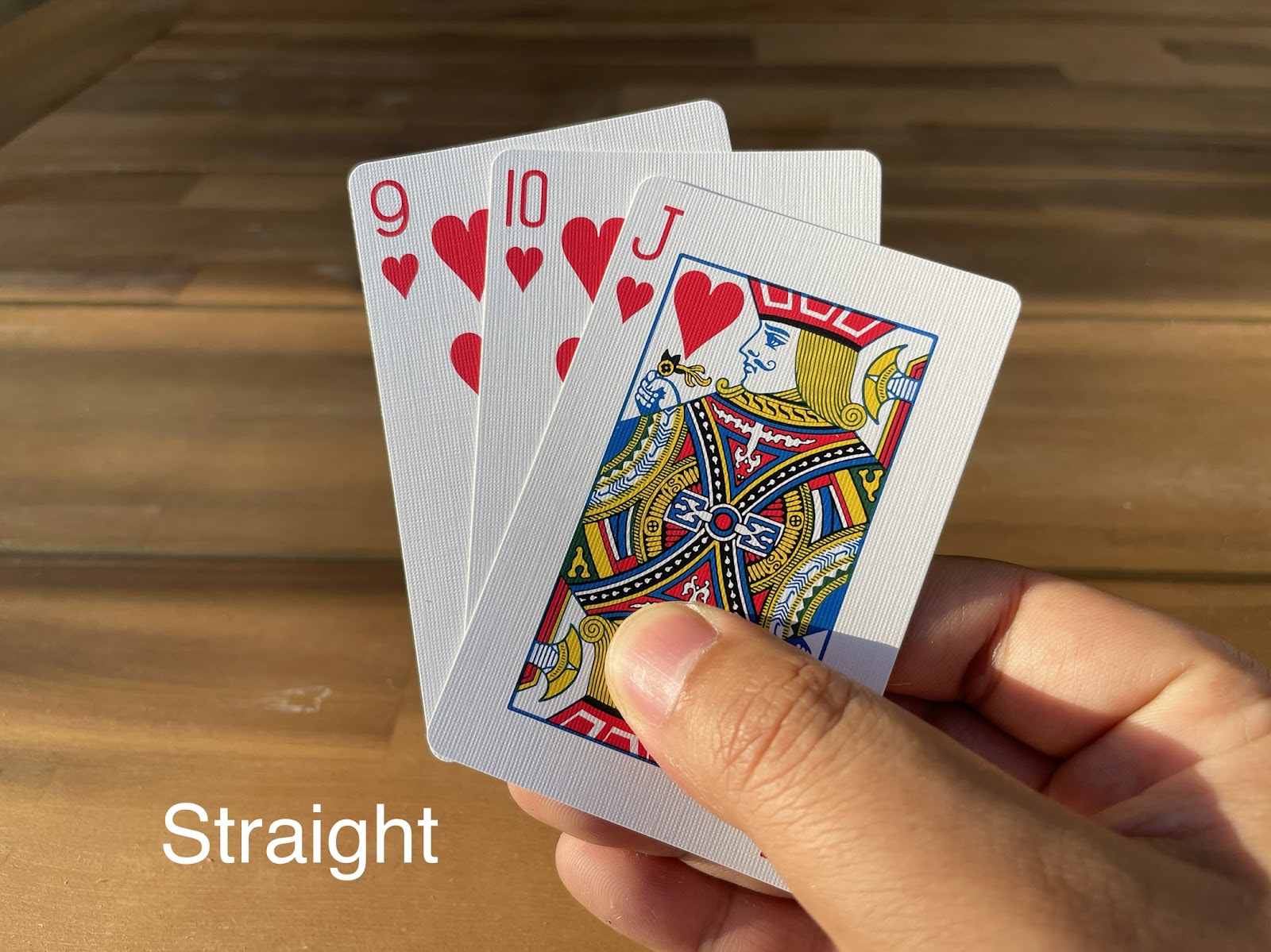
A straight of four or more cards is called an escalera.

Like the four-of-a-kind, an escalera can also be laid face down on the table as a secret, though you lose the ability to reorganize the cards later.

Note you can simply call a secret a secret. No need to identify it as an escalera or a four-of-a-kind. Of course with an escalera of five or more cards, it is apparent. But for four-card secrets, this is a useful mind game to play on your opponents who are unsure if your secret is a four-of-a-kind or a four-card escalera.
SETUP
The mano (dealer) can be determined randomly for the first game. For all subsequent games, the winner of the previous game is the mano. Gameplay is in a counterclockwise direction, like mahjong.
Beginning with themself, the mano deals one card to each player until each player has 12 cards and the mano has 13. The remaining cards are placed on the center of the table, forming the stock or draw pile. The mano begins gameplay by discarding one card.

GAMEPLAY
To begin their turn, the player can choose to draw a card from the stock or pick up the previous player’s discard. However they may only pick up a discard if that card completes a bahay, which they must now open by laying face up on the table.
During their turn, the player can also add any number of their cards to the open bahays of other players. This is called a sapaw and it helps to prevent a draw as will be explained later.

TONGITS
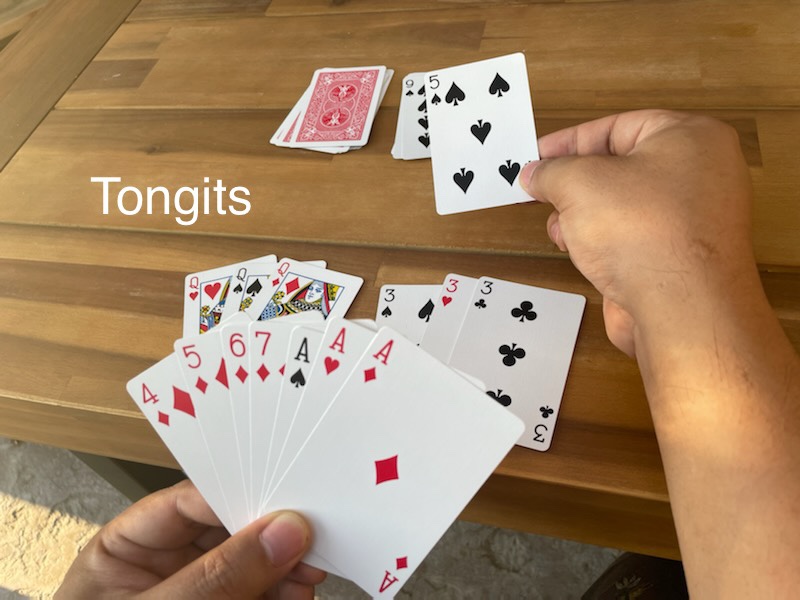
The most straightforward but most challenging way to win the game is by forming your entire hand into bahays (in the hand and on the table) and sapaws. This is called tongits and immediately ends the game. The player’s thirteenth (final) card can be discarded or added to a bahay or sapaw.
DRAW
In mahjong, it’s beneficial to keep bahays closed to minimize opponents’ knowledge of your cards and to preserve your ability to rearrange as needed. In tongits, however, that can be risky, because of the ability for players to call a draw.
A player may want to call a draw if they believe their tally of unmelded cards will be lower than the others (or if they believe they can successfully bluff the other players that that is so).
When a player calls a draw, they must discard to end their turn and gameplay. Players who do not have any bahay on the table are called sunog (burned) and immediately fold to accept the draw. If both opponents are sunog or otherwise accept the draw, the caller wins.
In order to call or challenge a draw: a player must have at least one bahay on the table.
Furthermore, for a player who wants to call a draw:
- At least one bahay on the table must be open, and
- The player must have survived the previous round without having an opponent sapaw one of their open bahays.
The typical way to have an open bahay is by picking up a discard, which requires you to expose the bahay anyway. But if you are eager to call a draw or if you sense that someone else will do so and want to be prepared to challenge, you can expose one of your closed bahays during your turn. The difficulty is selecting a bahay that your opponents are unlikely to sapaw.
Secrets, which are laid face down on the table, offer a safer way to ensure you can challenge a draw. However, because they are not open and therefore do not leave you vulnerable to sapaw, they do not allow you to call a draw.
Take note that just because you can challenge a draw doesn’t always mean you should. On one hand, winning a challenge gains you a payout similar to tongits. But there is also a correspondingly steeper penalty to losing a challenge than folding. Similar to the factors leading to calling a draw, challenge if you believe your tally is lower or if you believe the caller is bluffing. But fold if otherwise to minimize your losses.
SCORE
In the case of a draw or if the deck simply runs out of cards, only players with bahays on the table are eligible to tally their cards. Sunog players (those with no bahays on the table) automatically fold.
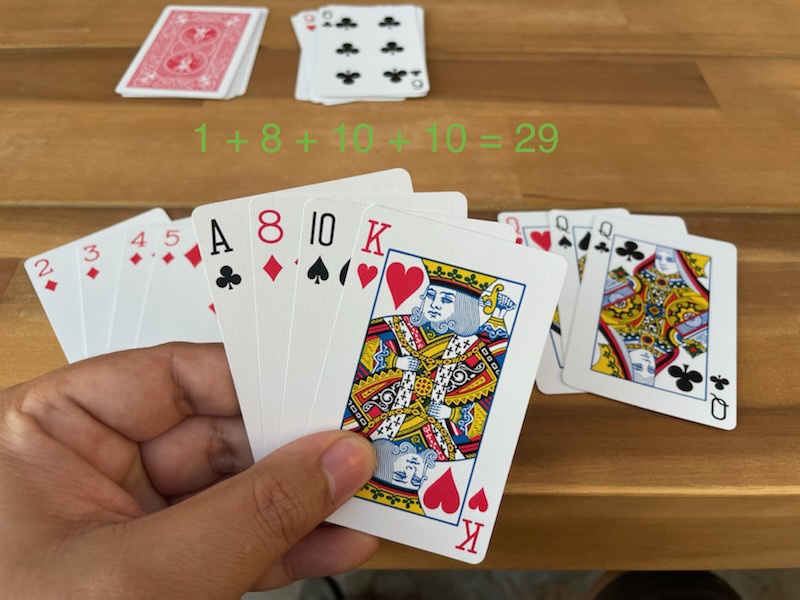
Players must tally up their unmelded cards (deadwood, to borrow a term from gin rummy).
Aces are worth 1 point. Face cards (Jack, Queen, and King) are worth 10 points. And everything in between (2, 3, 4, 5, 6, 7, 8, 9, and 10) match their value.
The lowest score wins the game.
In the case of a tie with the caller and a challenger, the challenger always wins. In the case of a three-way tie or a tie between the two challengers, the challenger to the right of the caller wins.
In the case of a tie when the deck runs out, the last player in the tie to have drawn a card wins.
PAYOUT
Tongits is perfectly fun without the added element of gambling. You can still go for tongits, a draw, or a challenge and have the satisfaction of winning a given game. That said, here’s how to play for money.
There are three types of wins: Tongits, Draw, and Challenge. Tongits is the best win with a payout of 3 from each player. A draw is the lowest win with a payout of 1. Winning a challenge can earn 3 from each of the challengers, but still just a payout of 1 for any player who folds.
Sunog players are the biggest losers and must pay the winner an extra payout of 1.
There are also special payouts for select cards and bahays in the winning hand. Aces and Kings earn a payout of 1 each. And four-of-a-kinds and escaleras earn 3 each. Note however that four-of-a-kinds and escaleras must be face down on the table as secrets or still be in hand. This is to avoid any confusion over whether sapaws from other players contributed to the bahay.
A simple jackpot can be contributed at the beginning of each game, $3 for the initial seed, and $1 for each subsequent game. Any player that wins two games in a row wins the jackpot. Another jackpot is initiated at the start of the next game.
—SJS
 mahjongero