This is what’s called a “poker mahjong” set. It’s basically a set of mahjong-style tiles, but marked as the standard 52 card deck of western-style playing cards (English pattern, French-suited playing cards) commonly used for poker, blackjack, gin rummy, et cetera. It goes for around $45 on Amazon.
It comes with two full decks and a bunch of joker tiles and blank tiles in a normal sized case. I think it would be cool to have a small case so that I could just carry a single deck of cards. I don’t know the first thing about making cases, so if you have any ideas, would love to hear in the comments.
The only difference with regular cards is that instead of being colored black and red, there is a different color for each suit:
Spades ♠️ = black
Hearts ♥️ = red
Clubs ♣️= green
Diamonds ♦️ = blue
I don’t know if there’s a reason for this or a particular game that this color scheme applies to. I wish they would have at least switched the colors for clubs and diamonds, because the blue ends up looking kinda black, which is disorienting to see on a diamond card. But you get used to it pretty quickly.
This set is awesome for rummy-type games like tong-its. We just use a single deck and set up a wall in an L-shape. After dealing out the tiles, you have a single draw wall, and it ends up feeling a lot like a little game of mahjong.
I can also see this set working well for Texas hold’em or blackjack. My sister taught me a fun game called golf, that works very well with these tiles.
The only game that didn’t really work as well was pusoy dos or other related shedding games like Tiến lên or thirteen. In these games, it’s really important to hide the arrangement of cards and the number of cards you have remaining, which is not really possible with tiles. Also, part of the fun in these games is throwing down hands on top of each other, which would be a bit hazardous with tiles.
So you’re ready to pull the trigger and buy your very own mahjong set. The majority of sets out there for purchase fall into one of three categories: Chinese, American, or Japanese (Riichi). Filipino mahjong traditionally uses a Chinese set, but because of the simplified gameplay, basically any mahjong set can be adapted for use. The Chinese mahjong set represents the original configuration of the game, and other variants generally just add tiles to the original 144 tiles. To play Filipino mahjong with a non-Chinese set, you can either remove the extra tiles, or just treat them like flowers. Personally, I prefer not to have a bunch of extra tiles, so all of my sets are Chinese. But some of the American and Japanese mahjong sets out there are simply too gorgeous to ignore, so keep an open mind.
Numerals
Another consideration is whether your set has western-style Arabic numerals. If you want to keep it traditional and simply learn the handful of Chinese characters for Filipino mahjong, ain’t no mountain high enough to keep you from learning those Chinese numbers. But if you really need a numbered set, just make sure to examine the photos and product description before making your purchase. American sets always have the western Arabic numerals, and there are plenty of Chinese sets available with western Arabic numerals as well.
Size of the Tiles
Another major consideration is the size of the tiles. Bigger is better for improved visibility and ease of manipulation, but, as with other matters, it also depends on how you use it. Some companies use labels like “small,” “medium,” “large,” etcetera, but these terms are not always consistent, even within the same company, so make sure to look at the actual tile dimensions. Note that Japanese Riichi tiles are generally smaller than Chinese tiles. American tiles are similar in size to Chinese tiles, except they are often thinner because they are used with racks.
I recommend 1.3 inch (height) tiles or larger. In my opinion, 1 inch tiles are a bit difficult to read from table height unless you use racks. Less than 1 inch tiles are more difficult to handle. The set that I grew up playing are standard 1.3 inch tiles, which are easy to manipulate for small and large hands.
My favorite set to play with are “X-large” 1.5 inch tiles. They are satisfying to hold and arrange, and very easy to read. I have gotten some complaints from my siblings that the extra large tiles are too heavy, but they’re complainers who take too long to build their walls even with standard tiles. My wife likes the extra large tiles and she has tiny hands. It’s ultimately a matter of preference.
Larger tiles can also present a problem depending on the size of the table that you plan on using. The chart below sets out some popular tile sizes and the wall size you can expect based on a square wall with sides 18 tiles across. Your table should be another 7 or 8 inches wider to leave space in front of each player. Note that the wall size varies primarily as a function of the width of the tiles.
Common Labels
Height
Width
Depth
Wall Size*
Min Table Size*
“Mini” or “Travel”
0.8” 20 mm
0.5” 14 mm
0.4” 11 mm
11.5” x 11.5”
18” x 18”
“Standard Riichi”
1” 26 mm
0.8” 20 mm
0.6” 16 mm
16.2” x 16.2”
24” x 24”
”Standard American”
1.2” 30 mm
0.9” 22 mm
0.5” 13 mm
18.6” x 18.6”
26” x 26”
“Large Riichi”
1.2” 30 mm
0.9” 22 mm
0.7” 17 mm
18.6” x 18.6”
26” x 26”
“Medium,” “Standard,” or “Large”
1.3” 33 mm
1.1” 27 mm
0.8” 20 mm
22.4” x 22.4”
30” x 30”
My folks’ set
1.35” 34.3 mm
1.05” 26.9mm
0.73” 18.5 mm
20.5”x 20.5”
28” x 28”
”X-Large”
1.5” 37 mm
1.1” 28 mm
0.9” 22 mm
24.8” x 24.8”
32” x 32”
”Champion”
1.6” 40 mm
1.1” 29 mm
0.8” 20 mm
23.7” x 23.7”
31” x 31”
*Calculations are approximate.
Accessories
As for accessories, Filipino mahjong does not require much. Two dice are needed for breaking the wall, and chips or point markers may be used if playing for money. You won’t need a wind indicator or betting sticks for Filipino mahjong. Racks are not necessary unless your set comes with smaller tiles (more common in travel sets or thinner American mahjong tiles). Most sets do not come with a cloth, so you can either buy a specialized mahjong table mat, or just go to a fabric store and get a piece of felt. 36 inches by 36 inches square is sufficient for any size set.
Value
The final consideration, of course, is price point. I have never spent more than $100 on a mahjong set, although I have definitely salivated over some of the more expensive sets. My favorite set, with extra large tiles, was around $50 from a strangely named eBay store called “wepayyoursalestax” [sic]. As mentioned above, I love the size, feel, and visibility of the tiles. But the case is pretty bad (it’s shaped like a plastic toolbox with a flimsy handle and the tiles are fairly loose without trays so they click around). I see similar extra large sets on Amazon and eBay with better cases for around $60.
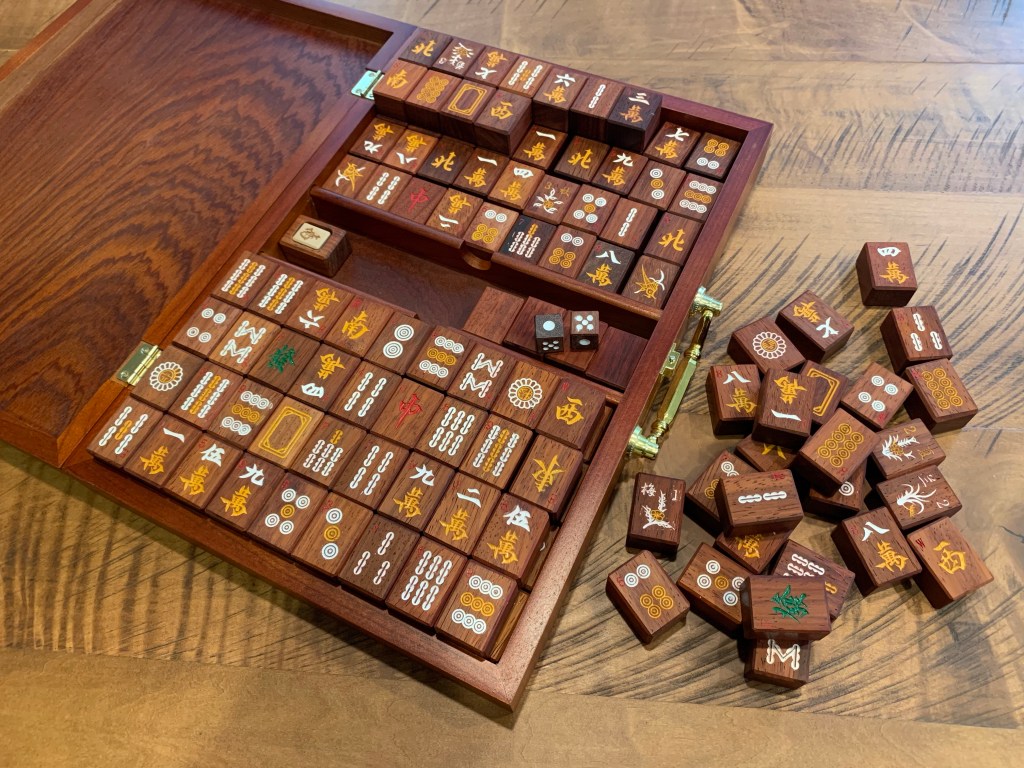
My most expensive set is a rosewood set from the same eBay store with beautiful rosewood tiles and a nice wood case that set me back around $95. It’s gorgeous and lightweight, and it smells and feels like playing with Lincoln Logs, like in elementary school. It doesn’t have quite the same satisfying clack as regular acrylic tiles. I play with it about ⅓ of the time just cuz it’s so pretty, and it’s light enough to travel.
My second most expensive set is a jet black set with “medium” 1.2-inch tiles from Yellow Mountain Imports. I don’t remember how much i spent on it, but the large/standard 1.3-inch tiles seem to be going for around $93. The black acrylic tiles and the matte black wood case with maroon velvet lining are truly stunning and feel great. My only complaint with this set was that the 1.2-inch tiles felt a little too small.
The set I grew up playing with is unbranded. The only marking on the case is a short dedication from my godmother who apparently gave it to my parents as a wedding gift over three decades ago. It has 1.3 inch tiles, a great zip up case, two dice, and pink point markers, and has gone between houses, on camping trips, to breweries, and back to my folks’ living room. The mossy brown felt table cloth has been washed a handful of times to get out the dog hair (don’t ask me how the hair got from our floor-hugging dachshund/chihuahua mix all the way up to the table—I have no idea). One of the east wind tiles has a small chip on it that my brother always manages to track down like a truffle pig. But we’ve still never gotten around to using one of the four blanks to replace it. Similar sets seem to go for around $60.
Good luck with your purchase! May it bring you many years of fun and good luck.
Reading Chinese characters is one of the most intimidating parts of getting started with mahjong for many Filipinos and other folks who don’t read Chinese. But fear not, there are a couple of easy strategies. Of course you can always get a set with western-style numerals. American mahjong sets work just fine for Filipino mahjong—just remove the joker tiles or treat them like flowers. Also many Chinese sets come with numbered tiles, and some people will even mark non-numbered tiles with nail polish (just make sure you don’t alter the sides or backs, which would destroy the tiles’ anonymity).
My recommendation, however, is just to take some time to learn the characters. For basic Filipino mahjong, this really only requires learning nine characters for the numbers in the character suit.
It should go without saying that written Chinese is one of the most rich and beautiful writing systems, with its own way of conceptualizing the characters and how to properly execute each constituent stroke. For our purposes, however, a less orthodox approach is sufficient. These are the mnemonic devices my mahjong barkada* came up with.
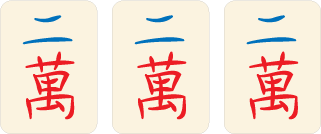
The first three Chinese numbers are easy: simply one 一, two 二, and three 三 horizontal strokes respectively.
Four 四 looks like a square, which has four sides.
Five 五 kinda looks like a five with an extra line segment.
Six 六 looks kinda like an “A” for “ant” 🐜 and ants have six legs.
Seven 七 looks like a lowercase cursive “t,” corresponding to Tuesday or Thursday, which are days of the week, and there are 7 days in a week. Alternatively, it looks kinda like a handwritten “7” upside down. On some sets, the character is slightly rotated, looking more like an “x.” X marks the spot for buried treasure on a pirate map, and pirates sailed the seven seas 🏴☠️.
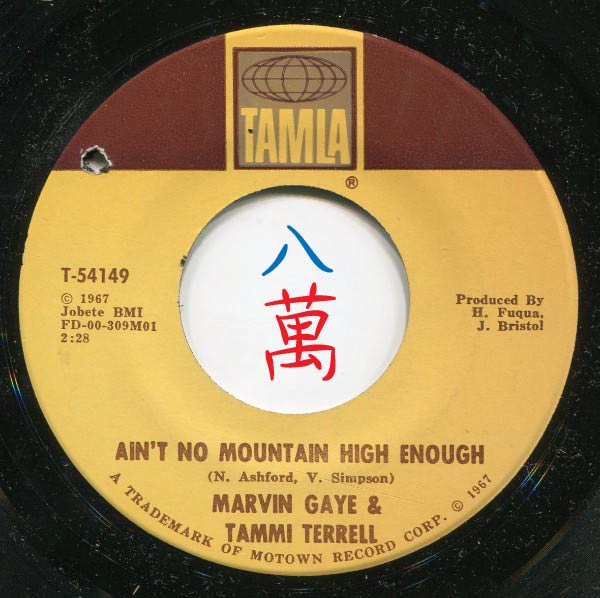
Eight 八 looks like a mountain, and as Marvin Gaye famously sang, “[eight] no mountain high enough.”
Nine 九 kinda looks like the Greek letter pi. Pi is close to 3, and 3 squared is 9. Okay, that’s a little more of a stretch, but it’s the last one anyway.
On that note, do you have your own tips and tricks for remembering these characters? Let us know in the comments.
*Stephanie Sia, Alex Chin, Patrick Buenaventura, and Allison Buenaventura. The pirate mnemonic for “7” was proposed by Stuart Sia.
The colorful illustrations. The delicately carved Chinese characters. The ever-eroding tile walls. The smell of small bills and copper and silver coins as they change hands. The clatter of tiles shuffling and the whoosh as they slide across the felt. The exclamations of triumph. The cries of defeat. This is mahjong, a fixture of any Filipino gathering, played with deft hands still oily from lumpia and empanadas. In between “chow!” and “pung!” and the occasional “kang!”, it’s a chance to catch up—births, deaths, graduations, new jobs—but more often the latest chismis (I hear Maritess and her boyfriend are moving in together).
Originally from China, mahjong is played across East and Southeast Asia, and is similar to melding type card games such as tong-its and gin rummy. The rules may vary, but the spirit is the same: complete your hand and rack up as many special points as you can along the way.
If you’re looking for somewhere to start, try Filipino mahjong. Filipino mahjong strips the game down to the basics with a quick gameplay that emphasizes strategy over luck.
The Tiles
Filipino Mahjong uses the standard 144-tile Chinese set. An American set (152 tiles) can be used, but the eight joker tiles should be removed.
The most important set of tiles for Filipino mahjong are the 108 suited tiles, which consist of three suits: sticks, balls, and characters. Each suit has four copies of nine unique tiles, numbered 1 to 9.
STICKS (also bamboo)
Notice that 1-stick is styled as a bird. 8-sticks has the sticks arranged in mirror-image “W” and “M” shapes.
BALLS
Notice that 1-ball is styled as a large colorful circle, and looks kind of like a flower. Do not be fooled.
CHARACTERS
The blue or black characters on top are the numbers one through nine in Chinese. Some sets have the Arabic numerals, but you may just have to learn Chinese.
FLOWERS
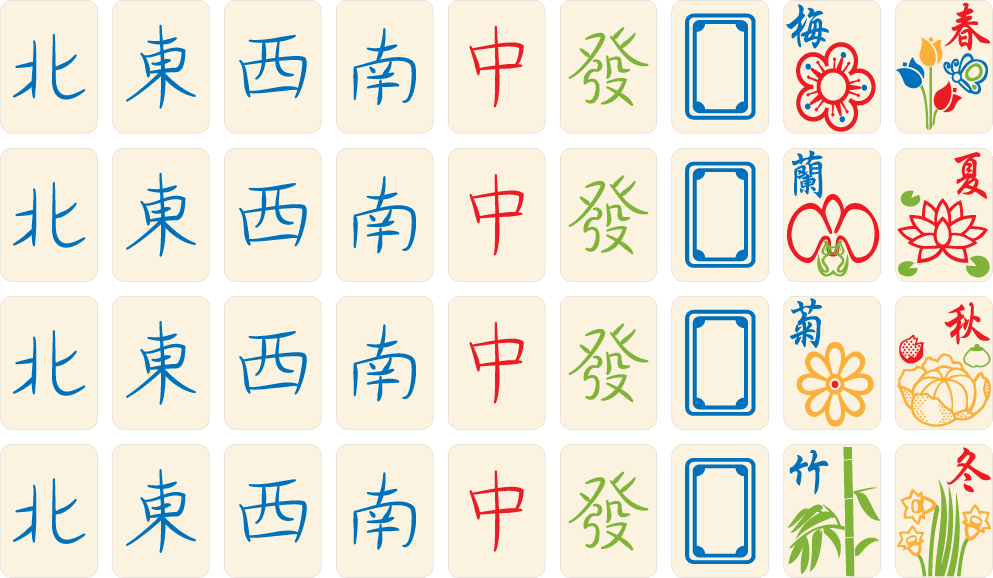
The remaining tiles can be categorized as dragons, winds, seasons, and flowers. However, in the basic Filipino game, all of these tiles are called “flowers.” In most forms of mahjong including Filipino mahjong, flowers are collected for bonus points.
Setup
Like most variants of mahjong, Filipino mahjong is intended for four players. Rules and customs for dealing the tiles out vary from version to version and table to table. This is how my family does it.
Building the Wall
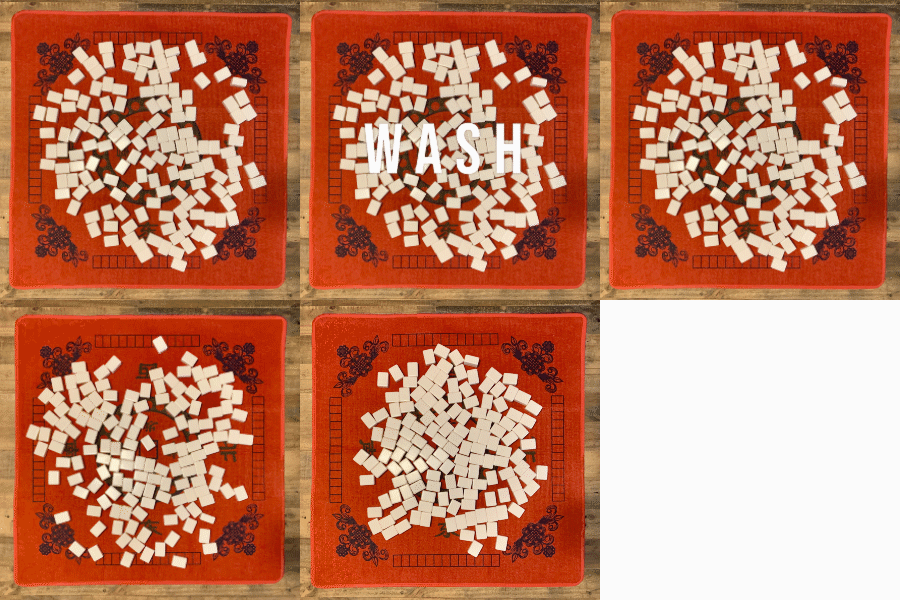
The first step is shuffling the tiles and building the wall. Turn the tiles faceside down and give them a good shuffle or “wash,” as we like to say. When I was a kid, this looked like the most fun part of the game.
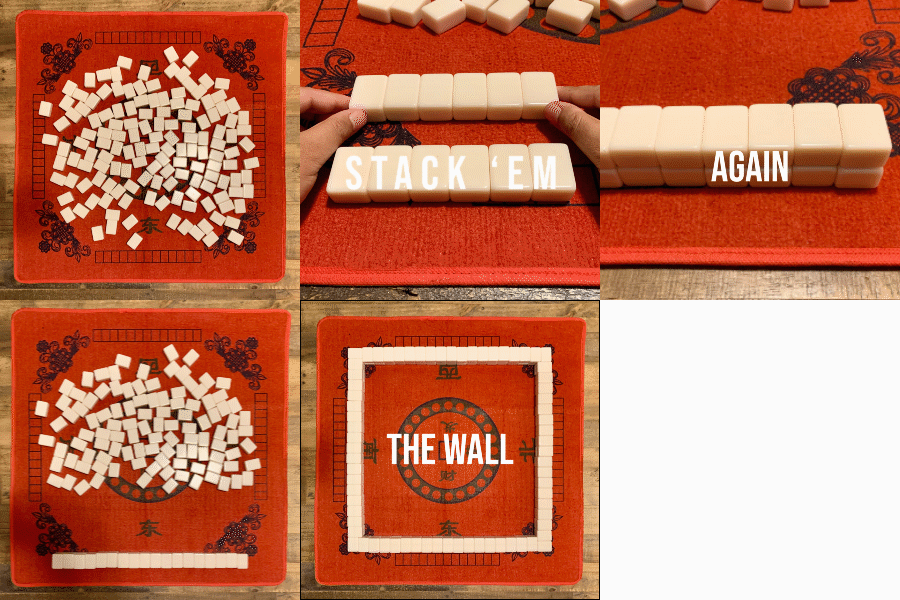
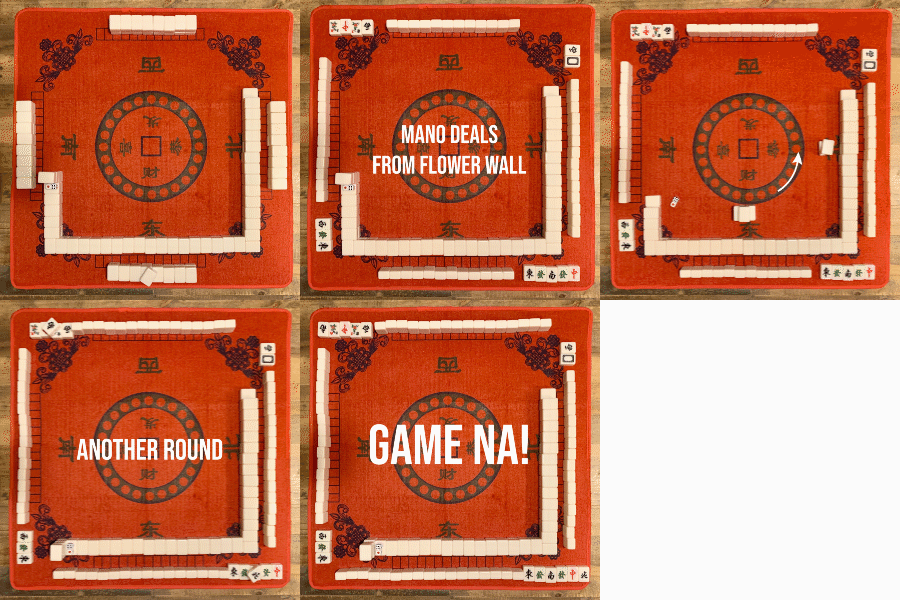
Then, each player should build their segment of the wall, which should be 18 tiles long and 2 tiles high (36 tiles total). Maneuver the wall segments to form a closed square(ish). Put the protractor away. It doesn’t have to be perfect.
Identifying the Máno
The next step is to determine the dealer, also referred to as the “máno.” At the start of the first game, the players roll a pair of dice. High roller deals first. After the first game, if the máno wins, they will be the máno again (they basically hold onto their position until they lose). Otherwise, the next person to the right (counterclockwise) becomes the máno.
Breaking the Wall
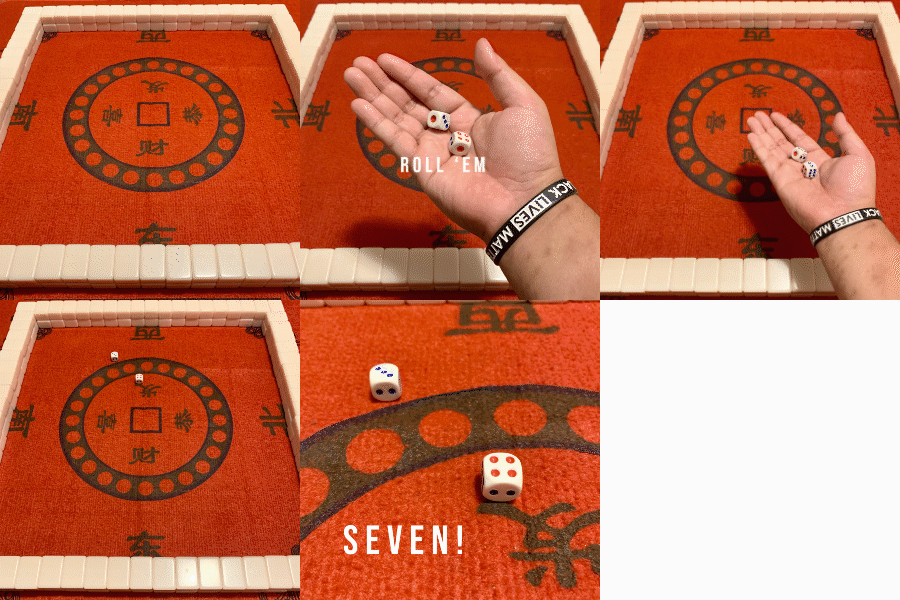
Once the máno has been selected, the máno rolls the dice to determine the starting wall. Let’s say you are the máno and you roll a seven.
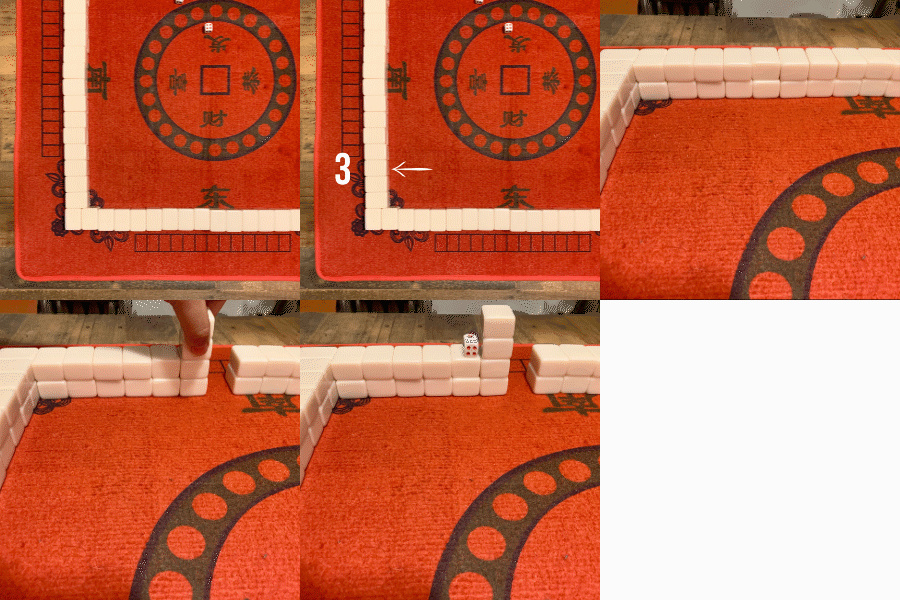
Starting with your own wall, count the walls in front of each player, moving counterclockwise around the table: 1, 2, 3, 4, 5, 6, 7. You should now be pointing at the wall of the player to your left. Note: if you roll a multiple of 4, you will land on the wall in front of you. However, it is taboo to deal from your own wall (because experienced mahjongeros are ninjas, notorious for sleight of hand and card counting), so if this happens, proceed to the wall on your right.
The next step is to determine where to break the wall.
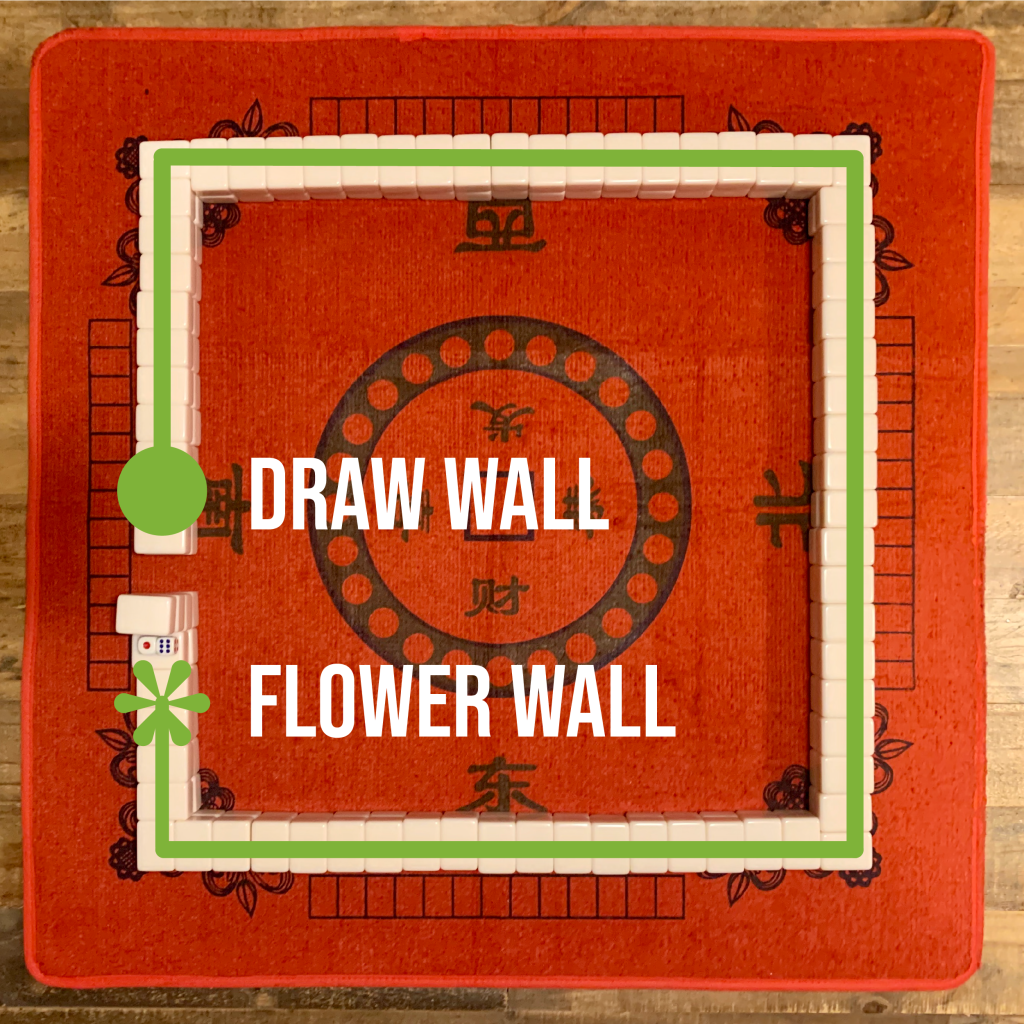
Use the same number from determining the starting wall. Starting on the end of the wall segment closest to you, count out seven tiles: 1, 2, 3, 4, 5, 6, 7. Pick up that seventh tile and the tile underneath it and stack them on top of the sixth tile, marking the start of the flower wall. Place the dice on top of the flower wall for good measure to clearly distinguish it. The tiles immediately after the flower wall (away from you) become the draw wall. If the starting wall is the back wall, start counting from either end, mano’s choice.
The wall is basically like a long deck of cards wrapping around the table in a square. The draw wall is like the top of the deck where the tiles will be dealt from and where the players will draw tiles from during gameplay. The flower wall is like the bottom of the deck, from which players only occasionally draw in order to replace flowers and to take gifts (to be discussed later). The wall must be broken in order to separate the ends of the draw wall and the flower wall.
Dealing the Hand
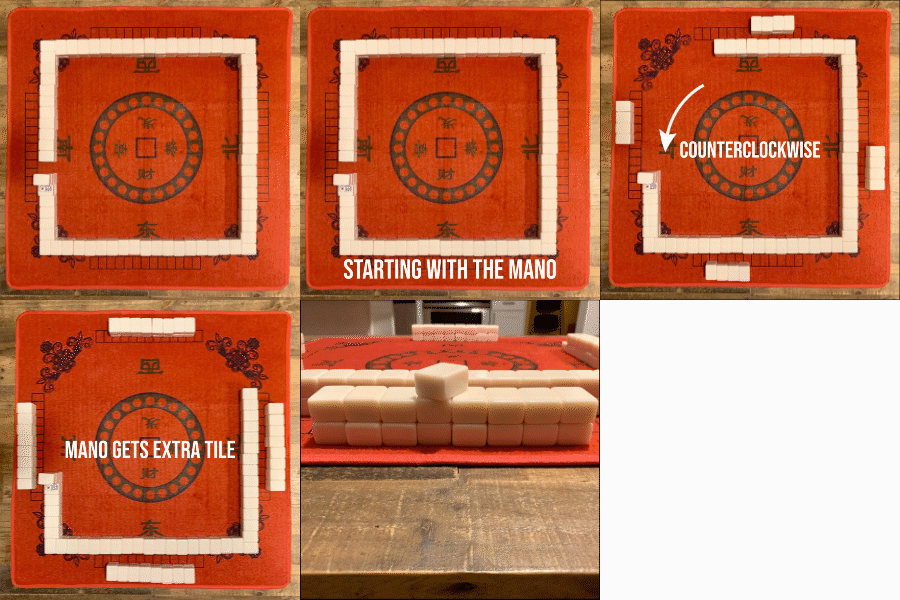
The next step is dealing the tiles. Starting from the draw wall, deal yourself eight tiles. Whoever is sitting in front of the draw wall should help out with this. Continuing to the right (counterclockwise), deal each player eight tiles in the same manner. Repeat this for one more round until all players have a total of 16 tiles. As the máno, you should grab a 17th tile from the draw wall, because you will be the first to discard.
All players can now turn their tiles facing towards them in a row, concealed from other players. The first thing all players should do is to sort out their flowers. Line them up face up so that they are exposed to other players and tell the máno how many replacement tiles you need. Similar to the deal, the máno should deal out replacement tiles from the flower wall to each player in a counterclockwise direction. Repeat another round of flower replacement as needed.
After replacing all flowers, players should make sure they have a total of 16 suited tiles in their hand (the máno should have 17). Players can arrange their tiles to begin forming báhay.
The máno begins gameplay by discarding one of their tiles.
Game Na!
Now that the first tile has been thrown, the game is afoot! By default, the next player is the player to the right (counterclockwise). Every turn goes the same way:
First, you get a tile, either from the draw wall or by seizing a tile that somebody discarded, discussed below.
Then you examine your hand and rearrange your tiles as needed to incorporate your new tile. The goal is to arrange your tiles into one pair (called an eye) and five sets of three (called báhay).
The last thing you do is discard a tile in the center of the table, officially ending your turn. Immediately after a tile is discarded, someone else can take it to form a báhay or to complete their winning hand. If nobody takes the discarded tile, that tile is out of play for the rest of the game and the next player draws from the wall.
Even if it is not your turn yet, this is not a time to sit idle. Although the next person is the player to the right by default, there are certain circumstances that allow somebody to jump ahead to seize a discarded tile. Also, even if you are unable to seize the tile, it is important for you to know what is thrown and what is out of play, so that you are not waiting for it in vain later on.
Getting a Tile
The main way to get a tile is to draw it from the draw wall. If you draw a flower, you must display the flower face up with your other flowers and replace the tile by drawing from the flower wall.
You can also get a tile when somebody discards it if it completes a báhay or a winning hand. The seized tile must be displayed face up with the completed báhay. This open báhay cannot be altered for the rest of the game. The discarded tile must be seized immediately (#yolo), or else the tile becomes dead and will remain in the discarded tile area for the rest of the game.
A pung is a three-of-a-kind.
If you need the discarded tile to complete a pung, you have to say “pung,” grab it, and display the completed pung face up next to your flowers. Pungs are powerful because you can seize it even if it isn’t your turn, and everyone before you will lose their turn.
A kang is a four-of-a-kind.
Kang is like a special type of pung, and can also be grabbed even if it’s not your turn. However, you have to also grab an extra tile called a gift from the flower wall. This is necessary for you to have enough tiles to complete a winning hand.
A chow is a three-tile straight of the same suit.
Unlike pung and kang, you can only chow when it’s your turn. This makes chows harder to get since you can only get it from the person right before you. The only exception to this is if the chow would result in you winning.
Generally you cannot seize a discarded tile to form a pair. The only exception is if you are waiting. Waiting means you only need one more tile to win. You might be waiting to complete a pung, a chow, or an eye in order to win. No matter what you’re waiting for, you can seize it if somebody discards it, anytime. Winning using a discarded tile is called tódas.
Conflict Resolution: What Happens If Two People Want to Seize a Discarded Tile?
Conflicts are resolved by table rules. In general, priority is given based on what the tile is being seized for: pung/kang takes precedence over chow and tódas has precedence over everything. If more than one player needs the discarded tile for tódas, it goes to whoever is closer in turn after the person who discarded the tile.
Others use a strict speed rule, i.e., the first one to call it and/or grab the tile gets to keep it. And some people lose their cool and flip the table, scattering tiles everywhere. They are not invited back to mahjong night.
Arranging Your Tiles
Remember, the goal of mahjong is to have all of your tiles arranged into five báhay and one eye (pair). After getting a tile, you should arrange your tiles and attempt to incorporate your new tile into your hand.
As discussed above, kang is a four-of-a-kind, which may be formed from a discarded tile. Related to kang is a secret. A secret is when you have four-of-a-kind that’s hidden in your own hand, which means that you drew it yourself and did not complete it using a discarded tile. In this case, because it’s concealed, the identity of the tile is valuable information and should not be displayed. But because it is a four-tile báhay, you must declare it and get a gift from the flower wall. Turn the outside tiles facedown to mark it as a secret. Just like with open báhay, your secret tiles will be out of play the rest of the game with no changes permitted.
Another related concept is sagása. Open báhay are generally locked in and cannot be changed. If you created a pung from a discarded tile, and later on, somebody throws the fourth matching tile, you will not be able to kang the discarded tile, because your pung was already open. However, there is a special exception: if it’s your turn and the tile that you draw from the wall happens to be the fourth matching tile, then you can add it to your completed pung. Declare “sagása” and set the matching tile on top of the middle tile of the pung. Since this is now a four-tile báhay, you must draw a gift from the flower wall.
Kangs, secrets, and sagása are “ambitions,” or special groupings of tiles which receive immediate payout from other players. Here are some more special ambitions.
thirteen flowers, any thirteen flowers
no flowers, may be paid if you have no flowers after the tiles are dealt, and again at the end of the game
escaléra, three chows in a full sequence, tiles 1-9
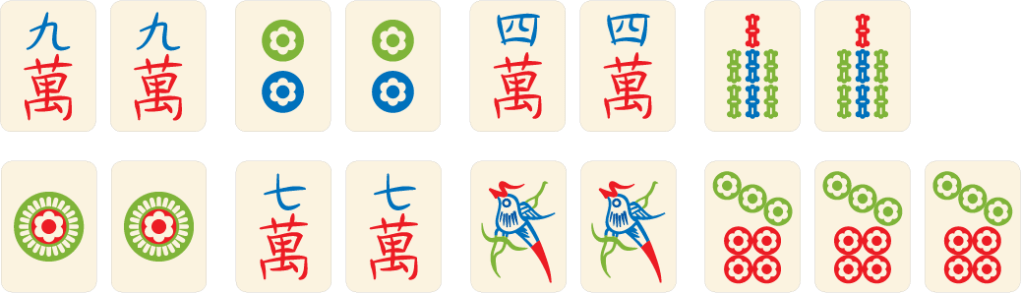
siete pares, seven pairs (and a báhay)
In the Filipino twittersphere, #sietepares or #syetepares are popular hashtags on social media, akin to #blessed. Siete pares is a unique winning hand that replaces the five báhay and one eye with seven eyes and one báhay (chow or pung). If the báhay is a pung, this is an even more special ambition called “international.”
Sometimes you draw a tile that does not really go with any of your existing tiles. This is probably a good candidate for the tile to discard.
Discarding a Tile
The only type of tile that cannot be discarded is a flower, since those must be exchanged from the flower wall. Generally you want to discard tiles that do not go with any of the other tiles in your hand to help you form appropriate báhay. If you can figure out what other players need, you should try to avoid discarding those tiles.
Winning
A player can declare tódas when they have completed five báhay and one eye.
An alternate winning configuration is known as siete pares or international.
A player can declare búnot if their winning tile was drawn directly from the wall. Búnot pays double.
Payouts
Of course, you don’t have to play mahjong for money. Growing up, we certainly never did. But knowing the payout rules gives you a good sense of what separates a good hand from a great hand.
One payout is typically $1. A half payout is 50¢. A quarter payout is 25¢.
INSTANT PAYOUT
Get payout from other players immediately upon declaration of ambition.
Sagása, Secret ½
Kang ¼
Thirteen Flowers ¼
No Flowers ¼
FINAL PAYOUT
Get payout from other players upon declaration of tódas, a win. Final payout is 1 for tódas plus special payouts for ambitions.
Tódas 1
Escaléra +½
Siete Pares +½
Búnot ×2
For a regular tódas where the winning tile was picked up from the discard pile, the discarder has to double the final payout to the winner.
For búnot, all players have to double the final payout to the winner.
Special Rules
Here are some special rules, which are optional to gameplay.
Doubles
At the start of the game, two dice are rolled to break the wall. A roll of doubles means all payouts are doubled.
Jai Alái
Players put a share, typically $1, into the jai alái (pronounced hai-a-lai). At the end of each game, the winner gets one marker, two for búnot. The first player to get five markers wins the jai alai.
Joker
This is a good way to mix up the game and make it go faster. At the start of the game, after all players have their tiles dealt and their flowers declared and replaced, the máno can roll the dice again to determine a joker tile. Say you (the máno) roll a 7. Count seven blocks down the flower wall. Turn over the top tile. (If the tile is a flower, keep turning over the next one until you have a suited tile.) This tile is now the joker and can represent any other suited tile.
Other Ambitions
If you want to up your game, here are some other ambitions that can earn you more payout.
Bisaklát, when the dealer’s opening hand is a winning hand +1
Before the 5th, when you win before the fifth discard +1
All flush, when all the tiles are of the same suit +½
All chow, when all báhay are chow. +¼
All pung, when all báhay are pung (or kang) +¼
All up, when none of your tiles are declared +¼
All down, when all of your tiles are declared +¼
Single, waiting on a single tile to complete your eye +¼
Back to Back, waiting on two pairs to complete a pung +¼
Paníngit, waiting on an incomplete chow with middle tile missing +¼
That last group of ambitions (single, back to back, and paníngit), I hesitate to call ambitions, because they are lower probability waiting scenarios that you generally try to avoid. Perhaps the payout is better thought of as recompense for the undue stress caused by these waiting scenarios.
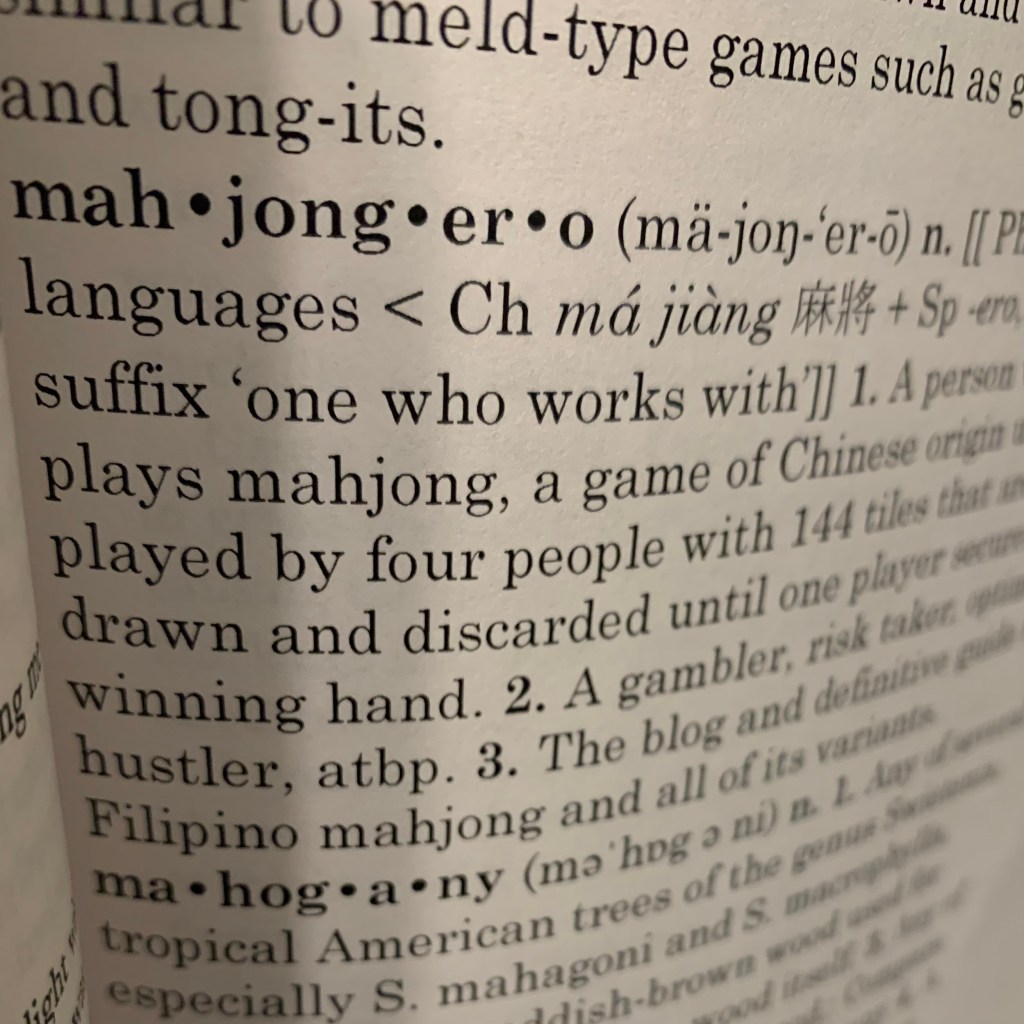
: a person who plays mahjong, a game of Chinese origin usually played by four people with 144 tiles that are drawn and discarded until one player secures a winning hand
Origin
Used in Philippine languages, from Chinese má jiàng (麻將), the name of the Chinese game, and the Spanish agentive suffix -ero ‘one who works with’















 mahjongero