We learned mahjong from our father who grew up in the Visayas. We have seen people playing this style coming from all over the Visayan islands including Cebu, Panay, Negros, and Leyte. The gameplay for Visayan mahjong (also Bisaya mahjong) is identical to that of the standard Filipino variant we go over in our original blog post on the game.
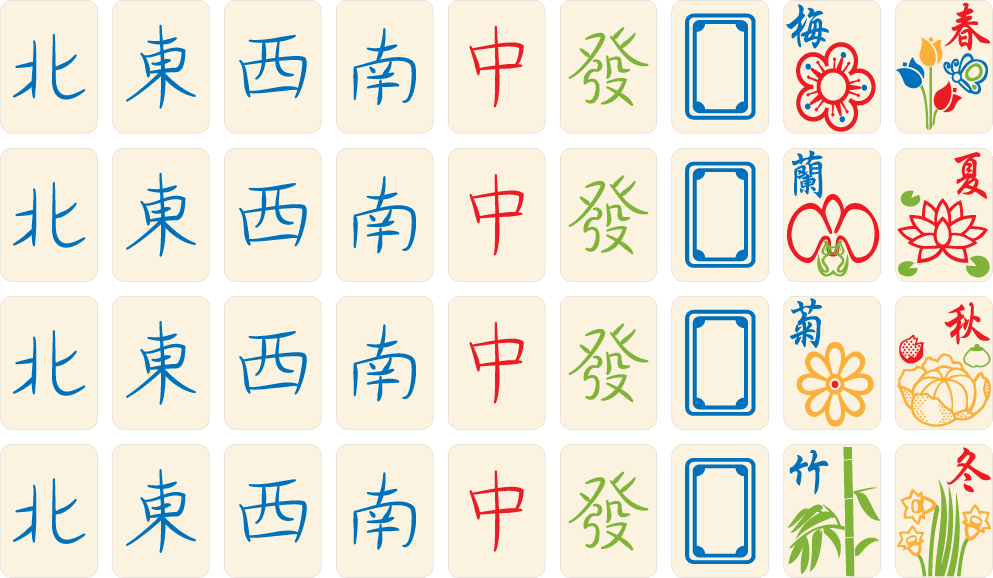
But unlike standard Filipino mahjong, Dad’s mahjong makes use of the winds and the so-called “dragon” tiles. So if you draw one of these tiles, instead of exchanging it for a new tile like a flower, you will keep it in your hand to form a pair, pung, or kang. Or you can use it to form a special báhay like beauty or NEWS, as discussed below.
Beauty
These three tiles are referred to collectively as beauty in Visayan mahjong, because, well, look how pretty they are! They are also called “dragons,” a term borrowed from American mahjong.
The first is called dagger in Visayan mahjong but may also be referred to as “red,” “pulá,” or “red dragon.” In Chinese, this is called “chun” or “zhōng” depending on the spelling system being used, and it means “center” or “middle.”
The second is called berde, also known as “green” or “green dragon.“ In Chinese, this is called “fā” which means “wealth” or “prosperity.”
The last is called mirror or window due to its shape, and is also known as the “white dragon.” In Chinese this is called “bái” meaning “white,” or “bái ban” meaning “white board.” This was originally a blank tile (which is still how it’s represented in Japanese Riichi mahjong sets).
There are four copies of each.
The beauty tiles can be drawn, discarded, and seized just like any of the suited tiles. Beauty tiles can be used to form a pair, a pung (three-of-a-kind), or a kang (four-of-a-kind).
Beauty also refers to a special báhay consisting of one of each: dagger, berde, and window. This is an ambition that gets immediate payout upon declaration! However, there are a few caveats. You can only form this báhay from tiles in your hand or taken in turn (similar to chow). Additionally, beauty must be declared in the first round.
For example, suppose you are not the dealer, and you have dagger and berde after the tiles are dealt. And then suppose that before your first turn, the person before you tosses a mirror tile. In this situation, you can seize the window tile and declare beauty receiving an immediate payout.
The same is true if you were to draw the window tile from the wall on your first turn.
However, once the first round is over, if you haven’t declared beauty, you can only use a beauty tile to form a pair, pung, or kang.
The Winds
The winds are named after the cardinal directions: North, East, West, and South. There are four copies of each.
The winds can be used to form pungs, kangs, or pairs as well, and can be drawn, discarded, and picked up just like any of the suited tiles.
NEWS
NEWS (pronounced like news) is a special báhay that, like beauty, can only be formed and must be declared within the first round. It consists of one of each of the winds. This is also an ambition that gets immediate payout upon declaration. Because it is a four-tile báhay, the player must take a gift (an extra tile) from the flower wall (similar to what happens with a kang or secret).
Payouts
The payout rules for Visayan mahjong are mostly the same, but with some key differences owing to the reduction in the number of flowers. The most notable differences are the addition of beauty and NEWS as ambitions and the loss of thirteen flowers as an ambition. The final payout rules remain the same.
Instant Payout
Get payout from other players immediately upon declaration of ambition.
Beauty ½ (can only be declared in the first round)
NEWS ½ (can only be declared in the first round)
Sagása, Secret ½
Kang ¼
No Flowers ¼ (can be declared in the first round and again at the game’s end if you still have no flowers)
Have a mahjong set, but none of your friends want to play? Are you stuck in quarantine, or just need some you time all to yourself? This is based on a fun mahjong solitaire app, but adapted for play with physical mahjong tiles. The app depicts mahjong cards, which stack differently from tiles. I found that transposing the set up so that the tiles stack in a horizontal direction works better. This is a fun game that rewards patience and planning ahead. As far as I can tell, every game seems to be solvable at the outset, but it’s easy to paint yourself into a corner if you’re not careful.
Setup
This game requires 39 tiles as follows
One set of balls 1-9
One set of sticks 1-9
One set of characters 1-9
4 red dragons (dagger)
4 green dragons (berde)
4 white dragons (mirror)
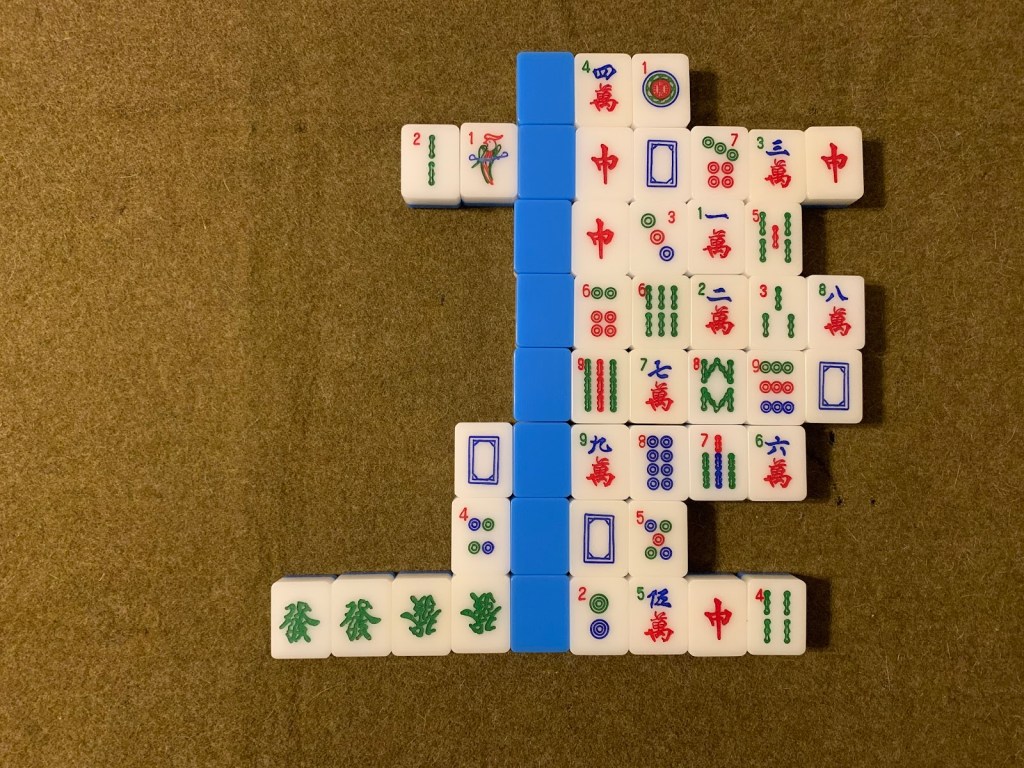
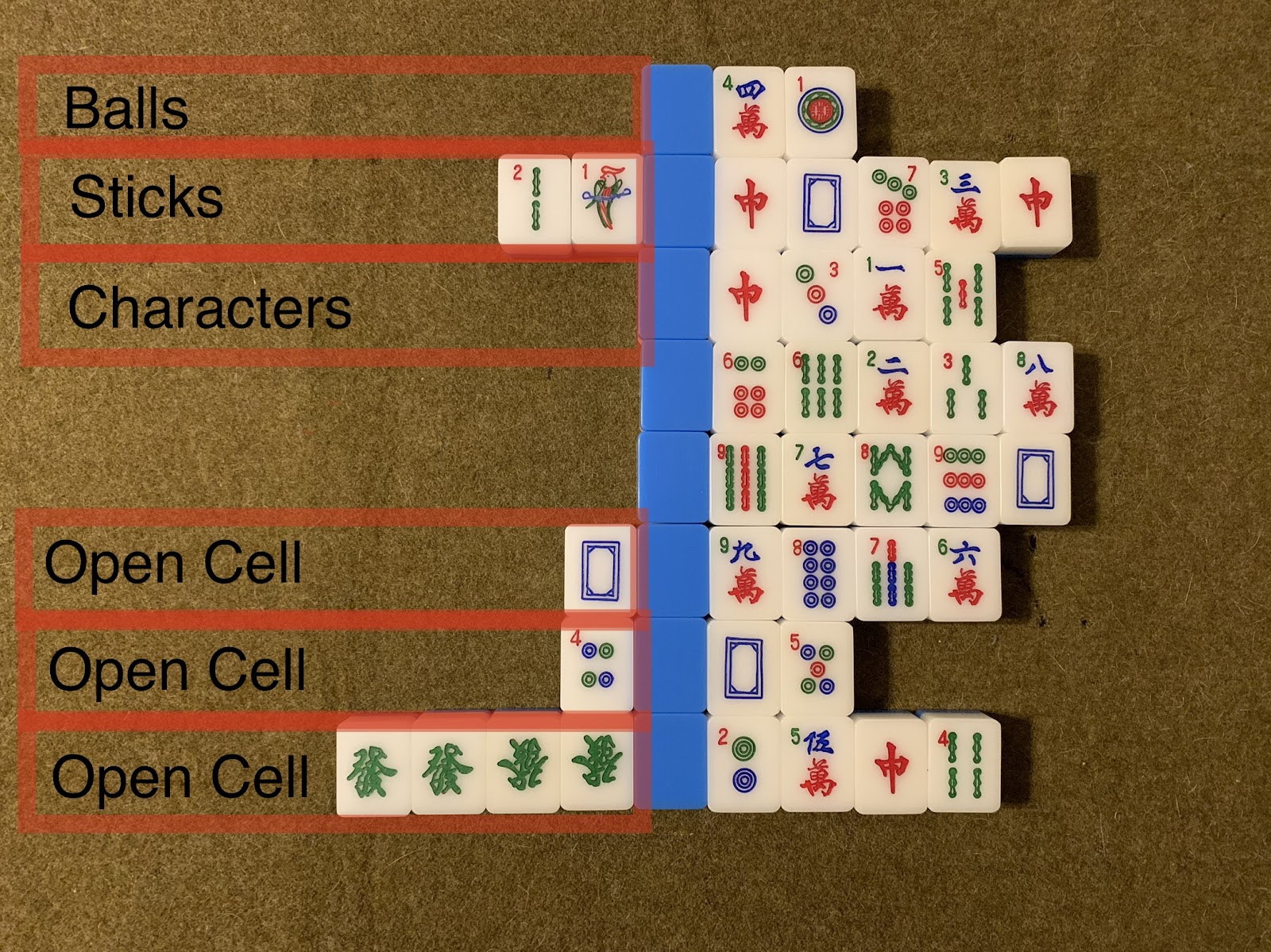
Shuffle the tiles, and arrange them face up in one row of four tiles and seven rows of five tiles. This grid should be on the right half of the table.
I also like to use eight wind tiles to act as a center divider as shown. Technically they can be any tiles since they’re gonna be facedown the whole time, but I use winds so that I don’t get confused in case they accidentally turn over. You could also use blank tiles or joker tiles.
Now you’re ready to play! The goal is to transfer all of the tiles across the center divider to the left half of the table, subject to the following rules:
Right Side
For the grid on the right side, only the last right-most tile of each row can be moved. Let’s call these the “exposed” tiles. An exposed tile can be moved to another row on the right if it is placed next to a tile that is one higher and a different suit, similar to classic solitaire (e.g. 4 balls can only be placed next to 5 sticks or 5 character). If multiple tiles are in descending order and in alternating suits, they can move as a group, also similar to classic solitaire. Dragon tiles cannot form groups. If a row on the right side is completely empty, any exposed tile or group of tiles can be placed there.
Left Side
On the left side, the top three rows are dedicated to balls, sticks, and characters, respectively. These tiles must be placed in order from 1 to 9, starting from the center divider and moving to the left.
The middle two rows are not used.
The bottom three rows on the left are open cells that can temporarily hold one tile of any type. Tiles placed in these open cells are exposed and can be moved anytime. The only exception is if all four dragons of one type are exposed. Then they can all be placed in one of the three rows, and will occupy that row permanently.
The game is complete when all suit tiles are in the upper left corner and all dragon tiles are in the lower left corner.
Halimbawa
Now for an example game. Consider this setup, and review the exposed tiles. Notice that the 7 sticks can be moved next to the 8 balls.
Now 6 character is exposed, and can be moved next to the 7 sticks.
Now the 8-7-6 row can be moved as a group next to the 9 character.
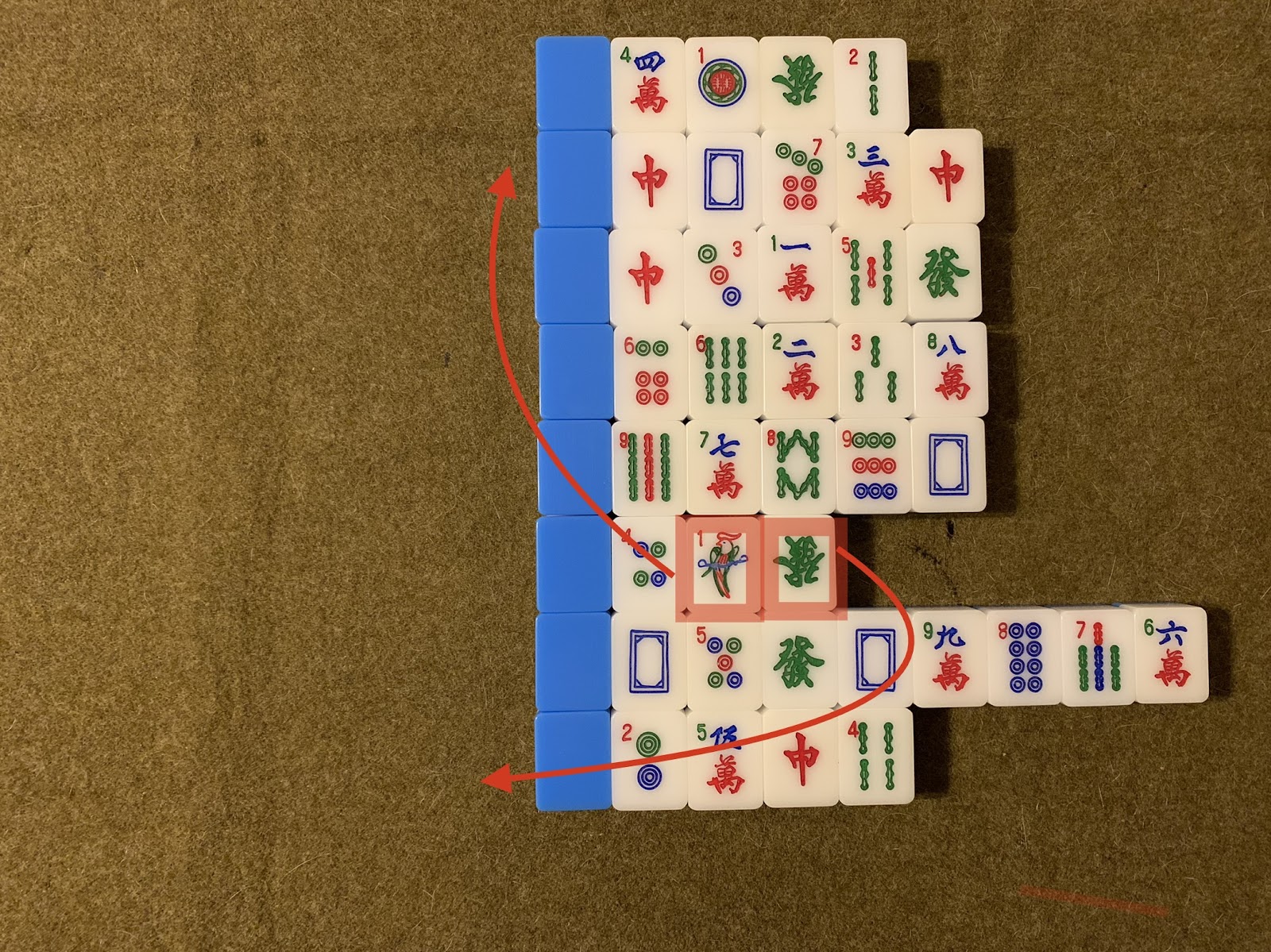
Now we’re close to exposing the 1 stick, but first we have to move the green tile out of the way by placing it in one of the open cells. Then the 1 stick can be moved to the stick area.
Now let’s move 4 balls to another open cell and move the 9-8-7-6 row to the open space.
Notice that the green tiles are now close to being all exposed. Let’s move the window/white dragon tile out of the way to the last free cell.
Now there is only one green tile that is still not exposed, blocked in by a 2 sticks tile. But we already ran out of open cells! Fear not, solo mahjongero, there is a 1 stick in the sticks area, and you can put it there.
Now that all four green tiles are exposed, they can all be placed together in one of the open cells.
Fast forward a bunch of moves and you’ll end up with something like this.
At this point, the puzzle is pretty much solved, with everything on the right side in well formed rows in descending order. It’s just a simple matter of disposing of the tiles in the suit tiles area in the upper left corner.
Wasn’t that satisfying? I think you’re ready to shuffle and play another game.
Mag-mahjong na tayo! Well, actually, mag-solitaire ka na lang, enjoy your alone time 😉 #selfcare
The colorful illustrations. The delicately carved Chinese characters. The ever-eroding tile walls. The smell of small bills and copper and silver coins as they change hands. The clatter of tiles shuffling and the whoosh as they slide across the felt. The exclamations of triumph. The cries of defeat. This is mahjong, a fixture of any Filipino gathering, played with deft hands still oily from lumpia and empanadas. In between “chow!” and “pung!” and the occasional “kang!”, it’s a chance to catch up—births, deaths, graduations, new jobs—but more often the latest chismis (I hear Maritess and her boyfriend are moving in together).
Originally from China, mahjong is played across East and Southeast Asia, and is similar to melding type card games such as tong-its and gin rummy. The rules may vary, but the spirit is the same: complete your hand and rack up as many special points as you can along the way.
If you’re looking for somewhere to start, try Filipino mahjong. Filipino mahjong strips the game down to the basics with a quick gameplay that emphasizes strategy over luck.
The Tiles
Filipino Mahjong uses the standard 144-tile Chinese set. An American set (152 tiles) can be used, but the eight joker tiles should be removed.
The most important set of tiles for Filipino mahjong are the 108 suited tiles, which consist of three suits: sticks, balls, and characters. Each suit has four copies of nine unique tiles, numbered 1 to 9.
STICKS (also bamboo)
Notice that 1-stick is styled as a bird. 8-sticks has the sticks arranged in mirror-image “W” and “M” shapes.
BALLS
Notice that 1-ball is styled as a large colorful circle, and looks kind of like a flower. Do not be fooled.
CHARACTERS
The blue or black characters on top are the numbers one through nine in Chinese. Some sets have the Arabic numerals, but you may just have to learn Chinese.
FLOWERS
The remaining tiles can be categorized as dragons, winds, seasons, and flowers. However, in the basic Filipino game, all of these tiles are called “flowers.” In most forms of mahjong including Filipino mahjong, flowers are collected for bonus points.
Setup
Like most variants of mahjong, Filipino mahjong is intended for four players. Rules and customs for dealing the tiles out vary from version to version and table to table. This is how my family does it.
Building the Wall
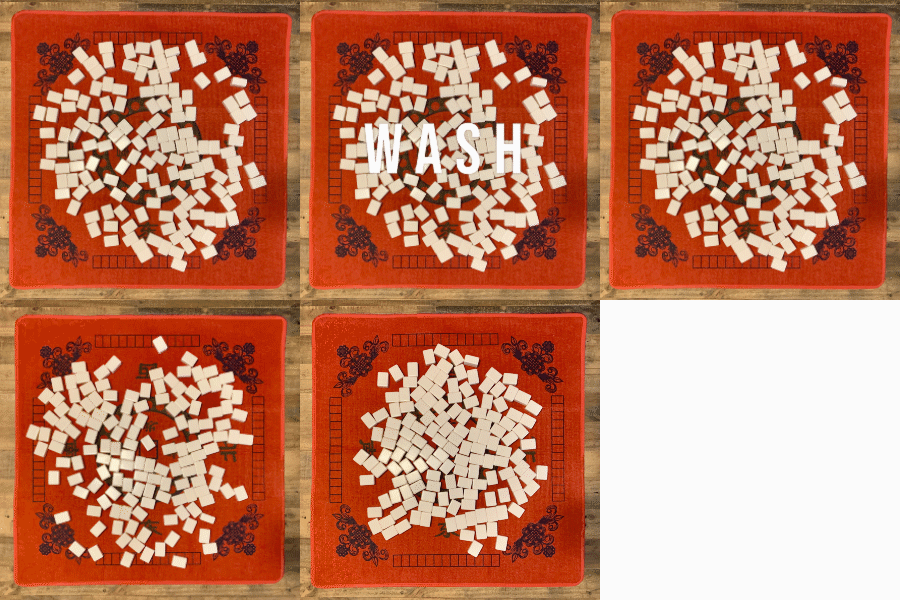
The first step is shuffling the tiles and building the wall. Turn the tiles faceside down and give them a good shuffle or “wash,” as we like to say. When I was a kid, this looked like the most fun part of the game.
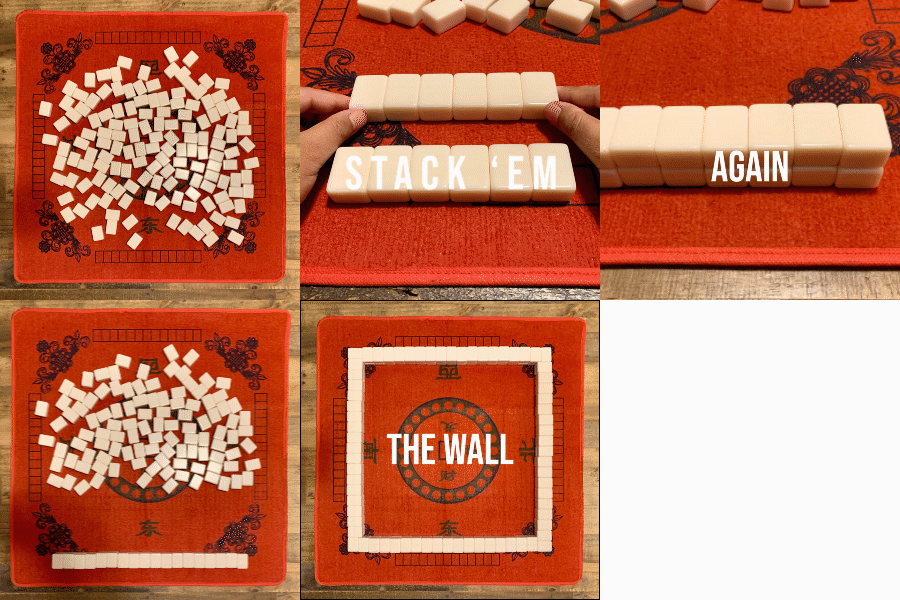
Then, each player should build their segment of the wall, which should be 18 tiles long and 2 tiles high (36 tiles total). Maneuver the wall segments to form a closed square(ish). Put the protractor away. It doesn’t have to be perfect.
Identifying the Máno
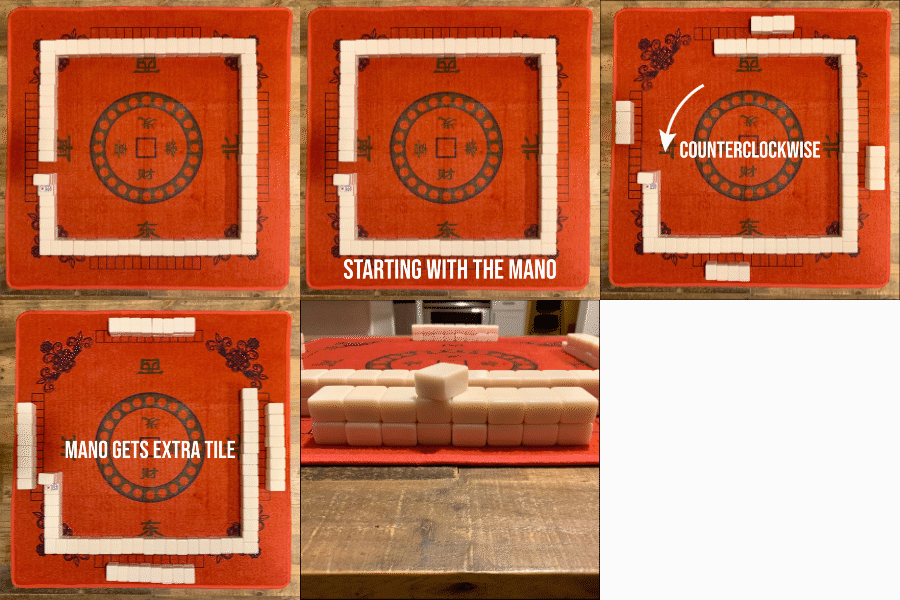
The next step is to determine the dealer, also referred to as the “máno.” At the start of the first game, the players roll a pair of dice. High roller deals first. After the first game, if the máno wins, they will be the máno again (they basically hold onto their position until they lose). Otherwise, the next person to the right (counterclockwise) becomes the máno.
Breaking the Wall
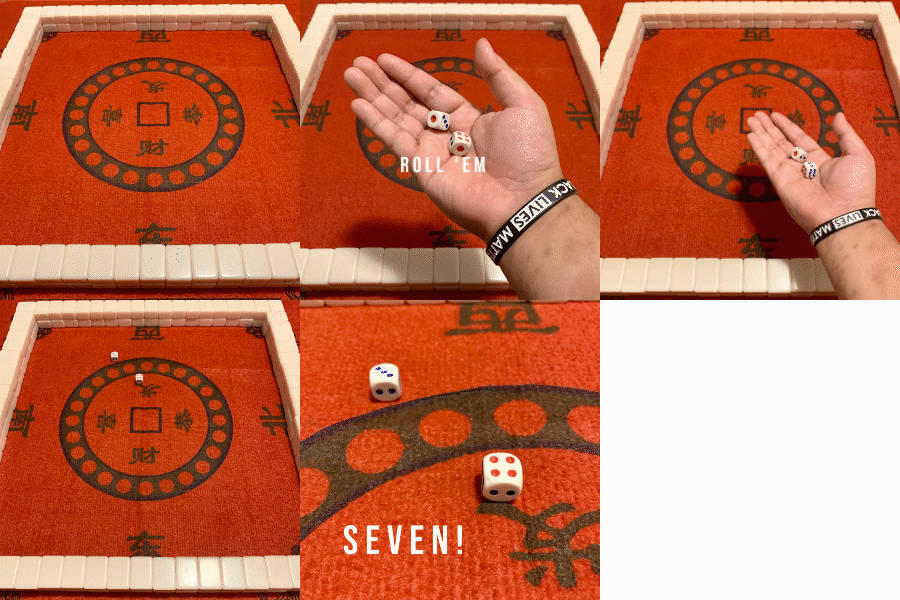
Once the máno has been selected, the máno rolls the dice to determine the starting wall. Let’s say you are the máno and you roll a seven.
Starting with your own wall, count the walls in front of each player, moving counterclockwise around the table: 1, 2, 3, 4, 5, 6, 7. You should now be pointing at the wall of the player to your left. Note: if you roll a multiple of 4, you will land on the wall in front of you. However, it is taboo to deal from your own wall (because experienced mahjongeros are ninjas, notorious for sleight of hand and card counting), so if this happens, proceed to the wall on your right.
The next step is to determine where to break the wall.
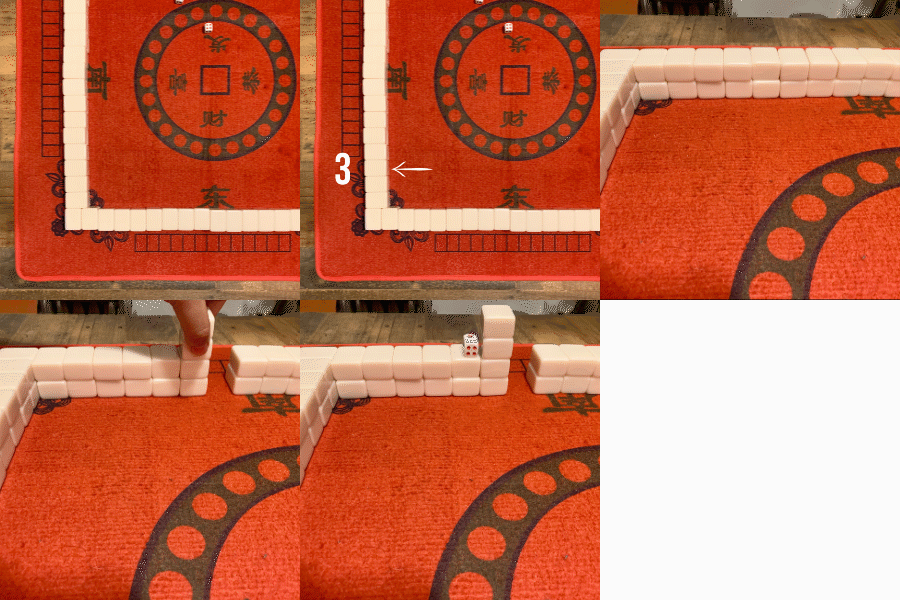
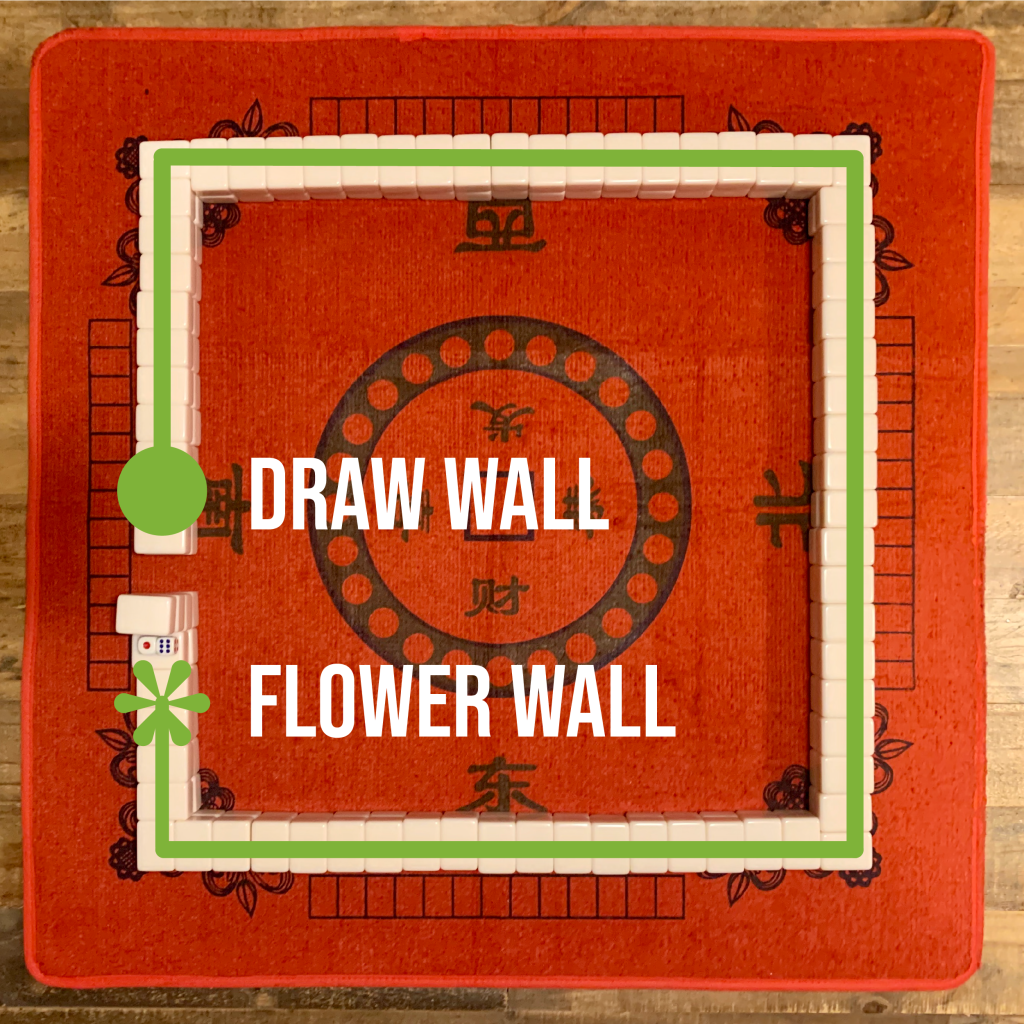
Use the same number from determining the starting wall. Starting on the end of the wall segment closest to you, count out seven tiles: 1, 2, 3, 4, 5, 6, 7. Pick up that seventh tile and the tile underneath it and stack them on top of the sixth tile, marking the start of the flower wall. Place the dice on top of the flower wall for good measure to clearly distinguish it. The tiles immediately after the flower wall (away from you) become the draw wall. If the starting wall is the back wall, start counting from either end, mano’s choice.
The wall is basically like a long deck of cards wrapping around the table in a square. The draw wall is like the top of the deck where the tiles will be dealt from and where the players will draw tiles from during gameplay. The flower wall is like the bottom of the deck, from which players only occasionally draw in order to replace flowers and to take gifts (to be discussed later). The wall must be broken in order to separate the ends of the draw wall and the flower wall.
Dealing the Hand
The next step is dealing the tiles. Starting from the draw wall, deal yourself eight tiles. Whoever is sitting in front of the draw wall should help out with this. Continuing to the right (counterclockwise), deal each player eight tiles in the same manner. Repeat this for one more round until all players have a total of 16 tiles. As the máno, you should grab a 17th tile from the draw wall, because you will be the first to discard.
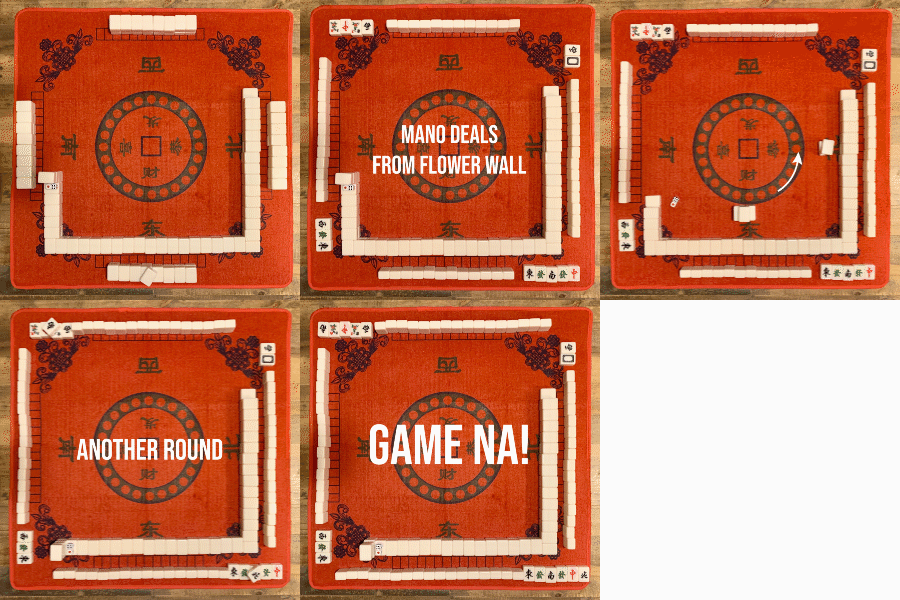
All players can now turn their tiles facing towards them in a row, concealed from other players. The first thing all players should do is to sort out their flowers. Line them up face up so that they are exposed to other players and tell the máno how many replacement tiles you need. Similar to the deal, the máno should deal out replacement tiles from the flower wall to each player in a counterclockwise direction. Repeat another round of flower replacement as needed.
After replacing all flowers, players should make sure they have a total of 16 suited tiles in their hand (the máno should have 17). Players can arrange their tiles to begin forming báhay.
The máno begins gameplay by discarding one of their tiles.
Game Na!
Now that the first tile has been thrown, the game is afoot! By default, the next player is the player to the right (counterclockwise). Every turn goes the same way:
First, you get a tile, either from the draw wall or by seizing a tile that somebody discarded, discussed below.
Then you examine your hand and rearrange your tiles as needed to incorporate your new tile. The goal is to arrange your tiles into one pair (called an eye) and five sets of three (called báhay).
The last thing you do is discard a tile in the center of the table, officially ending your turn. Immediately after a tile is discarded, someone else can take it to form a báhay or to complete their winning hand. If nobody takes the discarded tile, that tile is out of play for the rest of the game and the next player draws from the wall.
Even if it is not your turn yet, this is not a time to sit idle. Although the next person is the player to the right by default, there are certain circumstances that allow somebody to jump ahead to seize a discarded tile. Also, even if you are unable to seize the tile, it is important for you to know what is thrown and what is out of play, so that you are not waiting for it in vain later on.
Getting a Tile
The main way to get a tile is to draw it from the draw wall. If you draw a flower, you must display the flower face up with your other flowers and replace the tile by drawing from the flower wall.
You can also get a tile when somebody discards it if it completes a báhay or a winning hand. The seized tile must be displayed face up with the completed báhay. This open báhay cannot be altered for the rest of the game. The discarded tile must be seized immediately (#yolo), or else the tile becomes dead and will remain in the discarded tile area for the rest of the game.
A pung is a three-of-a-kind.
If you need the discarded tile to complete a pung, you have to say “pung,” grab it, and display the completed pung face up next to your flowers. Pungs are powerful because you can seize it even if it isn’t your turn, and everyone before you will lose their turn.
A kang is a four-of-a-kind.
Kang is like a special type of pung, and can also be grabbed even if it’s not your turn. However, you have to also grab an extra tile called a gift from the flower wall. This is necessary for you to have enough tiles to complete a winning hand.
A chow is a three-tile straight of the same suit.
Unlike pung and kang, you can only chow when it’s your turn. This makes chows harder to get since you can only get it from the person right before you. The only exception to this is if the chow would result in you winning.
Generally you cannot seize a discarded tile to form a pair. The only exception is if you are waiting. Waiting means you only need one more tile to win. You might be waiting to complete a pung, a chow, or an eye in order to win. No matter what you’re waiting for, you can seize it if somebody discards it, anytime. Winning using a discarded tile is called tódas.
Conflict Resolution: What Happens If Two People Want to Seize a Discarded Tile?
Conflicts are resolved by table rules. In general, priority is given based on what the tile is being seized for: pung/kang takes precedence over chow and tódas has precedence over everything. If more than one player needs the discarded tile for tódas, it goes to whoever is closer in turn after the person who discarded the tile.
Others use a strict speed rule, i.e., the first one to call it and/or grab the tile gets to keep it. And some people lose their cool and flip the table, scattering tiles everywhere. They are not invited back to mahjong night.
Arranging Your Tiles
Remember, the goal of mahjong is to have all of your tiles arranged into five báhay and one eye (pair). After getting a tile, you should arrange your tiles and attempt to incorporate your new tile into your hand.
As discussed above, kang is a four-of-a-kind, which may be formed from a discarded tile. Related to kang is a secret. A secret is when you have four-of-a-kind that’s hidden in your own hand, which means that you drew it yourself and did not complete it using a discarded tile. In this case, because it’s concealed, the identity of the tile is valuable information and should not be displayed. But because it is a four-tile báhay, you must declare it and get a gift from the flower wall. Turn the outside tiles facedown to mark it as a secret. Just like with open báhay, your secret tiles will be out of play the rest of the game with no changes permitted.
Another related concept is sagása. Open báhay are generally locked in and cannot be changed. If you created a pung from a discarded tile, and later on, somebody throws the fourth matching tile, you will not be able to kang the discarded tile, because your pung was already open. However, there is a special exception: if it’s your turn and the tile that you draw from the wall happens to be the fourth matching tile, then you can add it to your completed pung. Declare “sagása” and set the matching tile on top of the middle tile of the pung. Since this is now a four-tile báhay, you must draw a gift from the flower wall.
Kangs, secrets, and sagása are “ambitions,” or special groupings of tiles which receive immediate payout from other players. Here are some more special ambitions.
thirteen flowers, any thirteen flowers
no flowers, may be paid if you have no flowers after the tiles are dealt, and again at the end of the game
escaléra, three chows in a full sequence, tiles 1-9
siete pares, seven pairs (and a báhay)
In the Filipino twittersphere, #sietepares or #syetepares are popular hashtags on social media, akin to #blessed. Siete pares is a unique winning hand that replaces the five báhay and one eye with seven eyes and one báhay (chow or pung). If the báhay is a pung, this is an even more special ambition called “international.”
Sometimes you draw a tile that does not really go with any of your existing tiles. This is probably a good candidate for the tile to discard.
Discarding a Tile
The only type of tile that cannot be discarded is a flower, since those must be exchanged from the flower wall. Generally you want to discard tiles that do not go with any of the other tiles in your hand to help you form appropriate báhay. If you can figure out what other players need, you should try to avoid discarding those tiles.
Winning
A player can declare tódas when they have completed five báhay and one eye.
An alternate winning configuration is known as siete pares or international.
A player can declare búnot if their winning tile was drawn directly from the wall. Búnot pays double.
Payouts
Of course, you don’t have to play mahjong for money. Growing up, we certainly never did. But knowing the payout rules gives you a good sense of what separates a good hand from a great hand.
One payout is typically $1. A half payout is 50¢. A quarter payout is 25¢.
INSTANT PAYOUT
Get payout from other players immediately upon declaration of ambition.
Sagása, Secret ½
Kang ¼
Thirteen Flowers ¼
No Flowers ¼
FINAL PAYOUT
Get payout from other players upon declaration of tódas, a win. Final payout is 1 for tódas plus special payouts for ambitions.
Tódas 1
Escaléra +½
Siete Pares +½
Búnot ×2
For a regular tódas where the winning tile was picked up from the discard pile, the discarder has to double the final payout to the winner.
For búnot, all players have to double the final payout to the winner.
Special Rules
Here are some special rules, which are optional to gameplay.
Doubles
At the start of the game, two dice are rolled to break the wall. A roll of doubles means all payouts are doubled.
Jai Alái
Players put a share, typically $1, into the jai alái (pronounced hai-a-lai). At the end of each game, the winner gets one marker, two for búnot. The first player to get five markers wins the jai alai.
Joker
This is a good way to mix up the game and make it go faster. At the start of the game, after all players have their tiles dealt and their flowers declared and replaced, the máno can roll the dice again to determine a joker tile. Say you (the máno) roll a 7. Count seven blocks down the flower wall. Turn over the top tile. (If the tile is a flower, keep turning over the next one until you have a suited tile.) This tile is now the joker and can represent any other suited tile.
Other Ambitions
If you want to up your game, here are some other ambitions that can earn you more payout.
Bisaklát, when the dealer’s opening hand is a winning hand +1
Before the 5th, when you win before the fifth discard +1
All flush, when all the tiles are of the same suit +½
All chow, when all báhay are chow. +¼
All pung, when all báhay are pung (or kang) +¼
All up, when none of your tiles are declared +¼
All down, when all of your tiles are declared +¼
Single, waiting on a single tile to complete your eye +¼
Back to Back, waiting on two pairs to complete a pung +¼
Paníngit, waiting on an incomplete chow with middle tile missing +¼
That last group of ambitions (single, back to back, and paníngit), I hesitate to call ambitions, because they are lower probability waiting scenarios that you generally try to avoid. Perhaps the payout is better thought of as recompense for the undue stress caused by these waiting scenarios.





















 mahjongero