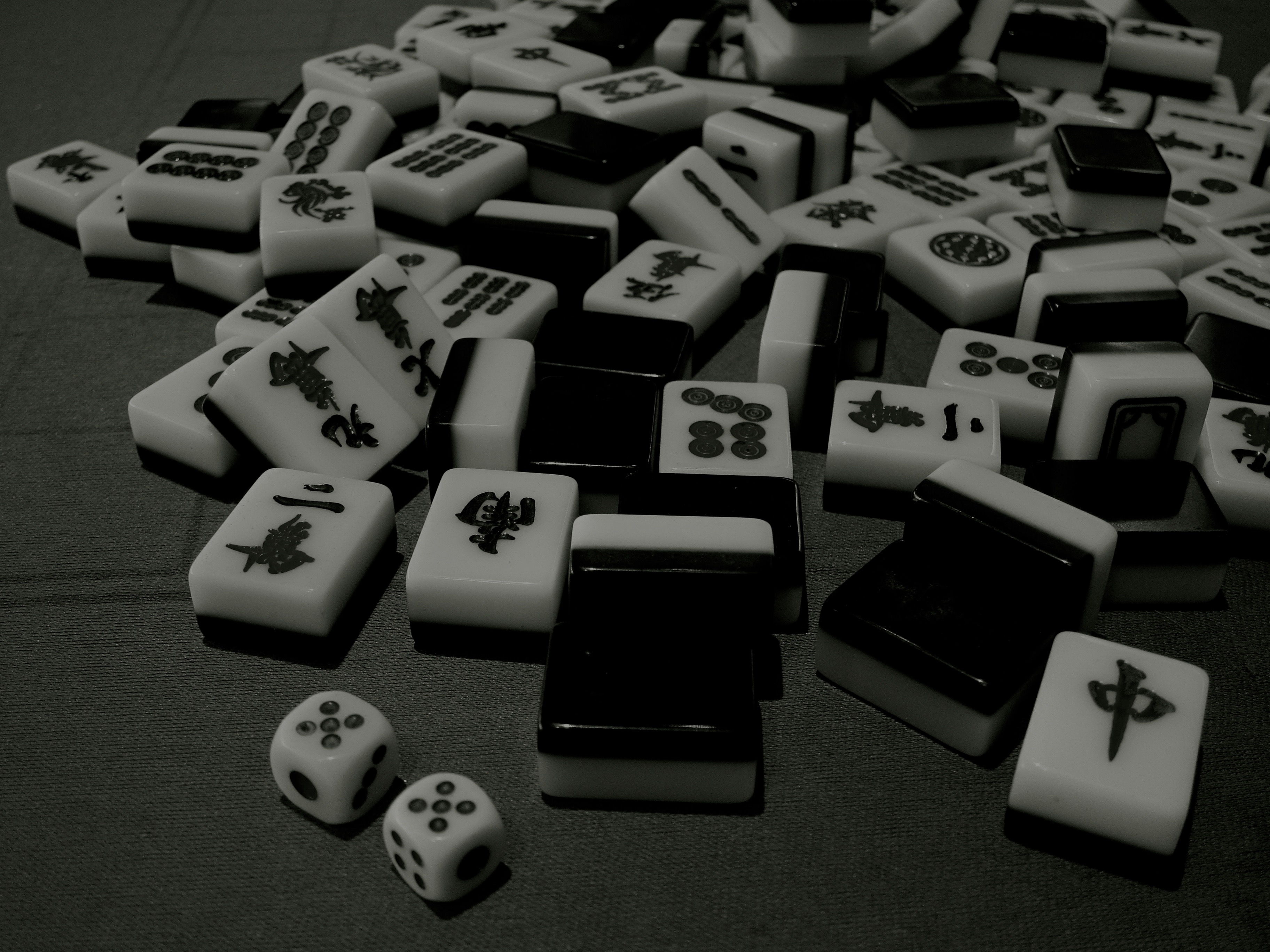
So you’re ready to pull the trigger and buy your very own mahjong set. The majority of sets out there for purchase fall into one of three categories: Chinese, American, or Japanese (Riichi). Filipino mahjong traditionally uses a Chinese set, but because of the simplified gameplay, basically any mahjong set can be adapted for use. The Chinese mahjong set represents the original configuration of the game, and other variants generally just add tiles to the original 144 tiles. To play Filipino mahjong with a non-Chinese set, you can either remove the extra tiles, or just treat them like flowers. Personally, I prefer not to have a bunch of extra tiles, so all of my sets are Chinese. But some of the American and Japanese mahjong sets out there are simply too gorgeous to ignore, so keep an open mind.
Numerals
Another consideration is whether your set has western-style Arabic numerals. If you want to keep it traditional and simply learn the handful of Chinese characters for Filipino mahjong, ain’t no mountain high enough to keep you from learning those Chinese numbers. But if you really need a numbered set, just make sure to examine the photos and product description before making your purchase. American sets always have the western Arabic numerals, and there are plenty of Chinese sets available with western Arabic numerals as well.
Size of the Tiles
Another major consideration is the size of the tiles. Bigger is better for improved visibility and ease of manipulation, but, as with other matters, it also depends on how you use it. Some companies use labels like “small,” “medium,” “large,” etcetera, but these terms are not always consistent, even within the same company, so make sure to look at the actual tile dimensions. Note that Japanese Riichi tiles are generally smaller than Chinese tiles. American tiles are similar in size to Chinese tiles, except they are often thinner because they are used with racks.
I recommend 1.3 inch (height) tiles or larger. In my opinion, 1 inch tiles are a bit difficult to read from table height unless you use racks. Less than 1 inch tiles are more difficult to handle. The set that I grew up playing are standard 1.3 inch tiles, which are easy to manipulate for small and large hands.
My favorite set to play with are “X-large” 1.5 inch tiles. They are satisfying to hold and arrange, and very easy to read. I have gotten some complaints from my siblings that the extra large tiles are too heavy, but they’re complainers who take too long to build their walls even with standard tiles. My wife likes the extra large tiles and she has tiny hands. It’s ultimately a matter of preference.
Larger tiles can also present a problem depending on the size of the table that you plan on using. The chart below sets out some popular tile sizes and the wall size you can expect based on a square wall with sides 18 tiles across. Your table should be another 7 or 8 inches wider to leave space in front of each player. Note that the wall size varies primarily as a function of the width of the tiles.
| Common Labels | Height | Width | Depth | Wall Size* | Min Table Size* |
| “Mini” or “Travel” | 0.8” 20 mm | 0.5” 14 mm | 0.4” 11 mm | 11.5” x 11.5” | 18” x 18” |
| “Standard Riichi” | 1” 26 mm | 0.8” 20 mm | 0.6” 16 mm | 16.2” x 16.2” | 24” x 24” |
| ”Standard American” | 1.2” 30 mm | 0.9” 22 mm | 0.5” 13 mm | 18.6” x 18.6” | 26” x 26” |
| “Large Riichi” | 1.2” 30 mm | 0.9” 22 mm | 0.7” 17 mm | 18.6” x 18.6” | 26” x 26” |
| “Medium,” “Standard,” or “Large” | 1.3” 33 mm | 1.1” 27 mm | 0.8” 20 mm | 22.4” x 22.4” | 30” x 30” |
| My folks’ set | 1.35” 34.3 mm | 1.05” 26.9mm | 0.73” 18.5 mm | 20.5”x 20.5” | 28” x 28” |
| ”X-Large” | 1.5” 37 mm | 1.1” 28 mm | 0.9” 22 mm | 24.8” x 24.8” | 32” x 32” |
| ”Champion” | 1.6” 40 mm | 1.1” 29 mm | 0.8” 20 mm | 23.7” x 23.7” | 31” x 31” |
*Calculations are approximate.
Accessories
As for accessories, Filipino mahjong does not require much. Two dice are needed for breaking the wall, and chips or point markers may be used if playing for money. You won’t need a wind indicator or betting sticks for Filipino mahjong. Racks are not necessary unless your set comes with smaller tiles (more common in travel sets or thinner American mahjong tiles). Most sets do not come with a cloth, so you can either buy a specialized mahjong table mat, or just go to a fabric store and get a piece of felt. 36 inches by 36 inches square is sufficient for any size set.
Value
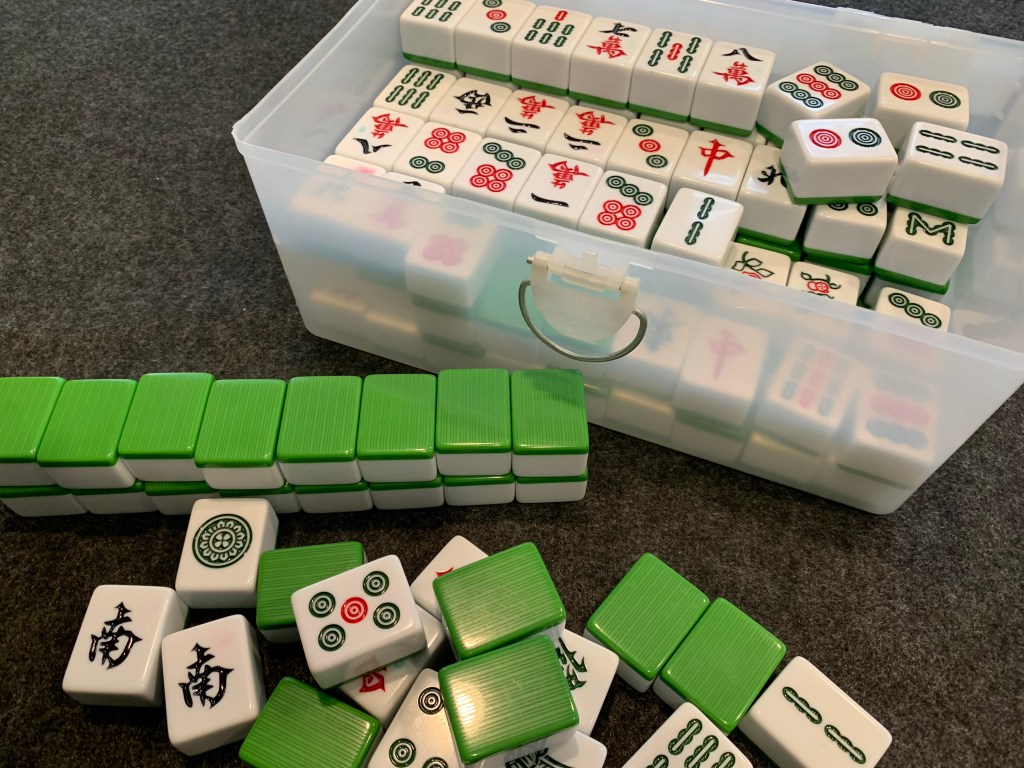
The final consideration, of course, is price point. I have never spent more than $100 on a mahjong set, although I have definitely salivated over some of the more expensive sets. My favorite set, with extra large tiles, was around $50 from a strangely named eBay store called “wepayyoursalestax” [sic]. As mentioned above, I love the size, feel, and visibility of the tiles. But the case is pretty bad (it’s shaped like a plastic toolbox with a flimsy handle and the tiles are fairly loose without trays so they click around). I see similar extra large sets on Amazon and eBay with better cases for around $60.
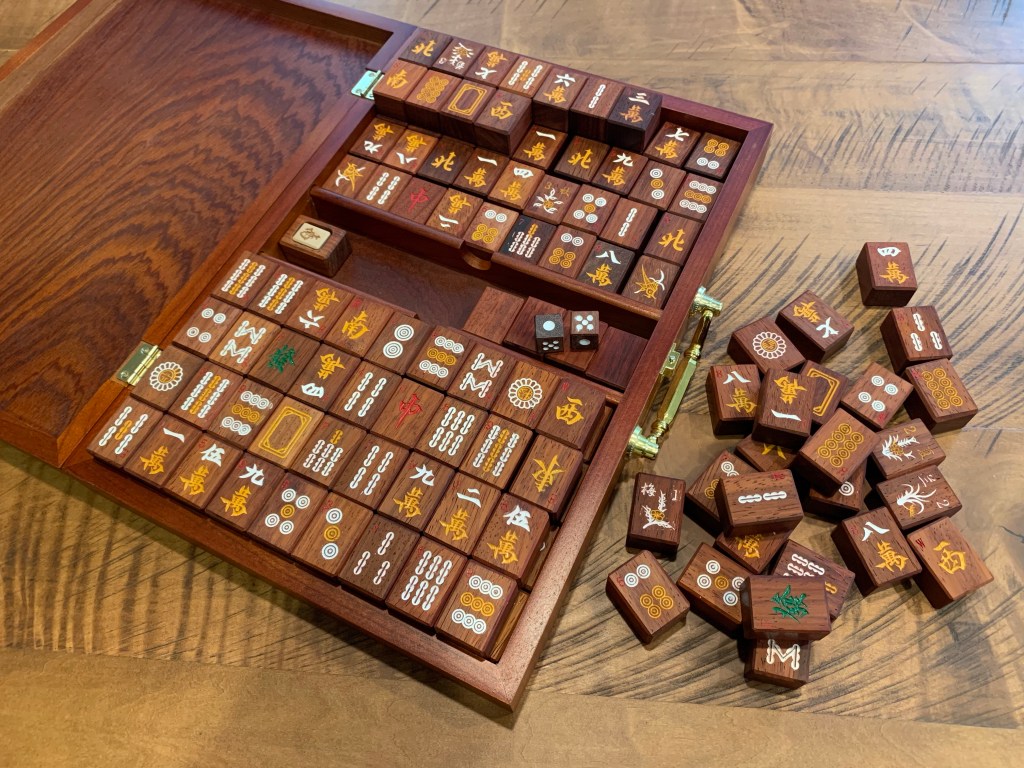
My most expensive set is a rosewood set from the same eBay store with beautiful rosewood tiles and a nice wood case that set me back around $95. It’s gorgeous and lightweight, and it smells and feels like playing with Lincoln Logs, like in elementary school. It doesn’t have quite the same satisfying clack as regular acrylic tiles. I play with it about ⅓ of the time just cuz it’s so pretty, and it’s light enough to travel.
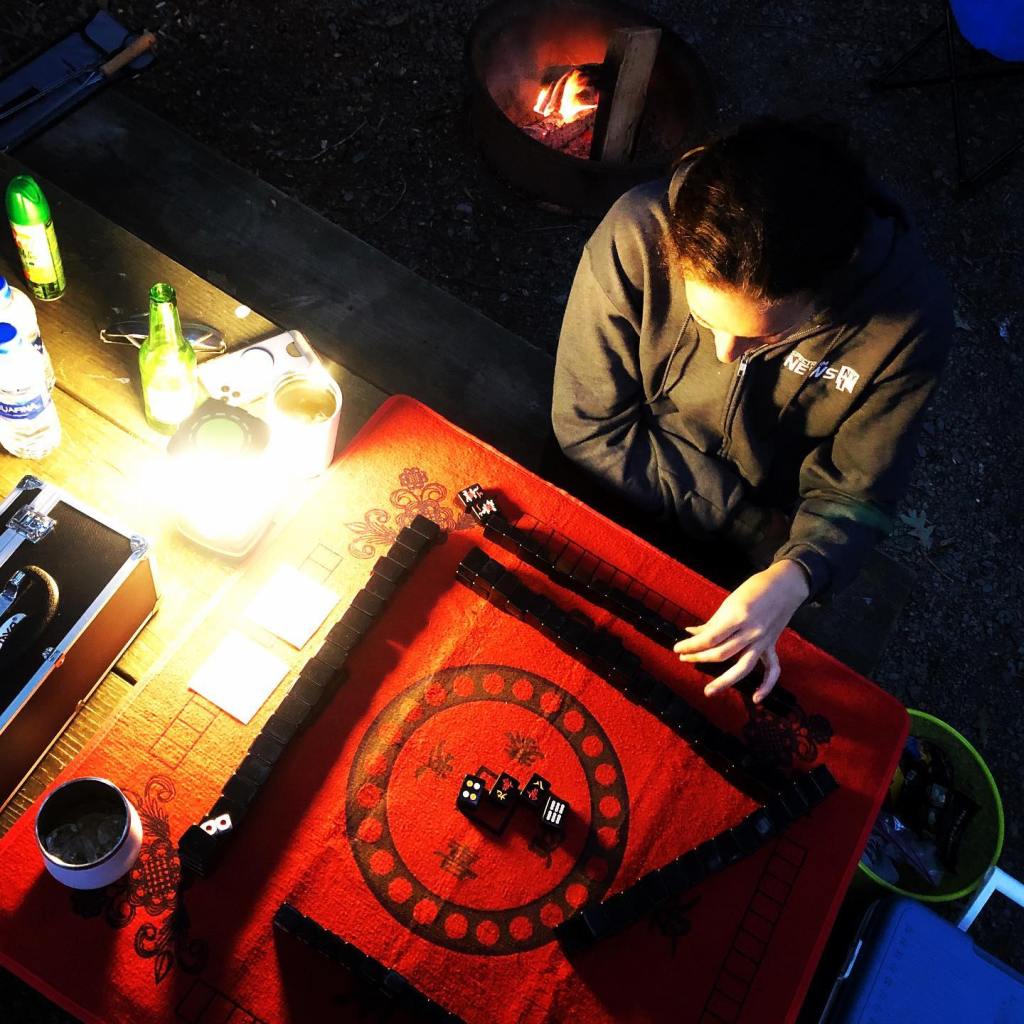
My second most expensive set is a jet black set with “medium” 1.2-inch tiles from Yellow Mountain Imports. I don’t remember how much i spent on it, but the large/standard 1.3-inch tiles seem to be going for around $93. The black acrylic tiles and the matte black wood case with maroon velvet lining are truly stunning and feel great. My only complaint with this set was that the 1.2-inch tiles felt a little too small.
The set I grew up playing with is unbranded. The only marking on the case is a short dedication from my godmother who apparently gave it to my parents as a wedding gift over three decades ago. It has 1.3 inch tiles, a great zip up case, two dice, and pink point markers, and has gone between houses, on camping trips, to breweries, and back to my folks’ living room. The mossy brown felt table cloth has been washed a handful of times to get out the dog hair (don’t ask me how the hair got from our floor-hugging dachshund/chihuahua mix all the way up to the table—I have no idea). One of the east wind tiles has a small chip on it that my brother always manages to track down like a truffle pig. But we’ve still never gotten around to using one of the four blanks to replace it. Similar sets seem to go for around $60.
Good luck with your purchase! May it bring you many years of fun and good luck.
 mahjongero
Can you post pictures of the sets you described? The black set sounds unique
LikeLike
Done!
LikeLike