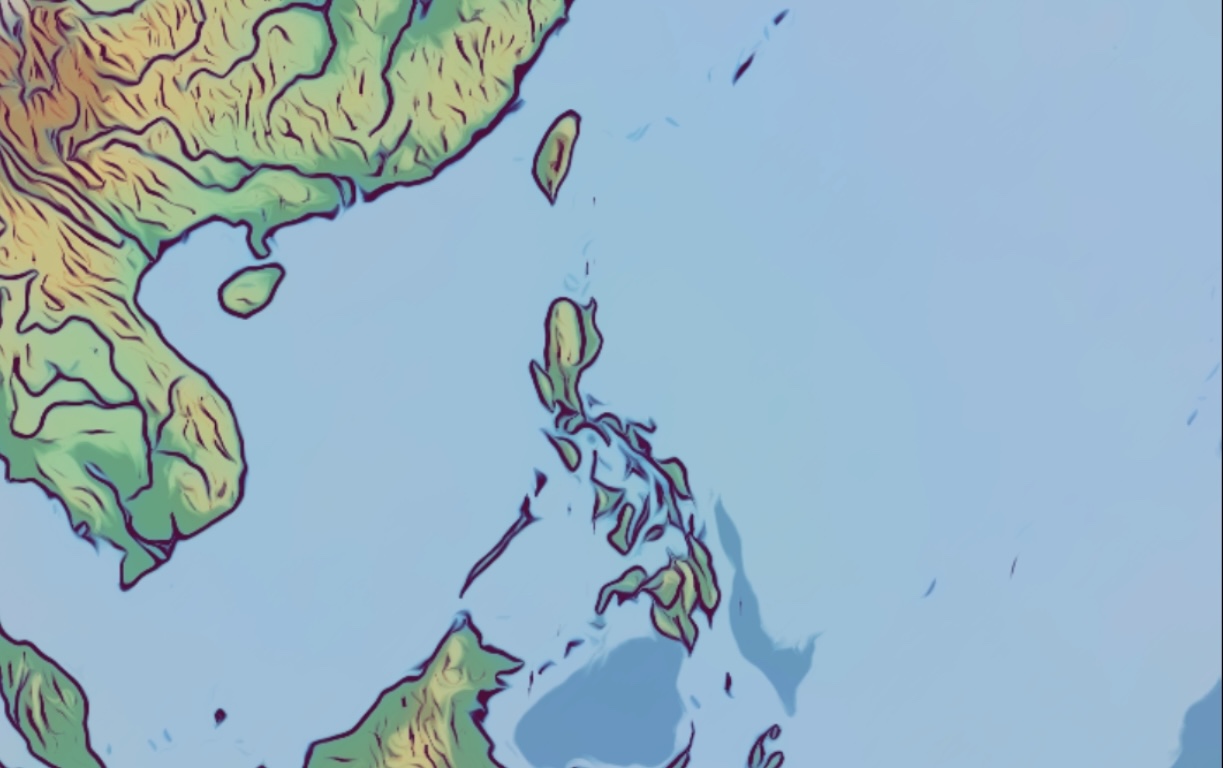
Taiwan has a special relationship with the Philippines, for a lot of reasons. Geographically, it’s very close, separated from the Philippines by the Luzon Strait. Linguistically, the island of Taiwan is the homeland of the Austronesian language family, which includes languages of the Philippines as well as Indonesia, Malaysia, Madagascar, and various Pacific islands. Taiwan and the Philippines share political ties as well, with longstanding relations with the U.S., and fraught relations with neighboring China.
Add to that list, mahjong!
The most significant commonality between Taiwanese mahjong and Filipino mahjong is the number of tiles in each player’s hand. In most styles of mahjong including Chinese, Japanese Riichi, and Singaporean mahjong, each player has 13 tiles in their hand, and requires 14 to win. A winning hand typically consists of four sets of three tiles (what we call “báhay” in Filipino mahjong), and one pair. On the other hand (pun intended), Taiwanese mahjong and Filipino mahjong are unique as the only styles that have 16-tile hands, adding another báhay. Both styles also permit an irregular winning hand consisting of seven pairs and one báhay.
This is notable because it means that it can take longer to form a winning hand, since you have to form five báhay instead of four. It also means that there are fewer tiles left in the draw wall, affecting how you calculate the odds of drawing a specific tile. As a result, Filipino and Taiwanese mahjong games require greater emphasis on reading other players, since a higher share of the tiles are in their hands.
Taiwanese mahjong and Filipino mahjong also have similar rules for resolving multiple claims to seizing a discarded tile, giving precedence to a winning claim, and then pung, and then chow.
There are some differences of course. Taiwanese mahjong preserves the Chinese rules for designating seats as different wind directions to determine who goes first and how tiles are dealt. In Filipino mahjong, seating is arbitrary, and the dealing of tiles is determined by rolls of the dice.
Another difference is that Taiwanese mahjong uses the wind and dragon tiles, while Filipino mahjong generally treats these tiles as flowers. However, as will be discussed in a future post, there are some variants of Filipino mahjong, including Bisaya mahjong and Philippine Hokkien mahjong, which use the wind and dragon tiles similar to Taiwanese mahjong.
Overall, the similarities are greater than the differences, and the differences are what make life exciting, between Filipino mahjong and Taiwanese mahjong, and traditional Chinese mahjong, for that matter.
Sources:


I had no idea our mahjong is like Taiwanese. I have to ask my Taiwanese friend to play now
LikeLiked by 1 person