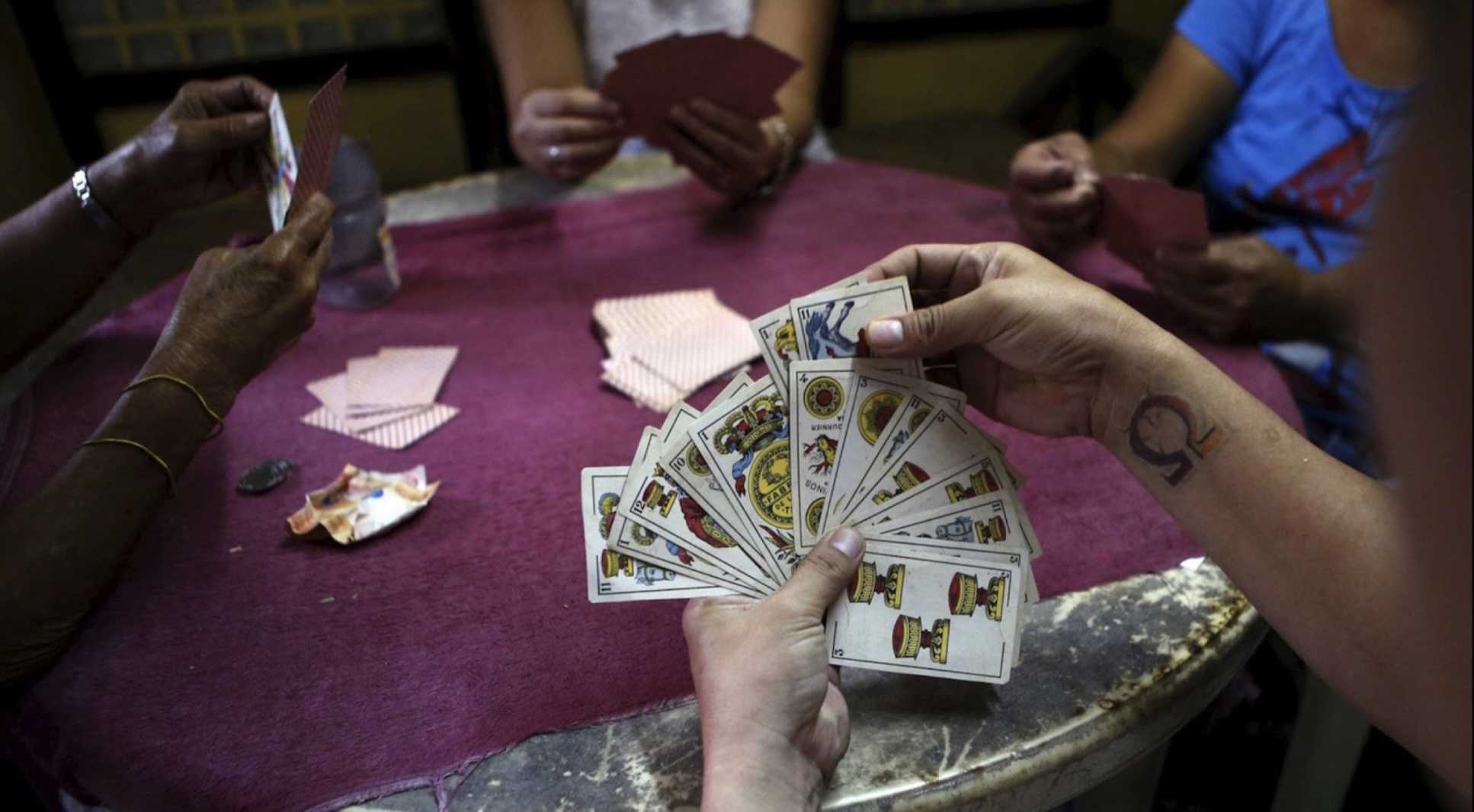
Cuajo is a rummy-style card game played in the Philippines with some similarities to mahjong, but some distinct features owing to its unique card deck. Also spelled kwaho, the game is especially popular in Pampanga and surrounding areas where my mom is from. But my family and I only recently started playing cuajo, which has been a refreshing change of pace from mahjong.

Credit: Erik de Castro/Reuters
Despite its Spanish orthography, cuajo is related to Chinese games like mahjong, with some conjecturing an etymological connection with another old Chinese rummy game called kanhu. Half a millennium ago, in the 1500s, the Spanish imposed a state monopoly on the manufacture and sale of playing cards resulting in a ban on all foreign playing cards in the Philippines, including Chinese chess, domino, and mahjong cards. This prompted two trends, the first being a shift to using tiles in the case of mahjong and dominoes, because tiles were not covered by the state monopoly. The second was an adaptation of games to use Spanish cards, including the precursor to cuajo, which originally used Chinese four color chess cards (sì sè pái 四色牌).
Cuajo continues to be played primarily with Spanish-suited cards, but it can also be played with the French-suited cards most people are familiar with.
Super cheap Spanish decks are available on Amazon or Ebay, where I managed to haggle down to $18 for a dozen decks. But, I’d recommend going with Fournier, a good quality brand manufactured in Vitoria, Spain, which is similar in popularity to the Bicycle cards we use in the U.S. They’re better quality cards that will last, and you can find them for $6 a pack. Fournier was founded in 1870, a few decades before Philippine independence from Spain. Historically, Fournier offered a special 112-card cuajo deck called Cuajo Filipino, which is still sold in the Philippines, but hard to find elsewhere.


The 48-card Filipino Spanish deck is composed of four suits: Oros (Coins), Kopas (Cups), Espadas (Swords), and Bastos (Clubs). There are only twelve ranks in contrast to the thirteen ranks of the French deck. The face cards, which are the Sota (Jack), Kabayo (Knight or Horse), and Hari (King), correspond with 10, 11, and 12 instead of 11 to 13 in the French deck. A 40-card deck missing the 8s and 9s is popular in Latin America for similar rummy games like Chinchón.

Take note that the Spanish deck has a Kabayo instead of the Queen of the French deck. Also, Alas (Ace) is simply denoted as a 1.

For the Spanish deck, Filipinos tend to say the rank and the suit, as in 5 Kopas, rather than 5 of Kopas. Also, though the Alas, Sota, Kabayo, and Hari are regularly referenced when referring to a group, individual cards are often called by their rank. For example Alas of Oros can be called 1 Oro.
The cuajo deck only makes use of the Alas, 3, 4, 5, Sota, Kabayo, and Hari of each suit. There are four copies of each card, for a total of 112 cards. You can make your own cuajo deck with four standard Spanish decks. Simply remove the deuces and ranks 6 through 9. If you are using 52-card French decks, you will have to also remove the 10s and substitute the Queen for the Kabayo.

The objective of the game is to be the first to arrange all 16 cards in your final hand into distinct bahay.
There are four types of bahay recognized in cuajo:
A Trio or Quadro consists of three or four cards of the same rank, but different suits. Take note that this is not the same as a pung or kang in mahjong, which would require identical suits.

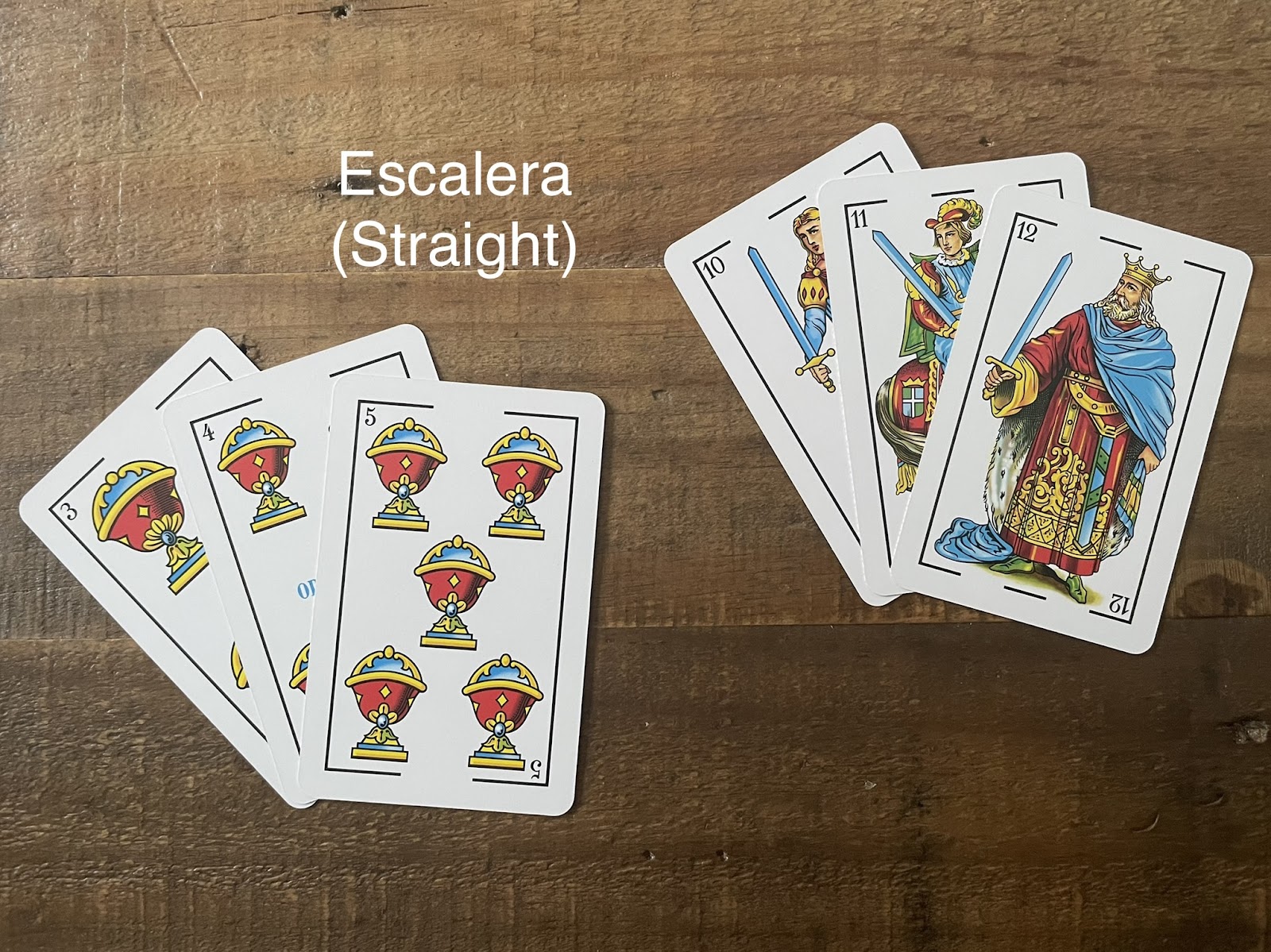
An Escalera (or Straight) is a sequence of three consecutive cards that must be of the same suit (akin to a chow in mahjong). The only escaleras possible in cuajo are 3-4-5 and Sota-Kabayo-Hari.
A Secreto is a set of four identical cards (akin to a secret or concealed kang in mahjong).

A Hari is a bahay unto itself. It does not need to be melded as a part of other bahay, but it can. Haris cannot be discarded, though it’s rare the situation where you would want to anyway.

Setup
Cuajo is played in teams, where players opposite each other are partners and share their winnings at the end of the game. For the first match, the mano (dealer) can be chosen at random. For subsequent matches, the winner of the previous match is mano.
The mano shuffles the deck and offers a cut to the player to their left. Like mahjong, deal and gameplay is to the right (counterclockwise).
The mano should deal 5 cards to each player, then 6 cards to themself. Continue dealing 2 more rounds of 5 cards each until each player has 15 cards (16 for the mano).
The remainder of the deck is placed in the middle of the table to form the stock.
The next card is dealt face up and placed under the stock at a right angle. This is called the sowee, which will be explained later.

Gameplay
Dealer discards one of their cards to begin the game. The next player can either pick up the discard, or draw from the stock. Unlike in mahjong, the next player can always pick up the discard, even if it does not complete a bahay. The discard is treated no different from a card drawn from the stock.

If it is your turn and you have a secret, you can declare it by placing all four cards face down on the table in front of you. You receive an immediate payment of 50¢ from each of the opposing players.
You can also declare a secret using the sowee, if you have the three other copies of it. Lay the three matching cards face down along with any fourth card to avoid revealing the identity of the secret. The fourth card must be eventually used as a part of its own bahay for your hand. For that reason, it’s a good idea to use a hari as the fourth card, which is of course a bahay unto itself.

Purro
When you reach a waiting position where you only need one card to win, you should declare purro. Place a hari on the table in front of you to indicate purro. If you don’t have a hari, you can use one of your chips. (Lacking a hari should be of particular alarm to your opponents, since winning without any haris in your hand can earn you a greater payout, as you’ll see later.) From this point on, the game continues with players drawing from the stock face up to give the waiting player a chance to intercept it. The waiting player does not need to draw faceup, unless there is another player waiting as well, in which case all players will draw from the stock face up.

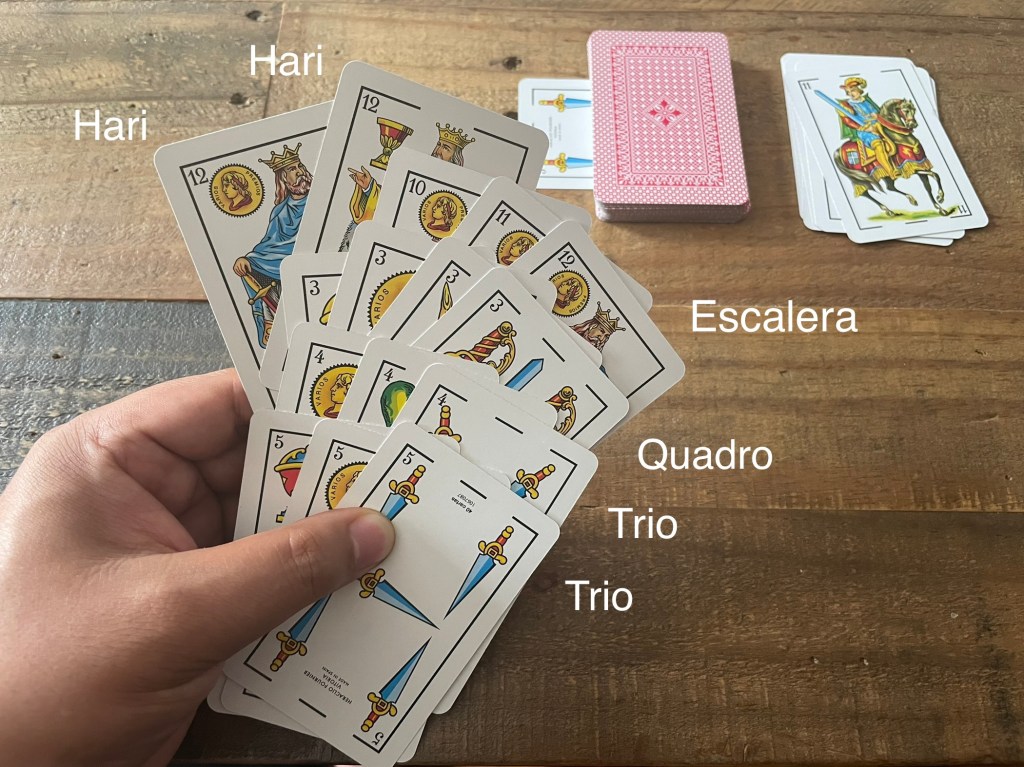
In the above example of purro, the player’s 15 cards are in already complete bahays. The final card they are waiting for could be a 5 Bastos for a quadro of 5s, a 4 Kopas for a quadro of 4s, or it could be a hari of any suit.
A waiting player that has declared purro can complete their hand and win in three ways:
- Drawing the winning card from the stock themself during their turn.
- Picking up the discarded card from the player on their left during their turn.
- Calling time and intercepting the card another player has drawn directly from the stock.

The above card was drawn from the stock and revealed to the player in purro. The waiting player may take the card if it completes their hand.
A waiting player cannot pick up discarded cards out of turn. This is distinctly different from mahjong, where a winning tile can be seized from a discard at any time.
If a card is drawn that completes more than one waiting player’s hand, the drawer, or the one closest to the drawer in turn takes precedence.
Losing Purro
It is possible to lose purro if you draw a hari (which may not be discarded), and are thereby forced to discard another card and potentially break up your waiting position. Declare you have lost purro. If nobody else is in purro, then players no longer have to draw from the stock face up.
As a penalty for losing purro, you must draw from the stock face up for two rounds. This is not an opportunity for others to intercept your draw—the punishment is that everyone can see the next two cards you draw. You may not declare purro or win during these two rounds. You resume normal play in the third round.
Winning and Payout
The winner must show their complete hand including any secrets. Any other players paid for secrets must also reveal their secret cards. Payout is only made by the two opposing players, not the partner. The bunot is defined as the last card drawn for the win. This should not be confused with the Filipino mahjong term, which is related in concept, but different.
The ideal win is where the bunot is self-drawn from the stock, which wins the full $1.10 (this happens to coincide with the mahjong concept of bunot).
Even if the bunot is not self-drawn, it is still possible to earn part or even the full bunot payment of $1.10 by meeting particular conditions. This is where the bunot and the sowee come into play. The concept of to go with is key to understanding this. Cards are said to go with another card when they form a straight. Since Aces cannot form a straight, the cards that go with an Ace are those that form a trio.
Note that these potential bahays may be a part of your winning hand, but that is not a requirement.
Having two cards that go with the bunot earns you 60¢. Similarly, having the sowee and two cards that go with the sowee earns you 70¢. If you do not have either of these conditions, you get a basic win payout of 20¢.

In the above example, a 4 Kopas is discarded by the player to your left, and it is your turn. You may pick up the 4 Kopas as your bunot (final card) to complete a quartet of 4s and win the game. You have two cards that go with your bunot: 3 and 5 Kopas. You also have the sowee (5 Espadas) and two cards that go with the sowee (3 and 4 Espadas).
Haris have special importance in cuajo. You are awarded 50¢ for any Haring Oros in your hand, and 20¢ for any other hari.
Porbis is a very special win consisting of no haris, or only one hari used in a Sota-Kabayo-Hari straight. Because haris are not allowed to be discarded, this is a rare occurrence and is awarded $3 from each opponent.
 mahjongero
Good clear layout of the rules. If I could ask there is one think I’m unsure of, would the single Hari in a porbis still be paid for?
LikeLike
Thanks Stan, yes, since Porbis permits maximum one Hari as a part of a straight, you could get extra payment from that single Hari. In general, ambitions can be racked up, i.e. you don’t have to pick one over the other.
LikeLike
Thank you for the swift reply! Can’t wait to check out more posts
LikeLike