Pusoy Dos is probably the most popular card game among Filipinos. It is known by many names including chikicha and sikitcha. Another tongue-in-cheek name for the game is Filipino poker, though the game is really a shedding game that borrows poker hands.
A familiarity with poker hands really helps with pusoy dos. You will need the standard 52-card, French-suited deck for this game.
RANK AND SUIT ORDER
Pusoy dos has an unusual rank order with deuces (2s) high. Therefore the ranks run from 3 being the lowest, 4, 5, 6, 7, 8, 9, 10, Jack, Queen, King, Ace, and finally Deuce as the highest. The importance of the Deuce is captured in the name, where dos means two in Spanish.
Furthermore, pusoy dos also has an order to the suits. From lowest to highest, the suit order is clubs ♣, spades ♠, hearts ♥ and diamonds ♦.
Take note that suits are only considered for comparing cards of equal rank, i.e., a card with a higher rank will always be higher, regardless of the suit.
Taken together, the 3♣ is the lowest card in the deck and the 2♦ is the highest.
BAHAYS
There are four categories of bahays in pusoy dos: one-card, two-card, three-card, and five card bahays. Note that unlike poker, there is no two pair bahay.
Single
A single is a single card, with 3♣ being the lowest card and the 2♦ being the highest.
Pair
A pair consists of two cards with matching ranks. A higher ranked pair will beat out a lower. And in the case of matching ranks, the pair with the diamonds will beat out the other pair. For example, a pair of fours with the 4♣ and 4♦ will beat another pair of fours with the 4♠ and 4♥.
Three-of-a-Kind
A three-of–kind consists of three cards with matching ranks. Similarly, a higher ranked three-of-a-kind beats out a lower.
Five-Card Bahays
The five-card bahays correspond to poker hands, with the same hierarchy. Pair and three-of-a-kind may not be used as five-card bahays.
Straight
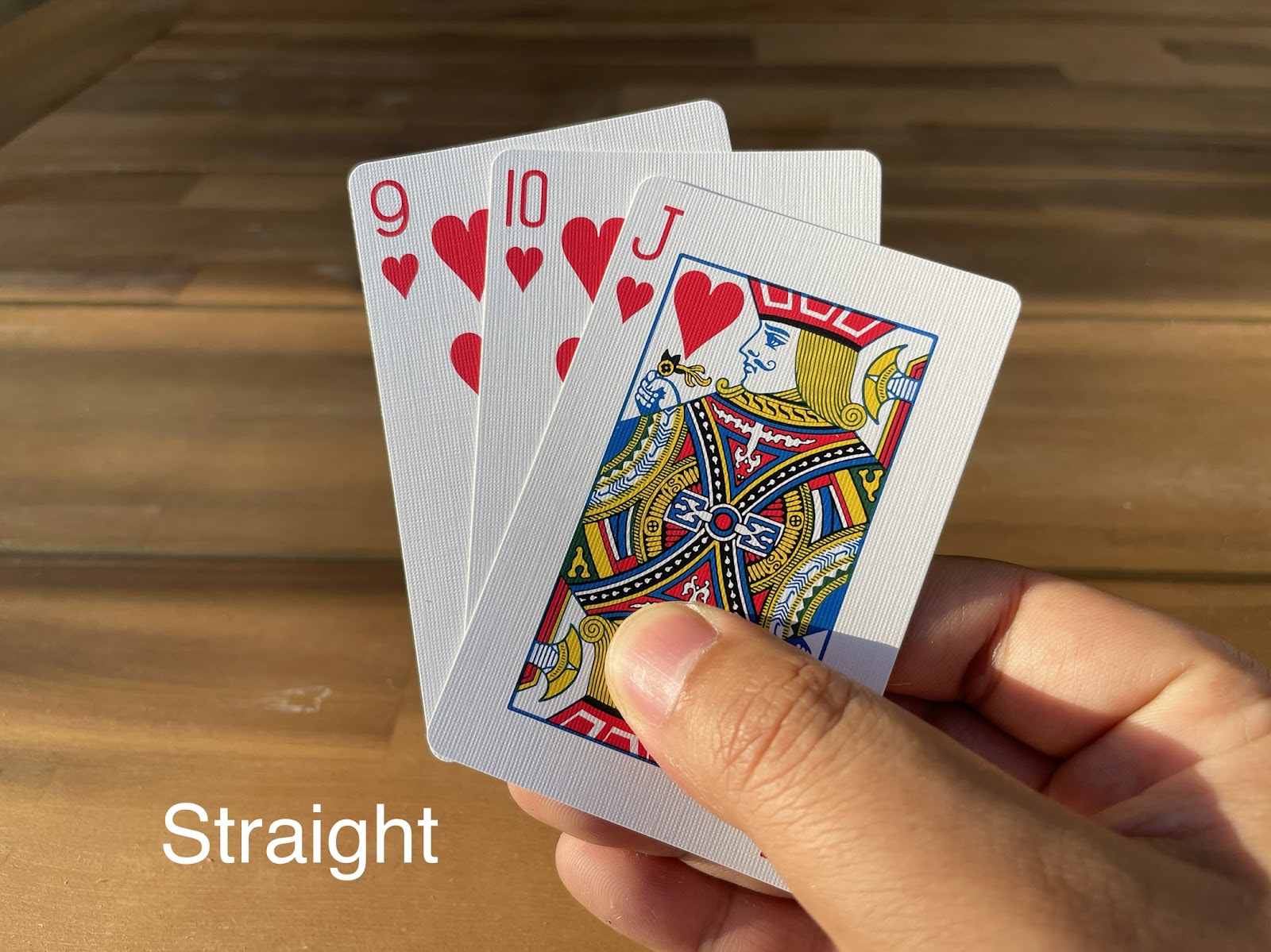
A straight is a five-card sequence. Straights are compared with each other based on their high cards. Remember that deuces are high, so J, Q, K, A, 2 is a valid straight, but 2, 3, 4, 5, 6 is not.
Flush
A flush is a five-card bahay of the same suit. Compare high cards to determine who beats whom between two flushes.
Full House
A full house is a five-card bahay consisting of a pair and a three-of-a-kind. Full houses are compared with each other based on the rank of the three-of-a-kind.
Four-of-a-kind
A four-of-a-kind is a five-card bahay consisting of four cards of the same rank along with a kicker, which can be any card the player wants to discard (strategically, it should be their lowest ranked, unmelded card).
Straight Flush
A straight flush is a five-card sequence of the same suit. Compare high cards to determine who beats who between straight flushes.
SETUP
The mano is determined randomly. The deal and gameplay are in a counterclockwise direction.
The mano deals 13 cards to each player. In games with two or three players, you can deal 17 cards per player. The rest of the deck is set aside and will not be needed for the rest of the game.
Players should organize their hands into bahays, and their singles should be organized by rank and suit.
GAMEPLAY
The player with the 3♣ makes the opening play by laying down a valid bahay using the 3♣ in the middle of the table, establishing the discard pile. The next player must lay down a higher bahay with the same number of cards, and gameplay continues to the right.
When a player cannot play a higher bahay, they must pass. If everyone has passed and the turn has returned to the player who laid down the last card, then the game resets and that player may now lay down a bahay of any number. As before, the next player must play a higher bahay of the same number of cards.
For example, you cannot play a three-of-a-kind to beat out a pair.
But if the player before you puts down a straight, you can play any 5-card bahay as long as it beats their straight.
The game ends when a player has laid down their final card to win the game. You can also keep playing until only one player has cards left.
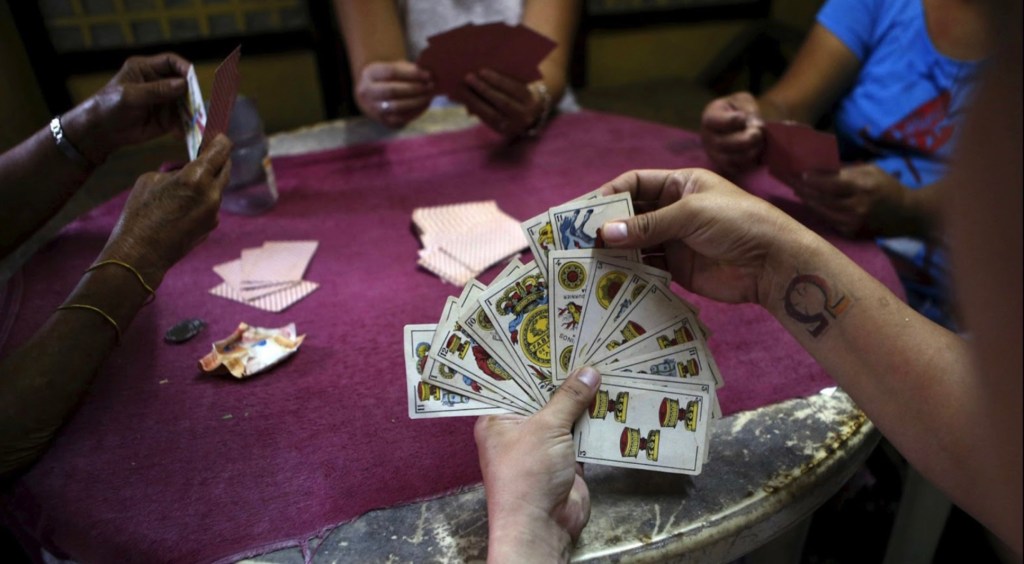
Cuajo is a rummy-style card game played in the Philippines with some similarities to mahjong, but some distinct features owing to its unique card deck. Also spelled kwaho, the game is especially popular in Pampanga and surrounding areas where my mom is from. But my family and I only recently started playing cuajo, which has been a refreshing change of pace from mahjong.
Credit: Erik de Castro/Reuters
Despite its Spanish orthography, cuajo is related to Chinese games like mahjong, with some conjecturing an etymological connection with another old Chinese rummy game called kanhu. Half a millennium ago, in the 1500s, the Spanish imposed a state monopoly on the manufacture and sale of playing cards resulting in a ban on all foreign playing cards in the Philippines, including Chinese chess, domino, and mahjong cards. This prompted two trends, the first being a shift to using tiles in the case of mahjong and dominoes, because tiles were not covered by the state monopoly. The second was an adaptation of games to use Spanish cards, including the precursor to cuajo, which originally used Chinese four color chess cards (sì sè pái 四色牌).
Cuajo continues to be played primarily with Spanish-suited cards, but it can also be played with the French-suited cards most people are familiar with.
Super cheap Spanish decks are available on Amazon or Ebay, where I managed to haggle down to $18 for a dozen decks. But, I’d recommend going with Fournier, a good quality brand manufactured in Vitoria, Spain, which is similar in popularity to the Bicycle cards we use in the U.S. They’re better quality cards that will last, and you can find them for $6 a pack. Fournier was founded in 1870, a few decades before Philippine independence from Spain. Historically, Fournier offered a special 112-card cuajo deck called Cuajo Filipino, which is still sold in the Philippines, but hard to find elsewhere.
The 48-card Filipino Spanish deck is composed of four suits: Oros (Coins), Kopas (Cups), Espadas (Swords), and Bastos (Clubs). There are only twelve ranks in contrast to the thirteen ranks of the French deck. The face cards, which are the Sota (Jack), Kabayo (Knight or Horse), and Hari (King), correspond with 10, 11, and 12 instead of 11 to 13 in the French deck. A 40-card deck missing the 8s and 9s is popular in Latin America for similar rummy games like Chinchón.
Take note that the Spanish deck has a Kabayo instead of the Queen of the French deck. Also, Alas (Ace) is simply denoted as a 1.
For the Spanish deck, Filipinos tend to say the rank and the suit, as in 5 Kopas, rather than 5 of Kopas. Also, though the Alas, Sota, Kabayo, and Hari are regularly referenced when referring to a group, individual cards are often called by their rank. For example Alas of Oros can be called 1 Oro.
The cuajo deck only makes use of the Alas, 3, 4, 5, Sota, Kabayo, and Hari of each suit. There are four copies of each card, for a total of 112 cards. You can make your own cuajo deck with four standard Spanish decks. Simply remove the deuces and ranks 6 through 9. If you are using 52-card French decks, you will have to also remove the 10s and substitute the Queen for the Kabayo.
The objective of the game is to be the first to arrange all 16 cards in your final hand into distinct bahay.
There are four types of bahay recognized in cuajo:
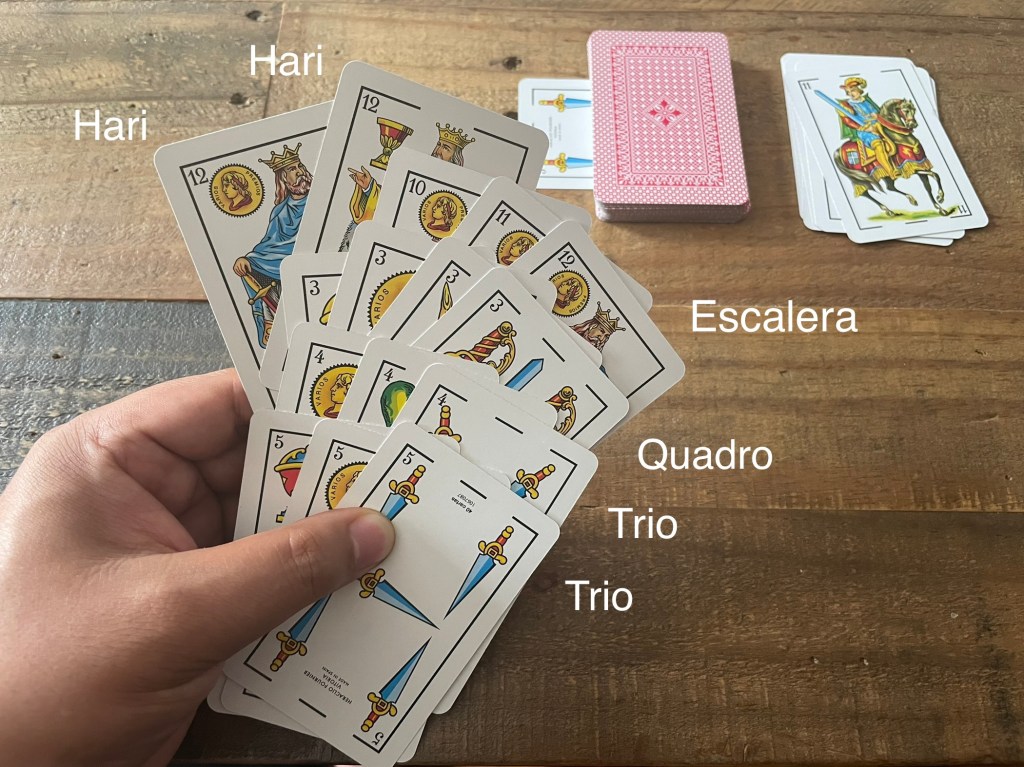
A Trio or Quadro consists of three or four cards of the same rank, but different suits. Take note that this is not the same as a pung or kang in mahjong, which would require identical suits.
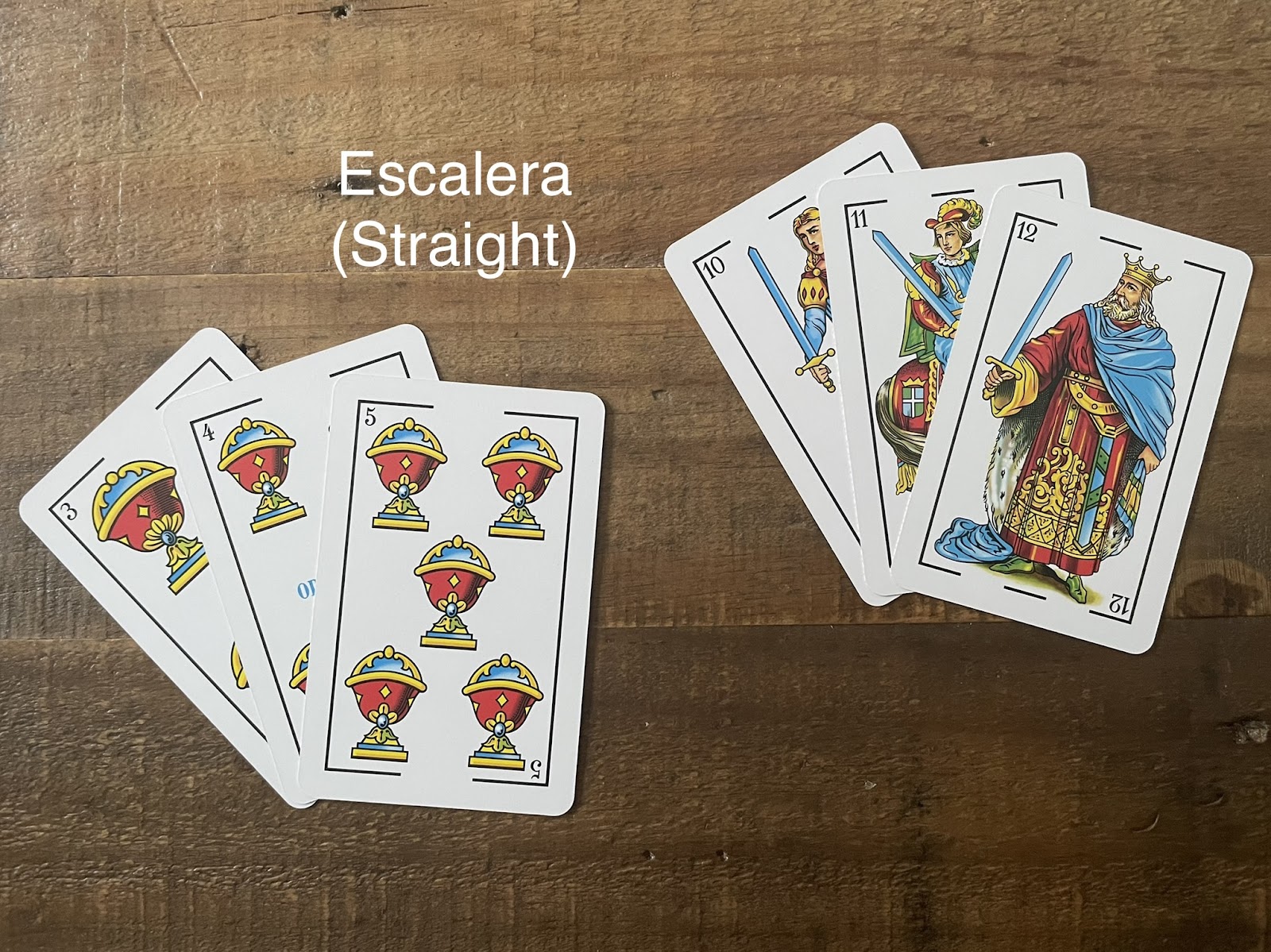
An Escalera (or Straight)is a sequence of three consecutive cards that must be of the same suit (akin to a chow in mahjong). The only escaleras possible in cuajo are 3-4-5 and Sota-Kabayo-Hari.
A Secreto is a set of four identical cards (akin to a secret or concealed kang in mahjong).
A Hari is a bahay unto itself. It does not need to be melded as a part of other bahay, but it can. Haris cannot be discarded, though it’s rare the situation where you would want to anyway.
Setup
Cuajo is played in teams, where players opposite each other are partners and share their winnings at the end of the game. For the first match, the mano (dealer) can be chosen at random. For subsequent matches, the winner of the previous match is mano.
The mano shuffles the deck and offers a cut to the player to their left. Like mahjong, deal and gameplay is to the right (counterclockwise).
The mano should deal 5 cards to each player, then 6 cards to themself. Continue dealing 2 more rounds of 5 cards each until each player has 15 cards (16 for the mano).
The remainder of the deck is placed in the middle of the table to form the stock.
The next card is dealt face up and placed under the stock at a right angle. This is called the sowee, which will be explained later.
Gameplay
Dealer discards one of their cards to begin the game. The next player can either pick up the discard, or draw from the stock. Unlike in mahjong, the next player can always pick up the discard, even if it does not complete a bahay. The discard is treated no different from a card drawn from the stock.
If it is your turn and you have a secret, you can declare it by placing all four cards face down on the table in front of you. You receive an immediate payment of 50¢ from each of the opposing players.
You can also declare a secret using the sowee, if you have the three other copies of it. Lay the three matching cards face down along with any fourth card to avoid revealing the identity of the secret. The fourth card must be eventually used as a part of its own bahay for your hand. For that reason, it’s a good idea to use a hari as the fourth card, which is of course a bahay unto itself.
Purro
When you reach a waiting position where you only need one card to win, you should declare purro. Place a hari on the table in front of you to indicate purro. If you don’t have a hari, you can use one of your chips. (Lacking a hari should be of particular alarm to your opponents, since winning without any haris in your hand can earn you a greater payout, as you’ll see later.) From this point on, the game continues with players drawing from the stock face up to give the waiting player a chance to intercept it. The waiting player does not need to draw faceup, unless there is another player waiting as well, in which case all players will draw from the stock face up.
In the above example of purro, the player’s 15 cards are in already complete bahays. The final card they are waiting for could be a 5 Bastos for a quadro of 5s, a 4 Kopas for a quadro of 4s, or it could be a hari of any suit.
A waiting player that has declared purro can complete their hand and win in three ways:
Drawing the winning card from the stock themself during their turn.
Picking up the discarded card from the player on their left during their turn.
Calling time and intercepting the card another player has drawn directly from the stock.
The above card was drawn from the stock and revealed to the player in purro. The waiting player may take the card if it completes their hand.
A waiting player cannot pick up discarded cards out of turn. This is distinctly different from mahjong, where a winning tile can be seized from a discard at any time.
If a card is drawn that completes more than one waiting player’s hand, the drawer, or the one closest to the drawer in turn takes precedence.
Losing Purro
It is possible to lose purro if you draw a hari (which may not be discarded), and are thereby forced to discard another card and potentially break up your waiting position. Declare you have lost purro. If nobody else is in purro, then players no longer have to draw from the stock face up.
As a penalty for losing purro, you must draw from the stock face up for two rounds. This is not an opportunity for others to intercept your draw—the punishment is that everyone can see the next two cards you draw. You may not declare purro or win during these two rounds. You resume normal play in the third round.
Winning and Payout
The winner must show their complete hand including any secrets. Any other players paid for secrets must also reveal their secret cards. Payout is only made by the two opposing players, not the partner. The bunot is defined as the last card drawn for the win. This should not be confused with the Filipino mahjong term, which is related in concept, but different.
The ideal win is where the bunot is self-drawn from the stock, which wins the full $1.10 (this happens to coincide with the mahjong concept of bunot).
Even if the bunot is not self-drawn, it is still possible to earn part or even the full bunot payment of $1.10 by meeting particular conditions. This is where the bunot and the sowee come into play. The concept of to go with is key to understanding this. Cards are said to go with another card when they form a straight. Since Aces cannot form a straight, the cards that go with an Ace are those that form a trio.
Note that these potential bahays may be a part of your winning hand, but that is not a requirement.
Having two cards that go with the bunot earns you 60¢. Similarly, having the sowee and two cards that go with the sowee earns you 70¢. If you do not have either of these conditions, you get a basic win payout of 20¢.
In the above example, a 4 Kopas is discarded by the player to your left, and it is your turn. You may pick up the 4 Kopas as your bunot (final card) to complete a quartet of 4s and win the game. You have two cards that go with your bunot: 3 and 5 Kopas. You also have the sowee (5 Espadas) and two cards that go with the sowee (3 and 4 Espadas).
Haris have special importance in cuajo. You are awarded 50¢ for any Haring Oros in your hand, and 20¢ for any other hari.
Porbis is a very special win consisting of no haris, or only one hari used in a Sota-Kabayo-Hari straight. Because haris are not allowed to be discarded, this is a rare occurrence and is awarded $3 from each opponent.
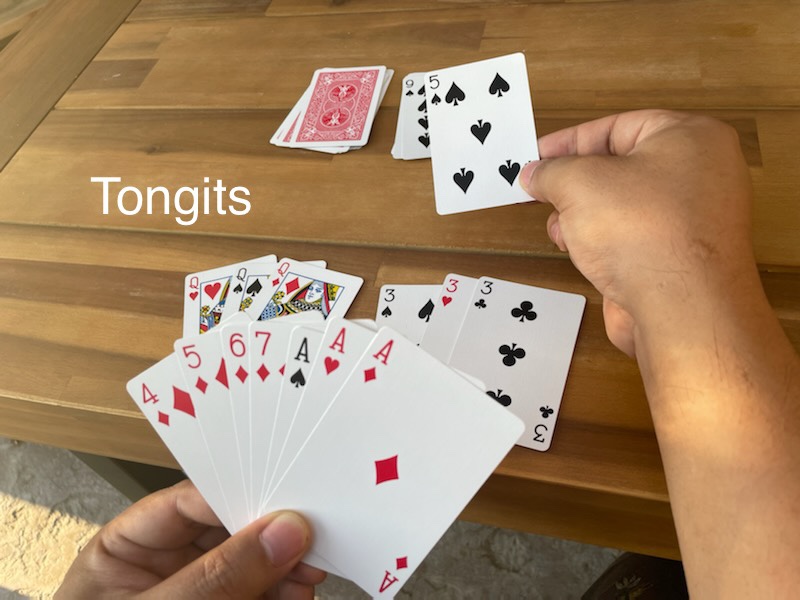
Along with pusoy dos, tongits is probably the most popular Filipino card game today. I learned tongits from my cousins in the Philippines before learning mahjong from my father. Over the years, the version we played has changed as we picked up new rules and have come to better understand the nuances of the game, especially payouts and opportunities for bluffing. It wasn’t until later that I noticed the strong similarities between tongits and mahjong.
In this World War II era photograph, taken in the Philippines circa 1942, two American soldiers are playing cards.
Like mahjong, tongits is a rummy game. But it likely traces its etymology to an American rummy game called tonk, which was popular among soldiers towards the end of the American colonial period as the military was just beginning to racially integrate in the 1940s. Historically, tonk was popular among Black communities in the American South, especially with jazz and blues musicians in Alabama and Louisiana.
The inverse and obverse sides of two coins minted during the American colonial period in the Philippines. The larger coin is a 1 centavo coin from 1911. The smaller coin is a 10 centavo coin from 1945, a year before Philippine independence from the U.S.
Two centuries earlier, in the 1700s, Louisiana was the site of the first Asians to arrive and settle in America—Filipino sailors who escaped Spanish galleons taking port in New Orleans and other Gulf of Mexico towns. Known as the Manilamen, these early Filipino Americans adapted well to the humid climate of the gulf and sheltered together with runaway enslaved people from West Africa who had similarly little hope of returning home. They lived on the land of the indigenous Chitimacha people, who would later manage to resist the forced displacement of American Indians in the southeastern U.S. during the Trail of Tears. With the influx of French Canadians kicked out of Acadia by the British, a new Cajun culture emerged from the mixing of these diverse peoples. Attested in the history books, the Manilamen contributed their fishing and maritime knowhow and even their DNA to the Louisiana bayou. But I doubt that captures the full extent of their influence.
Who knows, maybe those Filipino sailors escaping Spanish galleons and settling on Chitimacha land, played a Chinese mahjong-influenced rummy game that the descendants of runaway enslaved Africans and displaced French Canadians would later develop into tonk, which would become popular among racially integrated American soldiers, who would bring it back across the ocean for Filipinos to develop into tongits. Stranger things have happened.
How to play
Like golf and hearts, the objective of tongits is to get the lowest score, which is the sum of all of your cards (with aces worth 1 point, faces worth 10 points, and all other cards worth their rank). The primary way to lower your score is by forming bahays of three or more cards, which are worth 0 points. Ideally, you will form a complete hand in which all of your cards organized into bahays (called tongits), which results in a total score of zero. But it is also possible to win by ending the game early and having the lowest score. Better yet, you can win by tricking your opponents that you have the lowest score and getting them to fold. It’s like mahjong with an added game of chicken and a bit of bluffing like in poker as well.
Tongits makes use of a standard 52-card French-suited deck, which is the deck of cards you likely already have.
BAHAYS
A three-of-a-kind or four-of-a-kind consist of three or four equally ranked cards. Take note that though similar, this is different from the pung or kang in mahjong, which would require matching suits as well as equal ranks.
A four-of-a-kind wherein all four cards were dealt or drawn from the deck (not from a discard) can be laid face down on the table as a secret. This has the benefit of allowing you to challenge a draw (explained below), though you no longer have the freedom to reorganize the cards.
A straight is a sequence of three or more cards of the same suit. It is akin to a straight flush in poker and the chow in mahjong, though it can exceed three cards.
A straight of four or more cards is called an escalera.
Like the four-of-a-kind, an escalera can also be laid face down on the table as a secret, though you lose the ability to reorganize the cards later.
Note you can simply call a secret a secret. No need to identify it as an escalera or a four-of-a-kind. Of course with an escalera of five or more cards, it is apparent. But for four-card secrets, this is a useful mind game to play on your opponents who are unsure if your secret is a four-of-a-kind or a four-card escalera.
SETUP
The mano (dealer) can be determined randomly for the first game. For all subsequent games, the winner of the previous game is the mano. Gameplay is in a counterclockwise direction, like mahjong.
Beginning with themself, the mano deals one card to each player until each player has 12 cards and the mano has 13. The remaining cards are placed on the center of the table, forming the stock or draw pile. The mano begins gameplay by discarding one card.
GAMEPLAY
To begin their turn, the player can choose to draw a card from the stock or pick up the previous player’s discard. However they may only pick up a discard if that card completes a bahay, which they must now open by laying face up on the table.
During their turn, the player can also add any number of their cards to the open bahays of other players. This is called a sapaw and it helps to prevent a draw as will be explained later.
TONGITS
The most straightforward but most challenging way to win the game is by forming your entire hand into bahays (in the hand and on the table) and sapaws. This is called tongits and immediately ends the game. The player’s thirteenth (final) card can be discarded or added to a bahay or sapaw.
DRAW
In mahjong, it’s beneficial to keep bahays closed to minimize opponents’ knowledge of your cards and to preserve your ability to rearrange as needed. In tongits, however, that can be risky, because of the ability for players to call a draw.
A player may want to call a draw if they believe their tally of unmelded cards will be lower than the others (or if they believe they can successfully bluff the other players that that is so).
When a player calls a draw, they must discard to end their turn and gameplay. Players who do not have any bahay on the table are called sunog (burned) and immediately fold to accept the draw. If both opponents are sunog or otherwise accept the draw, the caller wins.
In order to call or challenge a draw: a player must have at least one bahay on the table.
Furthermore, for a player who wants to call a draw:
At least one bahay on the table must be open, and
The player must have survived the previous round without having an opponent sapaw one of their open bahays.
The typical way to have an open bahay is by picking up a discard, which requires you to expose the bahay anyway. But if you are eager to call a draw or if you sense that someone else will do so and want to be prepared to challenge, you can expose one of your closed bahays during your turn. The difficulty is selecting a bahay that your opponents are unlikely to sapaw.
Secrets, which are laid face down on the table, offer a safer way to ensure you can challenge a draw. However, because they are not open and therefore do not leave you vulnerable to sapaw, they do not allow you to call a draw.
Take note that just because you can challenge a draw doesn’t always mean you should. On one hand, winning a challenge gains you a payout similar to tongits. But there is also a correspondingly steeper penalty to losing a challenge than folding. Similar to the factors leading to calling a draw, challenge if you believe your tally is lower or if you believe the caller is bluffing. But fold if otherwise to minimize your losses.
SCORE
In the case of a draw or if the deck simply runs out of cards, only players with bahays on the table are eligible to tally their cards. Sunog players (those with no bahays on the table) automatically fold.
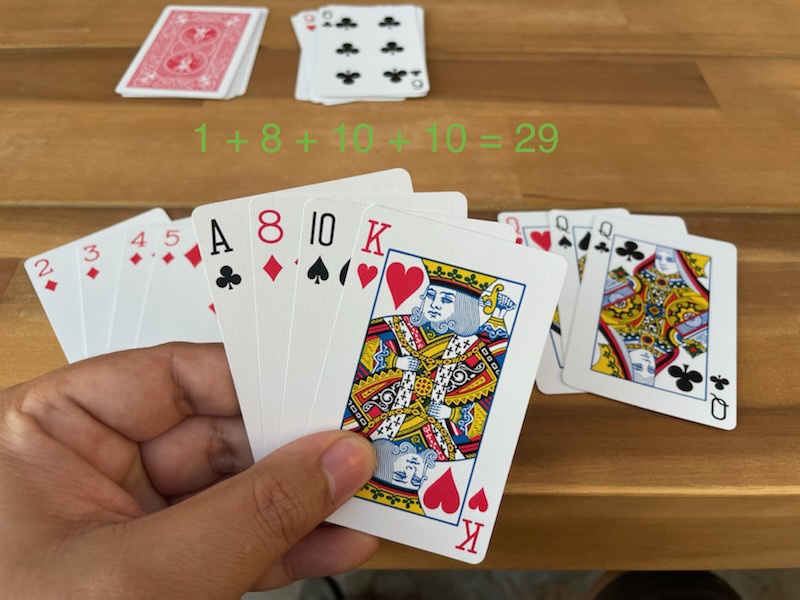
Players must tally up their unmelded cards (deadwood, to borrow a term from gin rummy).
Aces are worth 1 point. Face cards (Jack, Queen, and King) are worth 10 points. And everything in between (2, 3, 4, 5, 6, 7, 8, 9, and 10) match their value.
The lowest score wins the game.
In the case of a tie with the caller and a challenger, the challenger always wins. In the case of a three-way tie or a tie between the two challengers, the challenger to the right of the caller wins.
In the case of a tie when the deck runs out, the last player in the tie to have drawn a card wins.
PAYOUT
Tongits is perfectly fun without the added element of gambling. You can still go for tongits, a draw, or a challenge and have the satisfaction of winning a given game. That said, here’s how to play for money.
There are three types of wins: Tongits, Draw, and Challenge. Tongits is the best win with a payout of 3 from each player. A draw is the lowest win with a payout of 1. Winning a challenge can earn 3 from each of the challengers, but still just a payout of 1 for any player who folds.
Sunog players are the biggest losers and must pay the winner an extra payout of 1.
There are also special payouts for select cards and bahays in the winning hand. Aces and Kings earn a payout of 1 each. And four-of-a-kinds and escaleras earn 3 each. Note however that four-of-a-kinds and escaleras must be face down on the table as secrets or still be in hand. This is to avoid any confusion over whether sapaws from other players contributed to the bahay.
A simple jackpot can be contributed at the beginning of each game, $3 for the initial seed, and $1 for each subsequent game. Any player that wins two games in a row wins the jackpot. Another jackpot is initiated at the start of the next game.
Pua Tiong Chiu, a popular dice game played during the Mid-Autumn Festival in the Philippines. Credit: James Elijah Yap.
As summer winds down to a close, Chinese Filipinos are looking forward to the Mid-Autumn Festival, which will take place Saturday, September 10 this year. Filipinos of Chinese descent comprise over 20 million of the country’s population. That includes my family, through my lolo’s father, who was an immigrant to Negros Oriental from Amoy (now called Xiamen) in Fujian province. Though our branch grows more and more distant from our Chinese roots with each passing generation, we still have our Chinese last name — and mahjong.
Chinese Filipinos, colloquially known as Chinoys, largely trace their ancestry back to the Hokkien-speaking Fujian province, and Philippine Hokkien has developed as a lingua franca among the Chinese diaspora in the Philippines. Chinoys call the language Lán-nâng-uē, meaning our people’s speech. In practice though, many Chinoys would characterize their speech as Hokaglish, a form of code-switching between Hokkien, Tagalog, and English.
The Mid-Autumn Festival corresponds with the Chinese lunar calendar and is the second most important celebration for Chinoys after Lunar New Year. Also known as the Mooncake Festival, it celebrates the harvest and the autumn equinox when the moon is at its fullest and brightest. In the Philippines, mooncakes are called hopia, which means “good pastry” in Hokkien, and are often filled with an ube and mung bean paste. Some are savory though, with a sweet pork filling similar to siopao.
A fixture of the autumnal celebration is Pua Tiong Chiu (拔中秋), a dice game that requires some luck and very little strategy to win one of 63 prizes ranging from hopia to a hundred dollar bill. If you’re having trouble pronouncing it, try: WA-YONG-YU (one syllable each). Now add a P, T, and CH sound to the front of those syllables, respectively: PWA-TYONG-CHYU (one syllable each).
You may recognize the middle character of Pua Tiong Chiu: 中. Or perhaps this helps: 🀄. It is indeed the dagger or red dragon that you’re familiar with from mahjong. Here, it is the Hokkien tiong, which corresponds with the Mandarin zhong, meaning middle.
Six dice (preferably Chinese dice, which have red pips for the 1 and 4 faces)
One porcelain or glass bowl
63 prizes of varying values
The prizes are distributed across six tiers, which are named in Hokkien after imperial examination titles. The first three titles correspond with the first, second, and third highest scorers of the imperial exam. The fourth title refers to one who passed the imperial examination. The fifth title is one who passed at the provincial level. And the sixth title is one who passed the entry level exam at the county level. So, everyone’s a winner here, but some are bigger winners than others.
Tsiong Guan 狀 元 (1 prize)
Pong Gan 榜 眼 (2 prizes)
Tam Hue 碳 化 (4 prizes)
Tsin Si 進士 (8 prizes)
Ki Din 舉人 (16 prizes)
Siu Tsai 秀才 (32 prizes)
Tsiong Guan, the first tier, is the top prize with only one winner. It might be something very cool and very expensive, like a TV. The number of prizes increases exponentially with each successive tier down to Siu Tsai, the bottom tier, which has 32 prizes. However, as a counterpoint, the value of each prize exponentially decreases as well. A typical Siu Tsai prize is a humble hopia; it is the Mooncake Festival after all.
🏆
🏆🏆
🏆🏆🏆🏆
🏆🏆🏆🏆🏆🏆🏆🏆
🏆🏆🏆🏆🏆🏆🏆🏆🏆🏆🏆🏆🏆🏆🏆🏆
🏆🏆🏆🏆🏆🏆🏆🏆🏆🏆🏆🏆🏆🏆🏆🏆🏆🏆🏆🏆🏆🏆🏆🏆🏆🏆🏆🏆🏆🏆🏆🏆
Decide on a budget for prizes and divide by 6 to determine a rough earmark for each tier of prizes. For example, a total budget of $600 would correspond to a top prize valued at $100 and bottom tier prizes valued at approximately $3 each.
An easy way to do this is with cash prizes:
1 $100 bill for Tsiong Guan
2 $50 bills for Pong Gan
4 $20 bills for Tam Hue
8 $10 bills for Tsin Si
16 $5 bills for Ki Din
32 $2 bills for Siu Tsai
But it’s traditional and always fun to incorporate hopia. And with the first day of school approaching, school supplies and other household items are fair game for the lower and mid tier prizes. This is a family game, so ideally you’ll have prizes pleasing to both kids and adults.
GAMEPLAY
The game organizer will often act as the emcee in charge of initiating and facilitating the game. They should begin by explaining the rules and previewing the prizes for the participants. The emcee can also be in charge of distributing the prizes, but they may want to put someone else in charge of that in order to focus on maintaining the interest of the audience.
The prizes should be in an enticing display on a long table (a small table would suffice for cash prizes). And the bowl should be in a visible location in front of this display. It can be on the table or on a tall stool in front of the table. The clink of the dice against the porcelain bowl serves as a bell to draw in the attention of the crowd.
RULES
Each player gets one roll per round.
All the dice must remain in the bowl and must be laying flat against the bottom of the bowl. The player must roll again otherwise.
Tier 2 through Tier 6 prizes will be distributed immediately.
Players who roll a combination eligible for Tier 1 (Tsiong Guan) will have their names and combinations recorded. The Tsiong Guan winner will be determined and announced at the end of the game.
The winning combinations for Tiers 2 through 6 are as follows:
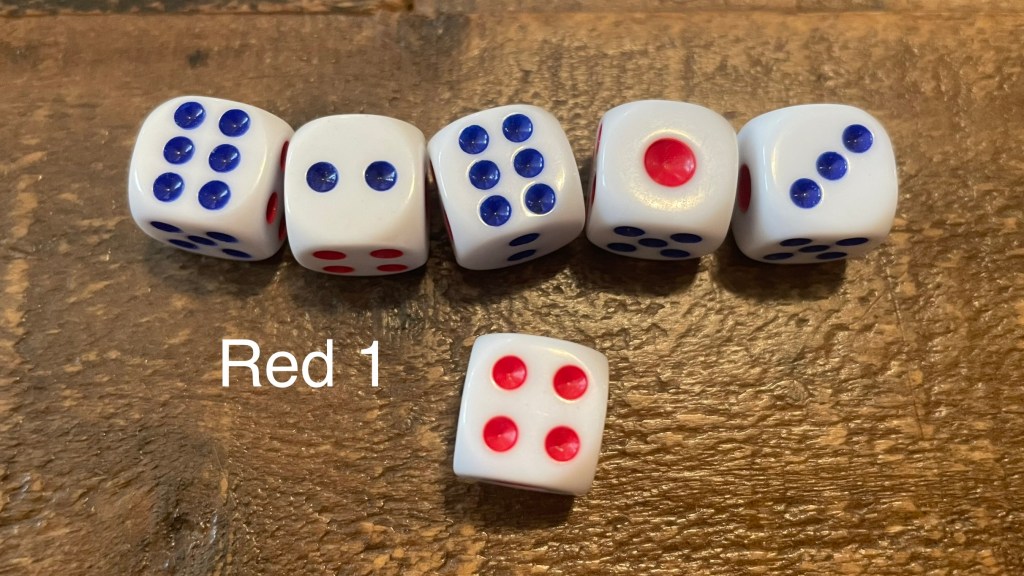
Tier 6 (Siu Tsai) requires a Red 1 — a single 4.
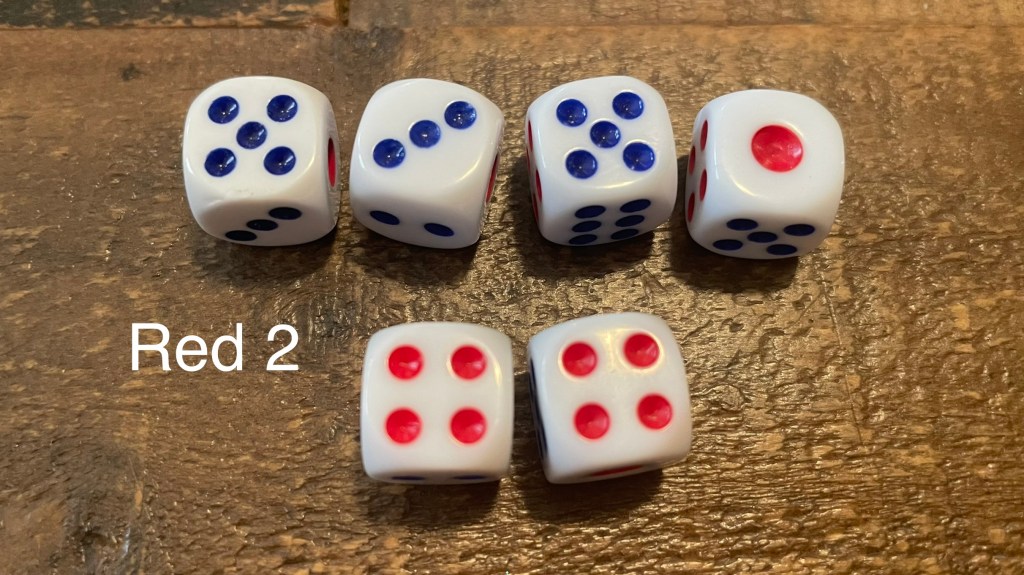
Tier 5 (Ki Din) requires a Red 2 — a pair of 4s.
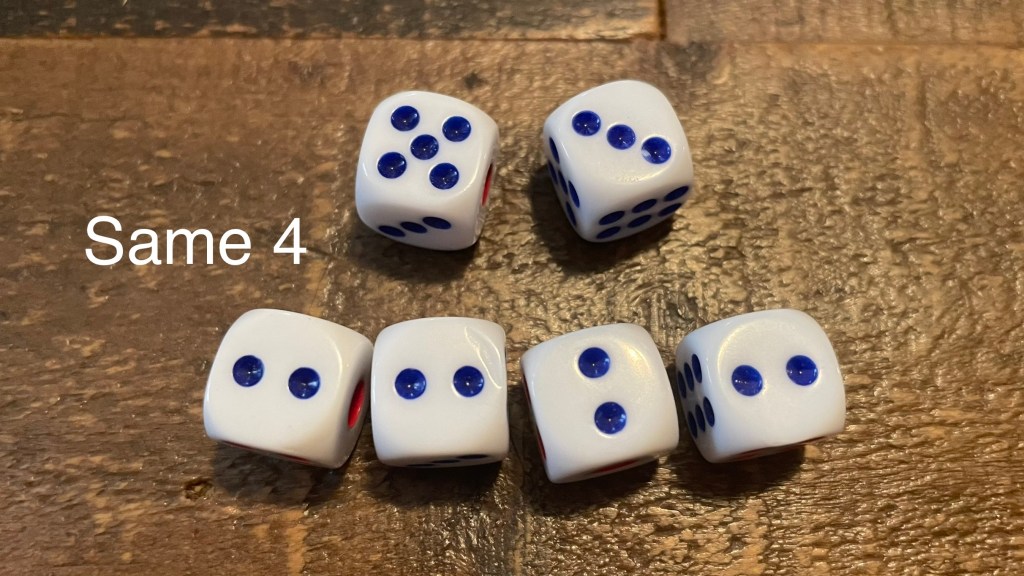
Tier 4 (Tsin Si) requires a Same 4 — a quartet of any face value but 4.
Tier 3 (Tam Hue) requires a Red 3 — a triplet of 4s.
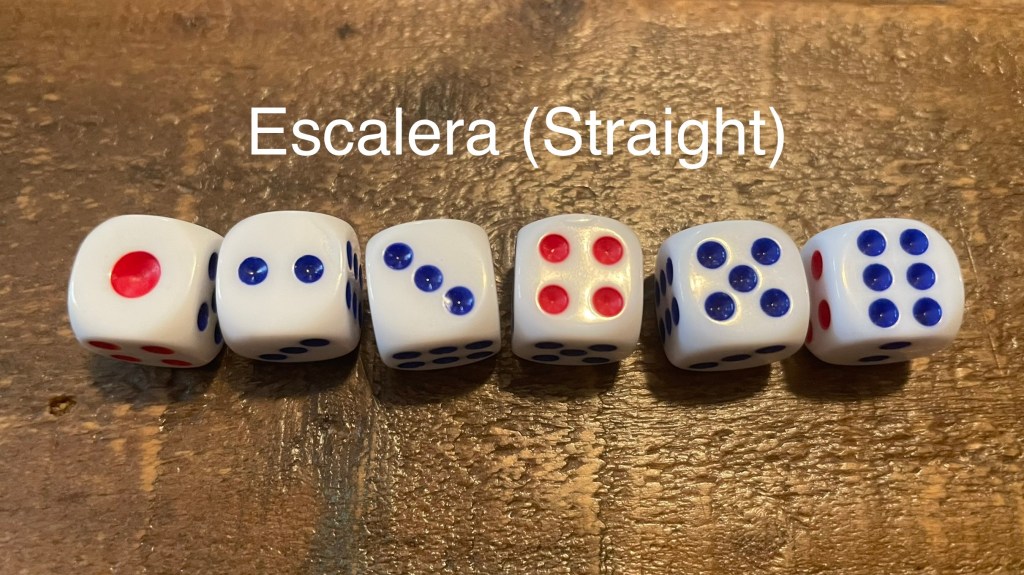
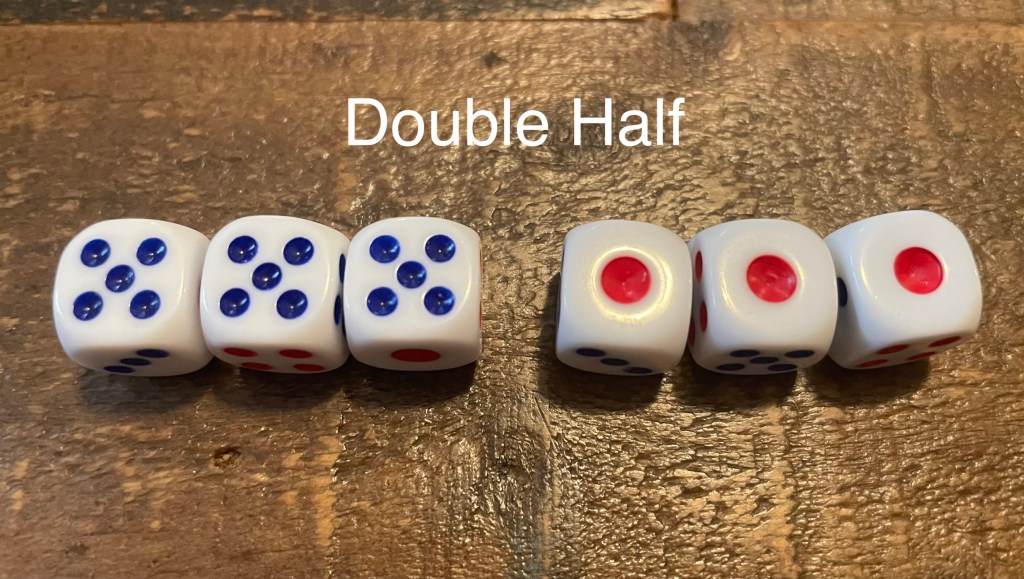
Tier 2 (Pong Gan) requires an Escalera (Straight) of 1-2-3-4-5-6, or a Double Half — two sets of triplets.
Tier 1 is TSIONG GUAN, and it is the top prize. There are multiple ways to be eligible for Tsiong Guan. Here is how each combination ranks from lowest to highest:
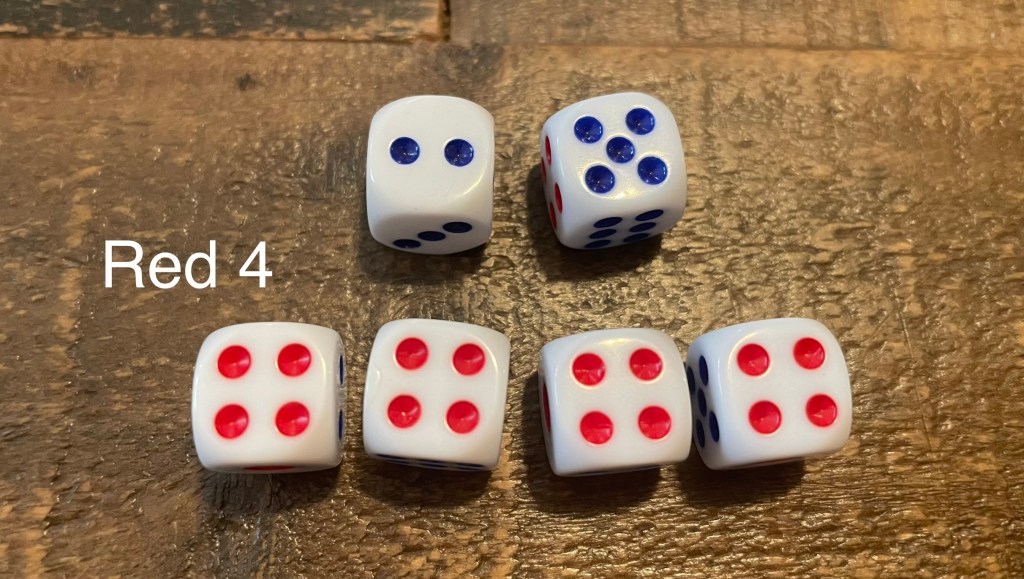
Red 4 is a quartet of 4s.
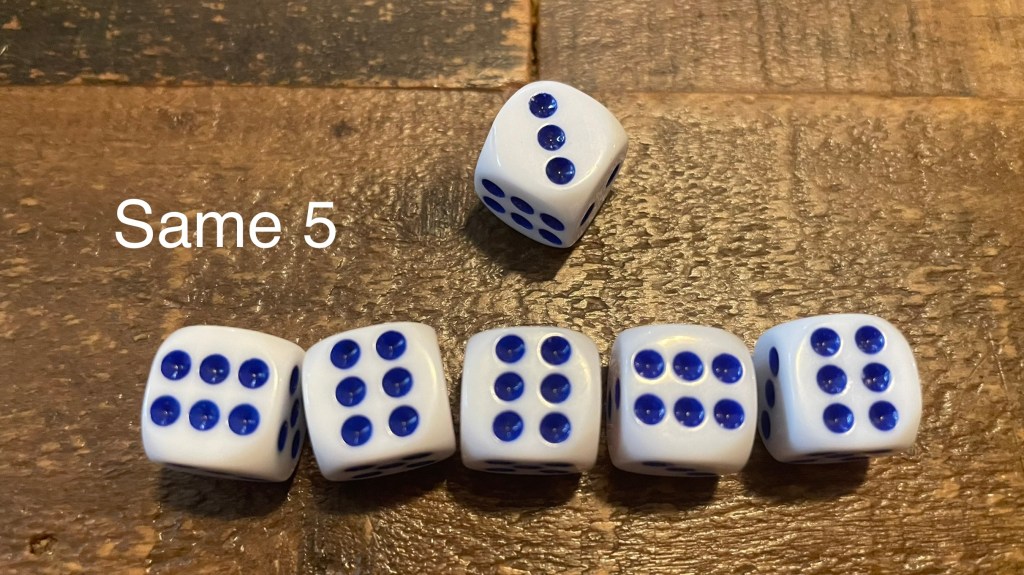
Same 5 is a quintet of any face value but 4.
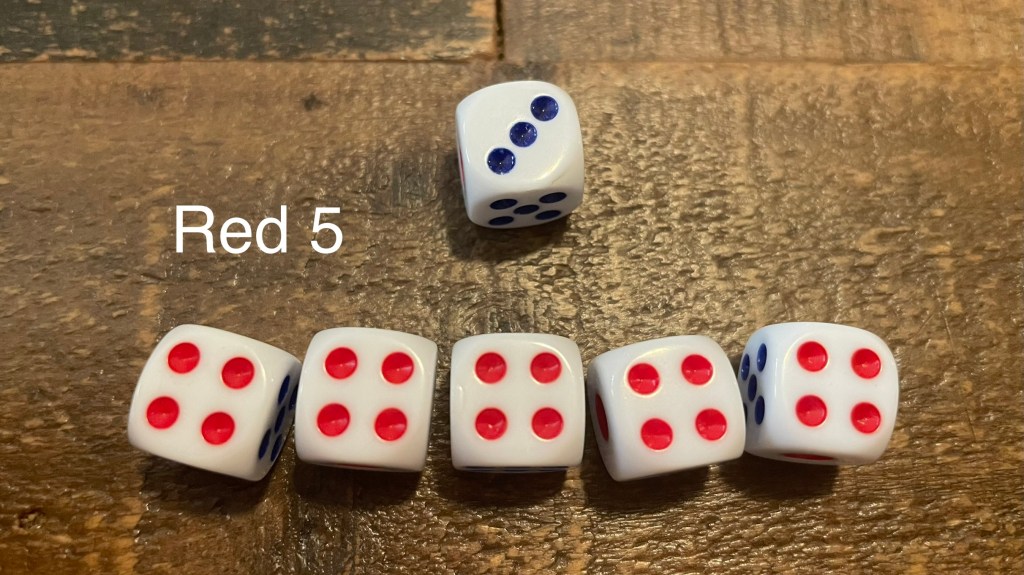
Red 5 a quintet of 4s.
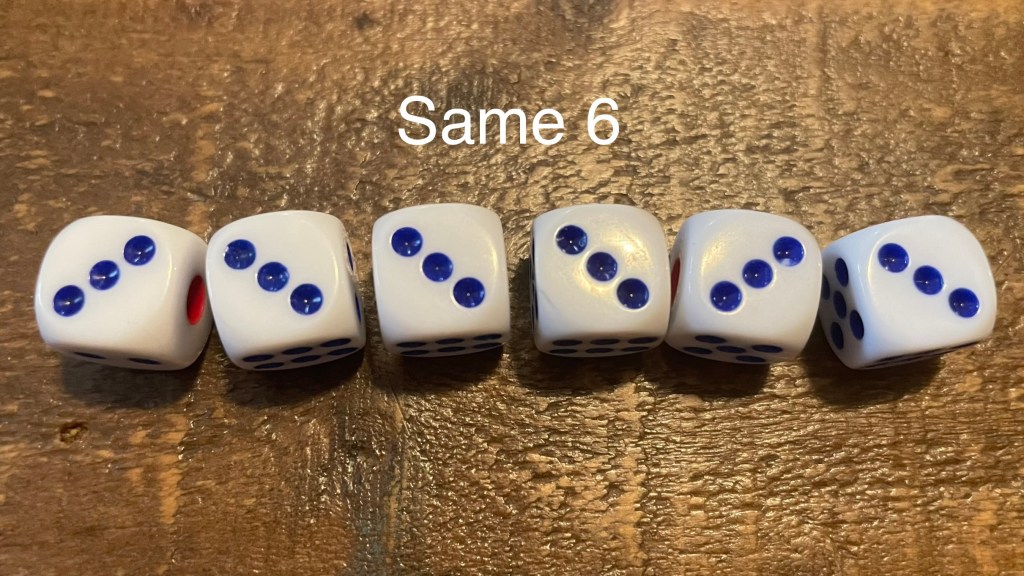
Same 6 is a sextet of any face value but 4. It is very rare.
For Same 5 or Same 6 combinations, a higher value will have a higher ranking. For example a Same 5 of 6s will outrank a Same 5 of 3s.
For Red 4, Same 5, and Same 6 combinations of equal value, the sum of the unmatched one or two dice will determine the ranking. For example if two players have Red 4 combinations of 4-4-4-4-1-6 and 4-4-4-4-3-5 respectively, the 4-4-4-4-3-5 will be more highly ranked, because the sum of its unmatched dice (3+5=8) is higher than the other (6+1= 7).
If somehow the two (or more) highest ranked combinations for Tsiong Guan are identical, then the competing players each get one more roll of the dice. The roll with the highest number of 4s wins. In the event that the top rolls are equal, the process repeats itself until there is a winner.
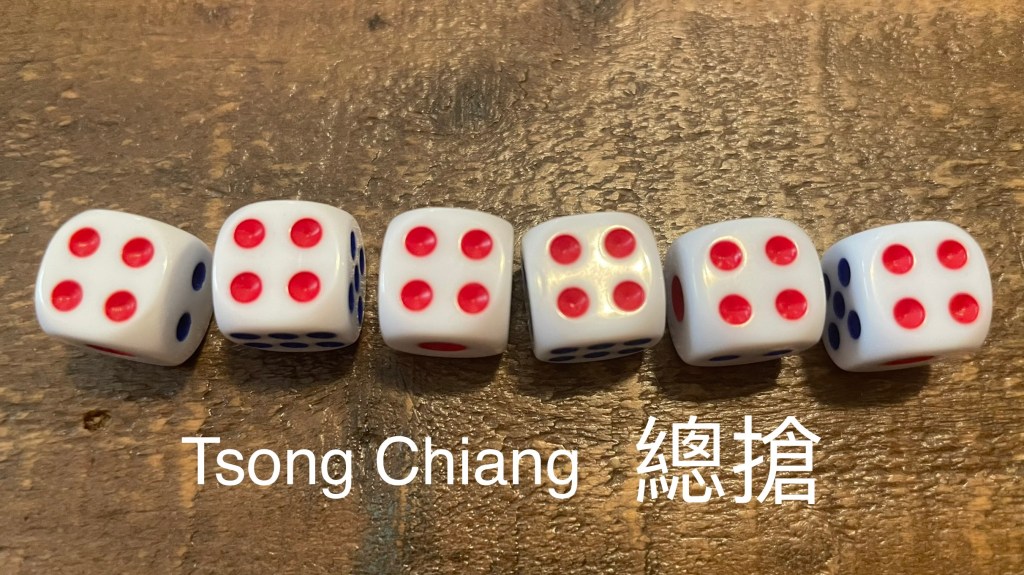
Tsong Chiang 總搶 means total grab or winner takes all in Hokkien. It is awarded for the most elusive roll of a Red 6. Tsong Chiang immediately ends gameplay and the winner is awarded all prizes, including the ones that have already been handed out.
I hope you enjoy the Mid-Autumn Festival this year and this fun game manages to make its way into your family traditions. Wishing you a good end of summer and a bountiful harvest!
If you’re playing Visayan mahjong, you really just need to be able to match the wind tiles and they don’t need to be put in any particular order. So technically you don’t need to be able to name the wind tiles individually. Numbered sets will designate the winds as “N,” “E,” “S,” and “W.” Here is some background on these characters, which may assist you in remembering them.
East (東 dōng) is often the biggest most gregarious looking character, which is appropriate because East goes first in traditional Chinese mahjong. The right half of the character kinda looks like an uppercase “E” if you really want to see it. Ancient Chinese character dictionaries describe this character as the sun (日) rising behind a tree (木) indicating East. Alternatively, language experts say this character came from from a pictorial representation of a bag tied at both ends, because it sounds like the Chinese word for East.
West (西 xí) has a horizontal line at the top making it wide. And “wide” starts with “w” for “West.” This character is traditionally described as a bird settling into its nest, which is associated with sunset, indicating West. Also, “nest” rhymes with “West.”
North (北 běi) looks kinda like a backwards “N.” Historical forms of this character show that it comes from a pictorial representation of two people back to back. South was an important direction for feng shui in ancient China, and houses were generally oriented on a North-South axis. Thus, North was the direction of the back when a person faced South.
South (南 nán) looks kinda similar to West. It has been described as a pictogram of a hanging percussion instrument. You can think of something hanging as pointing down, or South. It has also been described as the front of a house, since houses often faced South.
The Beauty Tiles (Dragons)
Finally, we turn to the beauty tiles or dragons. In English, they are easy to remember as they are simply identified by color: red dragon, green dragon, and white dragon. In Visayan mahjong, they are also referred to by their appearance: dagger/pulá/red, bérde/green, and window/mirror.
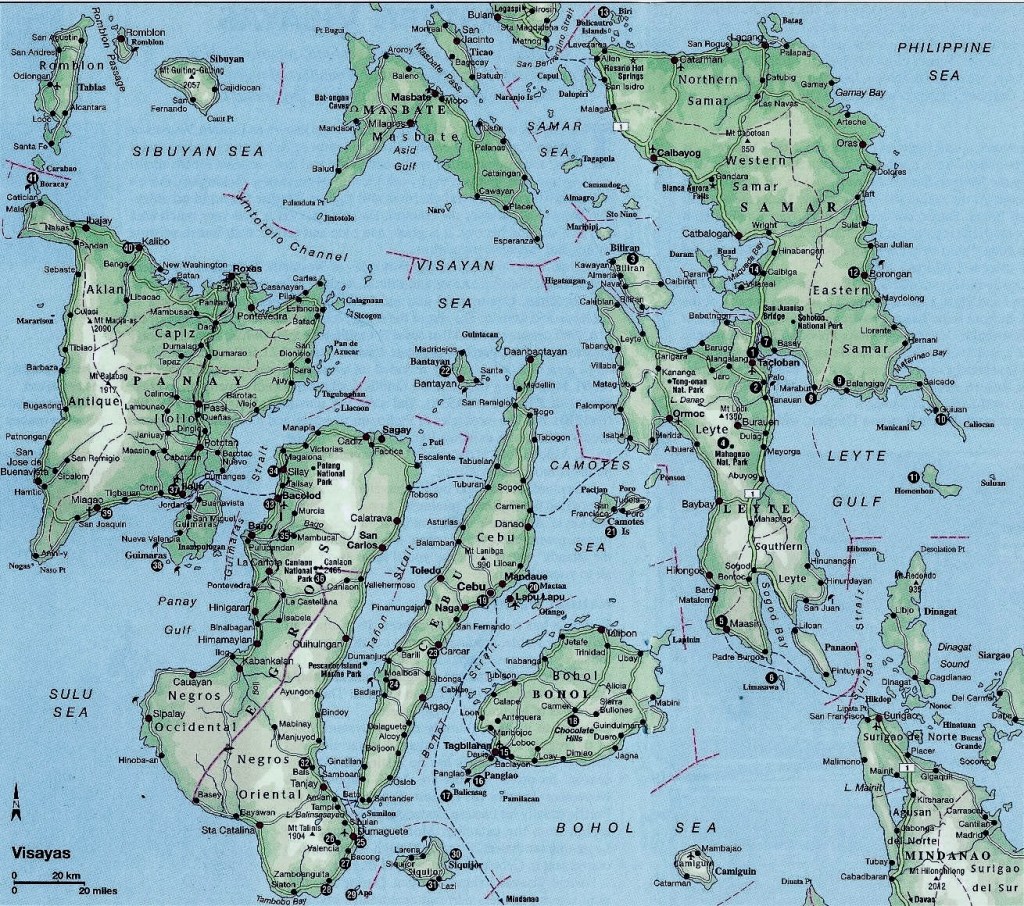
We learned mahjong from our father who grew up in the Visayas. We have seen people playing this style coming from all over the Visayan islands including Cebu, Panay, Negros, and Leyte. The gameplay for Visayan mahjong (also Bisaya mahjong) is identical to that of the standard Filipino variant we go over in our original blog post on the game.
But unlike standard Filipino mahjong, Dad’s mahjong makes use of the winds and the so-called “dragon” tiles. So if you draw one of these tiles, instead of exchanging it for a new tile like a flower, you will keep it in your hand to form a pair, pung, or kang. Or you can use it to form a special báhay like beauty or NEWS, as discussed below.
Beauty
These three tiles are referred to collectively as beauty in Visayan mahjong, because, well, look how pretty they are! They are also called “dragons,” a term borrowed from American mahjong.
The first is called dagger in Visayan mahjong but may also be referred to as “red,” “pulá,” or “red dragon.” In Chinese, this is called “chun” or “zhōng” depending on the spelling system being used, and it means “center” or “middle.”
The second is called berde, also known as “green” or “green dragon.“ In Chinese, this is called “fā” which means “wealth” or “prosperity.”
The last is called mirror or window due to its shape, and is also known as the “white dragon.” In Chinese this is called “bái” meaning “white,” or “bái ban” meaning “white board.” This was originally a blank tile (which is still how it’s represented in Japanese Riichi mahjong sets).
There are four copies of each.
The beauty tiles can be drawn, discarded, and seized just like any of the suited tiles. Beauty tiles can be used to form a pair, a pung (three-of-a-kind), or a kang (four-of-a-kind).
Beauty also refers to a special báhay consisting of one of each: dagger, berde, and window. This is an ambition that gets immediate payout upon declaration! However, there are a few caveats. You can only form this báhay from tiles in your hand or taken in turn (similar to chow). Additionally, beauty must be declared in the first round.
For example, suppose you are not the dealer, and you have dagger and berde after the tiles are dealt. And then suppose that before your first turn, the person before you tosses a mirror tile. In this situation, you can seize the window tile and declare beauty receiving an immediate payout.
The same is true if you were to draw the window tile from the wall on your first turn.
However, once the first round is over, if you haven’t declared beauty, you can only use a beauty tile to form a pair, pung, or kang.
The Winds
The winds are named after the cardinal directions: North, East, West, and South. There are four copies of each.
The winds can be used to form pungs, kangs, or pairs as well, and can be drawn, discarded, and picked up just like any of the suited tiles.
NEWS
NEWS (pronounced like news) is a special báhay that, like beauty, can only be formed and must be declared within the first round. It consists of one of each of the winds. This is also an ambition that gets immediate payout upon declaration. Because it is a four-tile báhay, the player must take a gift (an extra tile) from the flower wall (similar to what happens with a kang or secret).
Payouts
The payout rules for Visayan mahjong are mostly the same, but with some key differences owing to the reduction in the number of flowers. The most notable differences are the addition of beauty and NEWS as ambitions and the loss of thirteen flowers as an ambition. The final payout rules remain the same.
Instant Payout
Get payout from other players immediately upon declaration of ambition.
Beauty ½ (can only be declared in the first round)
NEWS ½ (can only be declared in the first round)
Sagása, Secret ½
Kang ¼
No Flowers ¼ (can be declared in the first round and again at the game’s end if you still have no flowers)
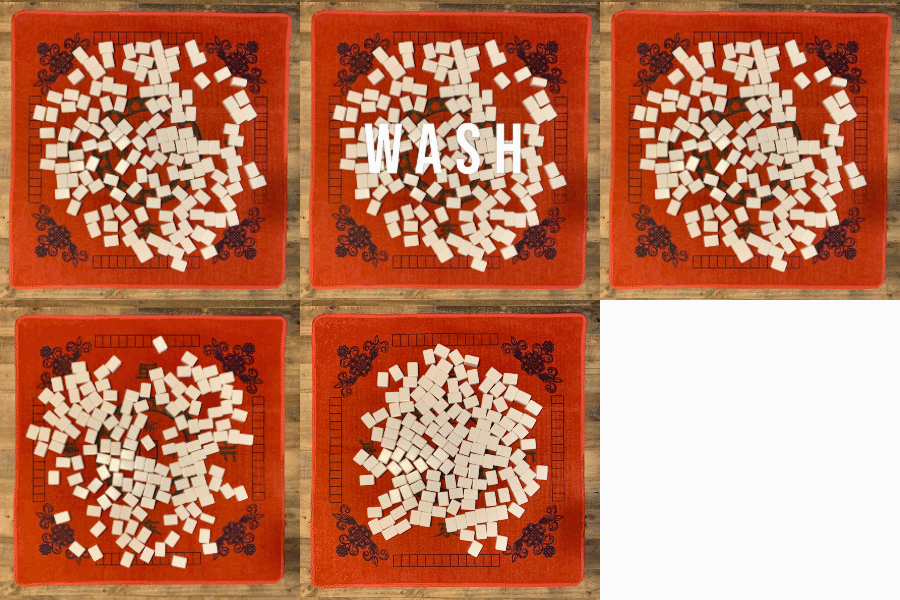
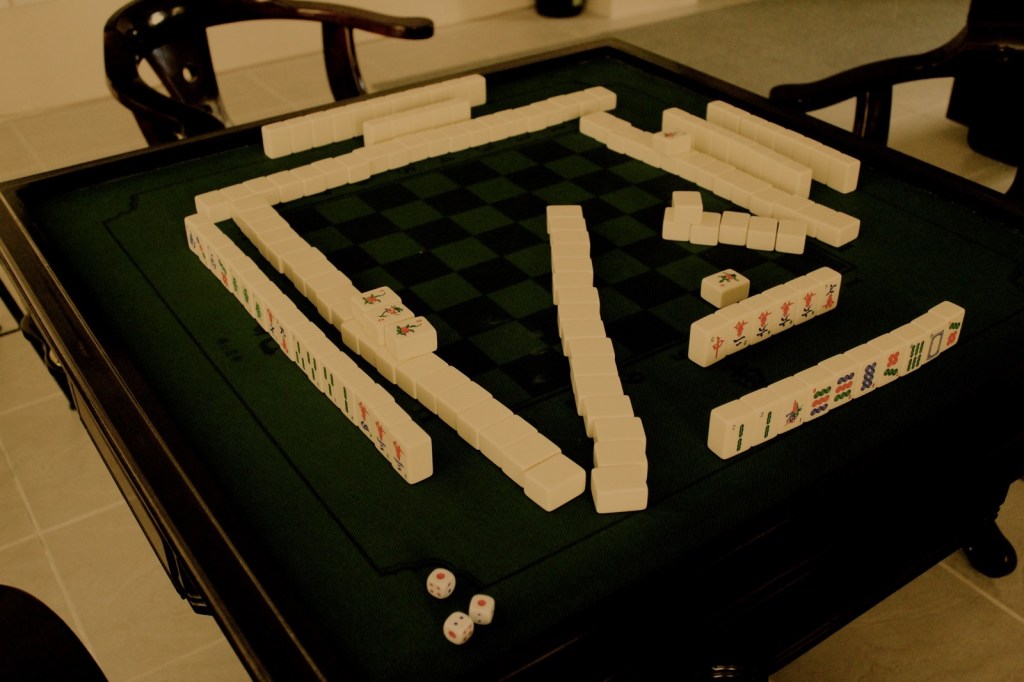
Every mahjong game starts with a good “wash” or shuffling of the tiles followed by building the wall. Some folks like to turn all the tiles back over before shuffling and/or building the wall. Theoretically, this is to prevent cheating, because if someone memorizes the position of a certain tile, they can use it to their advantage.
However, doing this creates multiple inefficiencies:
It hinders efficient shuffling if you’re trying to keep tiles from turning over. A poorly shuffled wall creates even less anonymity of tile positions. You’ll know what I mean if you’ve ever seen consecutive tiles drawn, or only tiles of a certain suit.
It slows down the building of the walls. Spending more time building means spending less time playing.
If any tiles do turn over in the shuffling or building process, they’re easier for someone to memorize discreetly and gain an advantage. It’s easier to memorize one or two tiles than dozens of them.
Also, it’s worth noting that in Filipino mahjong, no single tile is worth more or is more rare than others. Filipino mahjong does not use dedicated joker tiles, and does not reward additional payouts based on seat position for flower tiles. Every tile has four copies, and is only valuable in combination with others. So memorizing one or two tile positions, won’t get you anywhere. There’s so much chance involved in whether the random tile you’ve memorized is useful, and whether you will even gain access to it.
The main benefit I can see from memorizing a tile’s position is that you may be able to track it into somebody’s hand and have a more educated guess at what they are waiting for. For example, say that you know they have a 4 sticks tile because you tracked it, and then you see them throw a 3 sticks and a 5 sticks. That means there’s a good chance they have at least two 4 sticks tiles, otherwise they wouldn’t have thrown the neighboring tiles. So you should refrain from throwing that tile, to prevent a pung or todas.
It’s nearly impossible to get a tile from simply knowing its position in the wall. The only advantage is simply knowing if it’s still in the wall. E.g., you have a 3 ball and 5 ball, and you’re trying to determine if it’s worth waiting for the 4 ball to win by paningit. You see that one 4 ball tile has been thrown, but you’re worried the other 4 ball tiles might be in someone else’s hand as an eye or pong. In that case, it may be useful to know that at least one 4 ball is still in the wall. But you still have just a roughly 1 in 4 chance of getting it and nothing you can do will increase those odds. Even if it’s a multiple of 4 number of tiles away from you, you have to also hope that nobody pongs or chows a discard, throwing off the distribution of the draw wall.
But both of these cases require so many other things to line up in order to actually effectuate any advantage. That’s some next level mahjongery and outside the scope of this article.
I know some folks might disagree with this, and if you’re playing with strangers for real money, I would understand taking extra precautions. But for casual play with family and friends, I’ve never seen a need to take the extra step to turn over the tiles.
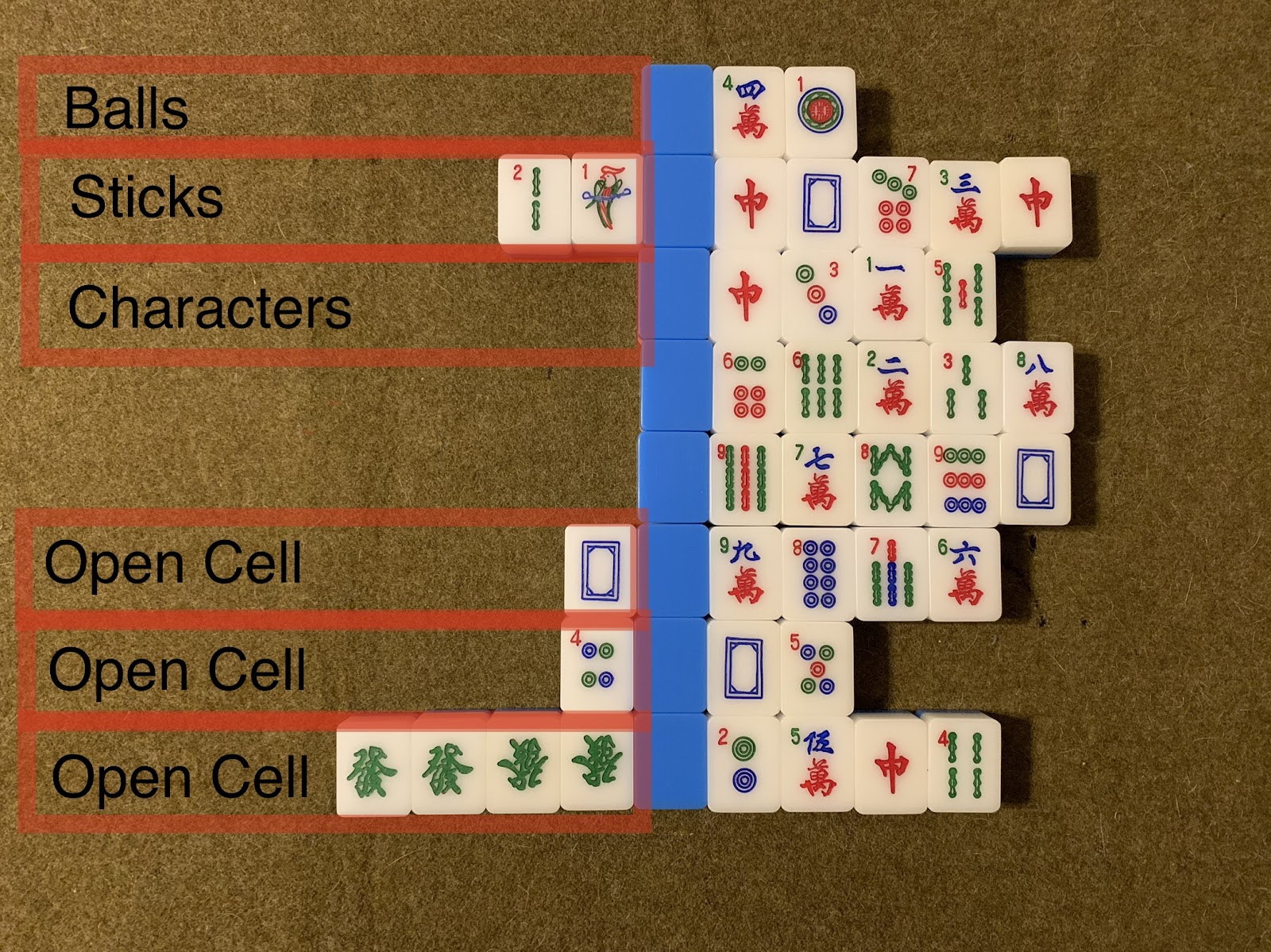
Have a mahjong set, but none of your friends want to play? Are you stuck in quarantine, or just need some you time all to yourself? This is based on a fun mahjong solitaire app, but adapted for play with physical mahjong tiles. The app depicts mahjong cards, which stack differently from tiles. I found that transposing the set up so that the tiles stack in a horizontal direction works better. This is a fun game that rewards patience and planning ahead. As far as I can tell, every game seems to be solvable at the outset, but it’s easy to paint yourself into a corner if you’re not careful.
Setup
This game requires 39 tiles as follows
One set of balls 1-9
One set of sticks 1-9
One set of characters 1-9
4 red dragons (dagger)
4 green dragons (berde)
4 white dragons (mirror)
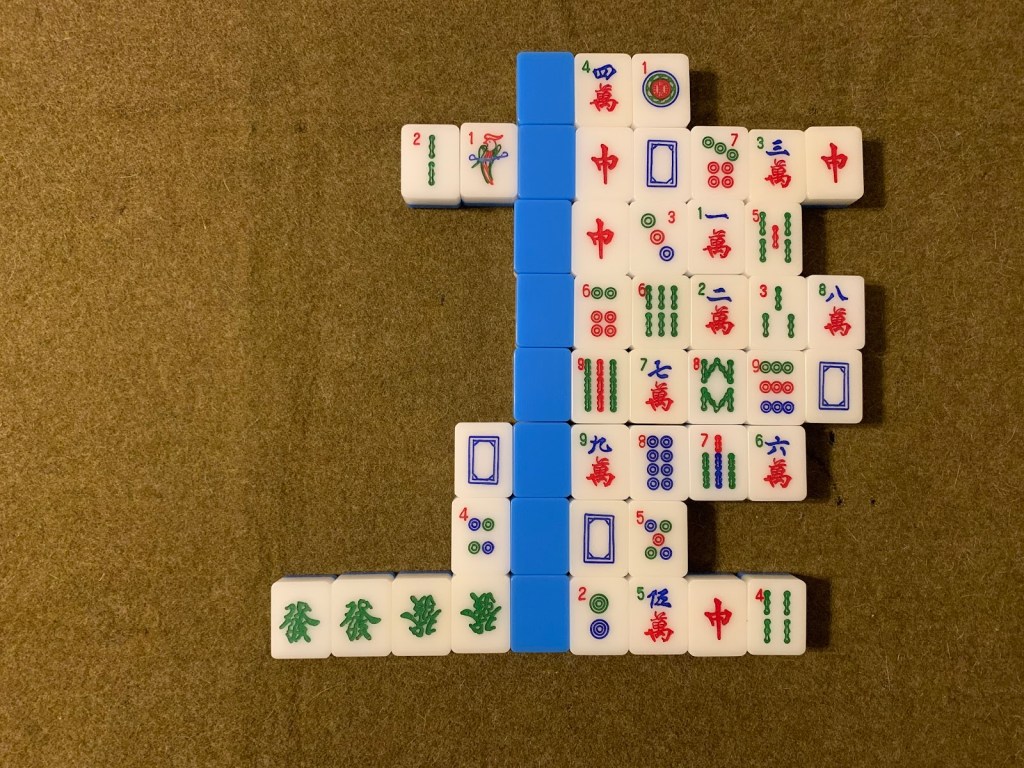
Shuffle the tiles, and arrange them face up in one row of four tiles and seven rows of five tiles. This grid should be on the right half of the table.
I also like to use eight wind tiles to act as a center divider as shown. Technically they can be any tiles since they’re gonna be facedown the whole time, but I use winds so that I don’t get confused in case they accidentally turn over. You could also use blank tiles or joker tiles.
Now you’re ready to play! The goal is to transfer all of the tiles across the center divider to the left half of the table, subject to the following rules:
Right Side
For the grid on the right side, only the last right-most tile of each row can be moved. Let’s call these the “exposed” tiles. An exposed tile can be moved to another row on the right if it is placed next to a tile that is one higher and a different suit, similar to classic solitaire (e.g. 4 balls can only be placed next to 5 sticks or 5 character). If multiple tiles are in descending order and in alternating suits, they can move as a group, also similar to classic solitaire. Dragon tiles cannot form groups. If a row on the right side is completely empty, any exposed tile or group of tiles can be placed there.
Left Side
On the left side, the top three rows are dedicated to balls, sticks, and characters, respectively. These tiles must be placed in order from 1 to 9, starting from the center divider and moving to the left.
The middle two rows are not used.
The bottom three rows on the left are open cells that can temporarily hold one tile of any type. Tiles placed in these open cells are exposed and can be moved anytime. The only exception is if all four dragons of one type are exposed. Then they can all be placed in one of the three rows, and will occupy that row permanently.
The game is complete when all suit tiles are in the upper left corner and all dragon tiles are in the lower left corner.
Halimbawa
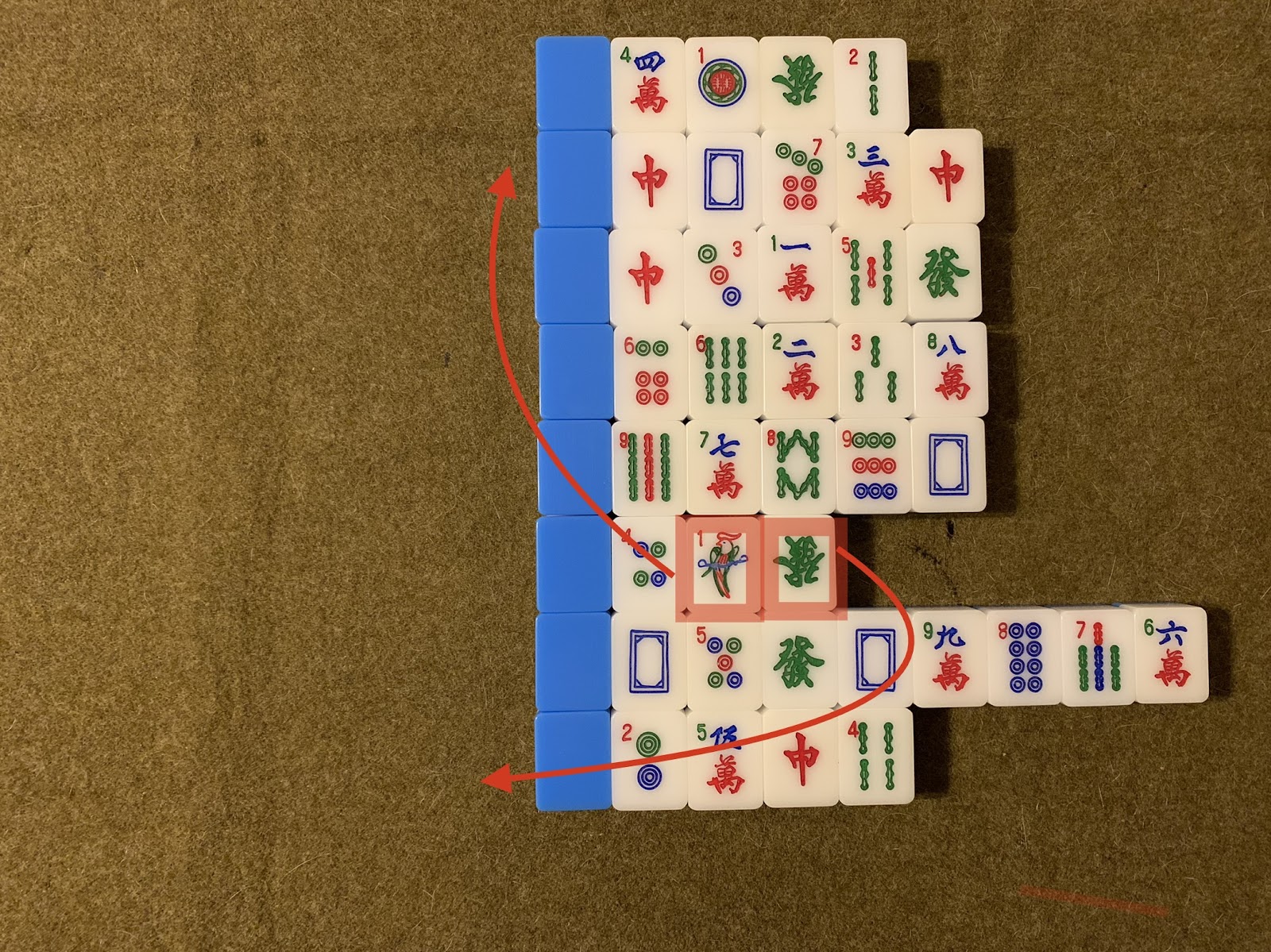
Now for an example game. Consider this setup, and review the exposed tiles. Notice that the 7 sticks can be moved next to the 8 balls.
Now 6 character is exposed, and can be moved next to the 7 sticks.
Now the 8-7-6 row can be moved as a group next to the 9 character.
Now we’re close to exposing the 1 stick, but first we have to move the green tile out of the way by placing it in one of the open cells. Then the 1 stick can be moved to the stick area.
Now let’s move 4 balls to another open cell and move the 9-8-7-6 row to the open space.
Notice that the green tiles are now close to being all exposed. Let’s move the window/white dragon tile out of the way to the last free cell.
Now there is only one green tile that is still not exposed, blocked in by a 2 sticks tile. But we already ran out of open cells! Fear not, solo mahjongero, there is a 1 stick in the sticks area, and you can put it there.
Now that all four green tiles are exposed, they can all be placed together in one of the open cells.
Fast forward a bunch of moves and you’ll end up with something like this.
At this point, the puzzle is pretty much solved, with everything on the right side in well formed rows in descending order. It’s just a simple matter of disposing of the tiles in the suit tiles area in the upper left corner.
Wasn’t that satisfying? I think you’re ready to shuffle and play another game.
Mag-mahjong na tayo! Well, actually, mag-solitaire ka na lang, enjoy your alone time 😉 #selfcare
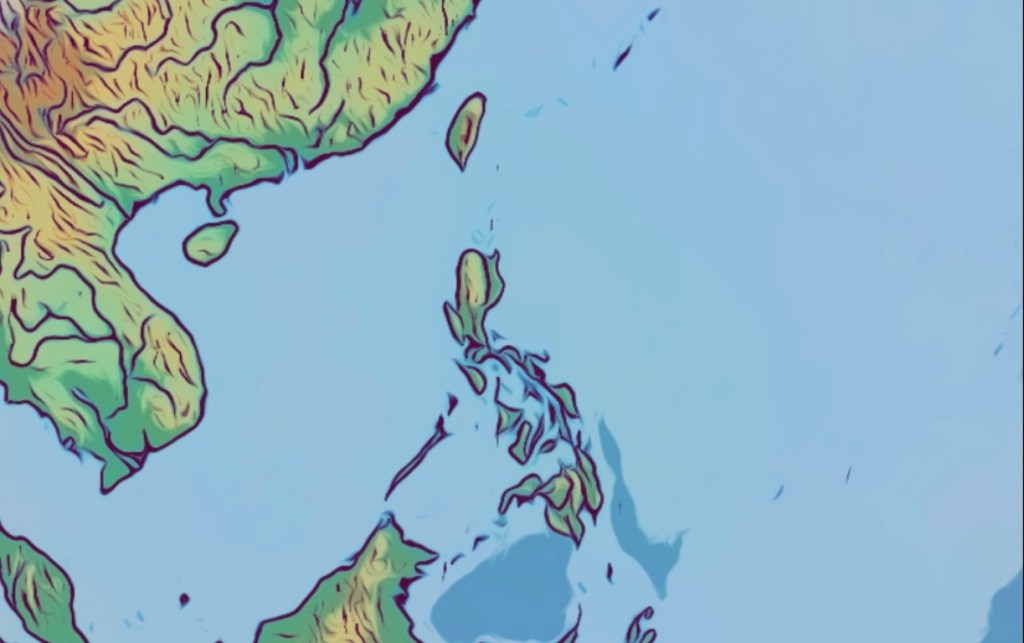
Taiwan has a special relationship with the Philippines, for a lot of reasons. Geographically, it’s very close, separated from the Philippines by the Luzon Strait. Linguistically, the island of Taiwan is the homeland of the Austronesian language family, which includes languages of the Philippines as well as Indonesia, Malaysia, Madagascar, and various Pacific islands. Taiwan and the Philippines share political ties as well, with longstanding relations with the U.S., and fraught relations with neighboring China.
Add to that list, mahjong!
The most significant commonality between Taiwanese mahjong and Filipino mahjong is the number of tiles in each player’s hand. In most styles of mahjong including Chinese, Japanese Riichi, and Singaporean mahjong, each player has 13 tiles in their hand, and requires 14 to win. A winning hand typically consists of four sets of three tiles (what we call “báhay” in Filipino mahjong), and one pair. On the other hand (pun intended), Taiwanese mahjong and Filipino mahjong are unique as the only styles that have 16-tile hands, adding another báhay. Both styles also permit an irregular winning hand consisting of seven pairs and one báhay.
This is notable because it means that it can take longer to form a winning hand, since you have to form five báhay instead of four. It also means that there are fewer tiles left in the draw wall, affecting how you calculate the odds of drawing a specific tile. As a result, Filipino and Taiwanese mahjong games require greater emphasis on reading other players, since a higher share of the tiles are in their hands.
Taiwanese mahjong and Filipino mahjong also have similar rules for resolving multiple claims to seizing a discarded tile, giving precedence to a winning claim, and then pung, and then chow.
There are some differences of course. Taiwanese mahjong preserves the Chinese rules for designating seats as different wind directions to determine who goes first and how tiles are dealt. In Filipino mahjong, seating is arbitrary, and the dealing of tiles is determined by rolls of the dice.
Another difference is that Taiwanese mahjong uses the wind and dragon tiles, while Filipino mahjong generally treats these tiles as flowers. However, as will be discussed in a future post, there are some variants of Filipino mahjong, including Bisaya mahjong and Philippine Hokkien mahjong, which use the wind and dragon tiles similar to Taiwanese mahjong.
Overall, the similarities are greater than the differences, and the differences are what make life exciting, between Filipino mahjong and Taiwanese mahjong, and traditional Chinese mahjong, for that matter.
A lot of beginners struggle with handling the tiles and making efficient decisions, which just won’t fly if you want to play with serious mahjongeros. For those who have never watched a real game with experienced players, it is truly a sight to behold. No more than a few seconds pass between discards, with players swiftly grabbing and dropping tiles like hot potatoes. Taking too long to throw a tile or sending tiles tumbling as you fumble an attempt to move a wall are sure fire ways to get you uninvited from a really competitive table. Or at least suffer some disapproving murmurs.
But don’t be intimidated! You too can sling those mahjong tiles like a pro with these tips.
Pro Tip 1: Really shuffle those tiles.
Anybody who has ever felt the impulse to jump on a sand castle will be a natural at this. Basically you’ve got to really dig into the tiles, mess up any existing walls, and scatter the tiles around. I like to actually pick up and drop tiles across to opposite sides of the table to really mix them up. Especially if this is after a round of play, you definitely want to break up those pongs and chows.
Pro Tip 2: Build walls in segments of six.
Assuming a standard 144 tile set, you will need to build four walls that are 18 tiles across and 2 tiles tall. Since there are four players, each player should build one wall each. The best way to build a wall is with three segments that are 6 tiles across and 2 tiles high. These wall segments will be easier to count at a glance and move into position. Don’t waste time counting them one-by-one. Counting is not building, and building is not playing.
Pro Tip 3: Handle rows of tiles in smaller segments.
Moving rows of tiles is easier in segments of around six across. I mean, sure, you can move a whole wall 18 across if you feel like showing off. But I’d rather not risk the embarrassing tumble.
Squeeze the row together from each end, gripping firmly from the bottom, using your fingers to support the other tiles. The longer the row, the more firmly you have to grip.
Pro Tip 4: To move a longer row of tiles, shimmy it diagonally, never perpendicularly.
Note that when you’re holding a row of tiles in front of you with both hands, one hand on each end, it is easier to move it horizontally to the left or right rather than vertically/perpendicularly. So if you need to move a longer row perpendicularly, it’s better to slide it back and forth in diagonal motions to shimmy it into position. 😏
Pro Tip 5: When seizing a tile, declare it loudly and quickly.
When seizing a pung or kang, make sure to declare it loudly and quickly. If the next person has already picked up their next tile, you may have missed your chance. As soon as you declare it, then display your tiles completing the set, grab a gift if it was a kang, and discard a tile in order to keep the game going.
Pro Tip 6: When drawing a tile, dip it low, pick it up slow.
You don’t want anybody to see your tile. Experienced players will keep the tile face down and slide it towards them along the felt until it’s in front of them, safe from prying eyes.
If the draw wall or flower wall are all the way across from you, you can ask somebody to pass it to you. Etiquette would be for them similarly to keep the tile low and place it on the felt within your reach. Older mahjongeros like to joke that they’re reading your tile by feeling the face of the tile like it’s Braille. At least I thought they were joking. On second thought, maybe it’s better to not let anybody feel up your tile, I can think of a few tiles that would be relatively easy to identify by feel.
Pro Tip 7: Discard tiles where they are visible (and maybe even announce the tile if that’s your custom).
Tiles are discarded in the center of the table. The most important thing is for the tiles to be face up and visible. Do not stack discarded tiles on top of each other because everyone needs to be able to clearly see what tiles are out of play. In my family, we also announce the value and suit as we discard.
Pro Tip 8: Always make sure to have a plan for which tile to throw, and have backup choices.
Remember, your turn doesn’t end until you’ve discarded a tile. Other players will get annoyed if you hem and haw, holding up the game. However, you still need to be adaptable in case the tile you draw changes your decision about what to throw. So just have a plan, and make your choice quickly.
Pro Tip 9: Go from GAT to GTA.
For beginners, each turn can be summarized as GAT:
Get a tile, either by seizing a discard or by drawing from the wall.
Arrange your tiles, incorporating the new tile.
Throw a tile, ending your turn.
But for faster gameplay, more experienced players will usually make their decisions quickly and discard right after getting a tile so that the next player can go, making it GTA:
Get a tile
Throw a tile, ending your turn
Arrange your tiles while the next player goes.
Just keep these tips in mind and you’ll be a mahjong pro in no time.


























 mahjongero